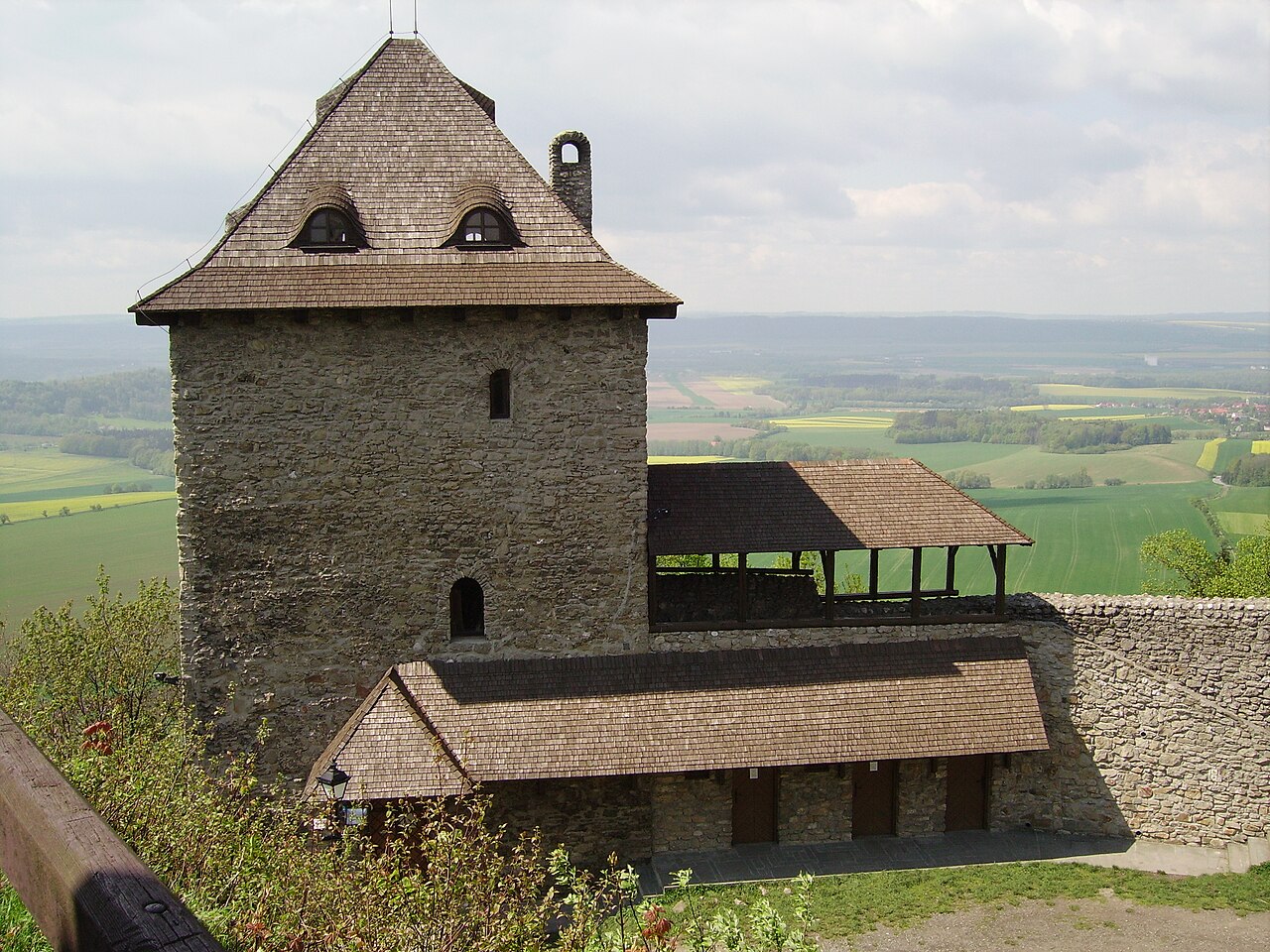
Drahotuš Gord
Drahotuš Gord is a medieval hill castle located in the village of Podhoří within the Czech Republic. Founded in the 1260s by Bohuš of Drahotuš, a Moravian marshal and burgrave of Přerov, the castle was strategically established to oversee and secure vital trade routes passing through the Moravian Gate. This natural corridor was a key passage linking northern and southern Europe, making the castle's position of considerable military and economic importance during the High Medieval period.
The earliest documented reference to Bohuš at this site dates to 1269, confirming the castle's origins in the mid-13th century. Initially, the fortress remained under the control of the Lords of Drahotuš until 1371, when it was sold to Moravian Margrave John Henry. The castle's ownership during the early 15th century was marked by frequent changes, reflecting the turbulent political landscape of Moravia during the Late Medieval period. In 1408, Margrave Jošt pawned Drahotuš Gord to Ctibor of Cimburk. Shortly after, in 1416, King Václav IV granted it to Lacko of Kravaře.
The castle's strategic value was underscored during the Hussite Wars (1419–1434), when it was seized by Boček Puklice of Pozořice. This seizure was later legitimized in 1446 by Hynek of Valdštejn and Židlochovice, the rightful owner at the time. By the mid-15th century, control passed to Vok of Sovinec, before reverting to the Lords of Cimburk. The last significant ownership change was in 1476, when Ctibor Tovačovský of Cimburk sold the estate to Vilém of Pernštejn.
Following this sale, Drahotuš Gord declined as a residential fortress and gradually fell into ruin. Over subsequent centuries, the castle was abandoned and deteriorated, leaving only fragmentary remains. Today, the site is recognized as an important cultural monument within the Czech Republic, protected for its historical and archaeological significance.
Architectural features and site layout
The remains of Drahotuš Gord are situated on a prominent promontory of the Juřacka hill massif, within the Oderské vrchy mountain range. This elevated position offered commanding views over the surrounding landscape, consistent with the castle's original defensive and surveillance functions. The location, known locally as Hradisko, typifies the strategic siting of hill castles in medieval Moravia.
The castle's surviving structures are largely in ruins, with no comprehensive layout fully preserved. Archaeological evidence indicates the presence of defensive walls enclosing the site, though no detailed plans or decorative architectural elements remain visible. The fortress likely featured typical medieval fortifications such as curtain walls, towers, and a gatehouse, adapted to the natural topography.
Near the village of Podhoří, a notable surviving element is a stone bridge associated with the castle complex. While specific construction details are scarce, the bridge's robust stonework suggests it was an important access route to the fortress, designed for durability and defense. The presence of this bridge reflects the castle's role in controlling movement along key transportation corridors.
Defensive advantages and natural setting
The castle's position on a steep promontory provided natural defensive advantages, limiting approaches to narrow paths easily defended by the garrison. The surrounding Oderské vrchy hills and the proximity to the Moravian Gate enhanced its strategic importance, enabling control over trade and military movements.
Historical significance and ownership transitions
Drahotuš Gord played a significant role in the complex feudal and military history of Moravia. Its foundation by Bohuš of Drahotuš under the auspices of King Přemysl Otakar II reflects the crown's efforts to consolidate control over key territories and trade routes in the 13th century.
The castle's ownership history is marked by frequent transitions among prominent Moravian noble families, including the Lords of Drahotuš, the Cimburks, and the Pernštejns. These changes mirror the broader political instability of the region during the Late Middle Ages, including the upheavals of the Hussite Wars.
The seizure of the castle by Boček Puklice during the Hussite conflicts and its subsequent legitimization by Hynek of Valdštejn illustrate the contested nature of territorial control in this era. The castle's decline after its acquisition by Vilém of Pernštejn signals a shift in regional power dynamics and the reduced military importance of such hilltop fortresses as centralized state power grew.
Archaeological research and preservation efforts
Today, Drahotuš Gord is classified as an archaeological site, with ongoing efforts to study and preserve its remains. Excavations have revealed the castle's footprint and some structural elements, though much of its internal layout and material culture remain elusive due to the fragmentary nature of the ruins.
Protection as a cultural monument ensures the site's conservation and facilitates public education about its historical role. The surrounding landscape, including former mining sites to the north, provides additional context for understanding the castle's economic and strategic environment, though these mines are closed to visitors and have not contributed directly to knowledge of the castle's architecture.
Visitor experience and accessibility
While the castle itself is largely in ruins, the site offers visitors a tangible connection to Moravia's medieval past and its network of hill castles. The elevated terrain affords panoramic views, enhancing appreciation of the castle's strategic location.
Interpretive signage and local guides help contextualize the site's history, though the absence of extensive above-ground structures means visitors must rely on imagination and archaeological interpretation to visualize the former fortress.
Frequently asked questions (FAQ)
- How do I get to Drahotuš Gord?
- Drahotuš Gord is located near the village of Podhoří in the Moravian region of the Czech Republic. Visitors can reach the site by local roads and hiking trails that lead up to the Juřacka hill massif where the castle ruins are situated.
- What is the historical significance of Drahotuš Gord?
- Drahotuš Gord was founded in the 1260s to secure important trade routes through the Moravian Gate. It played a key role in regional defense and witnessed ownership changes during the Hussite Wars, reflecting Moravia's medieval political dynamics.
- Can I explore the ruins of Drahotuš Gord?
- Yes, visitors can explore the archaeological site of Drahotuš Gord, though the remains are fragmentary. The site offers scenic views and an opportunity to connect with Moravia's medieval history, but facilities and detailed structures are limited.
- When is the best time to visit Drahotuš Gord?
- The best time to visit Drahotuš Gord is during the warmer months from late spring to early autumn when hiking conditions are favorable and the landscape is accessible.
- Is there an entrance fee to visit Drahotuš Gord?
- There is no entrance fee to visit the Drahotuš Gord archaeological site, making it freely accessible to the public.
Information
Loading map...
Visitor reviews
No reviews yet. Been here? Write the first review and help other travelers!
Write the first reviewVisited this castle? Share your experience
Your review helps other travelers and adds first-hand knowledge to our encyclopedia.