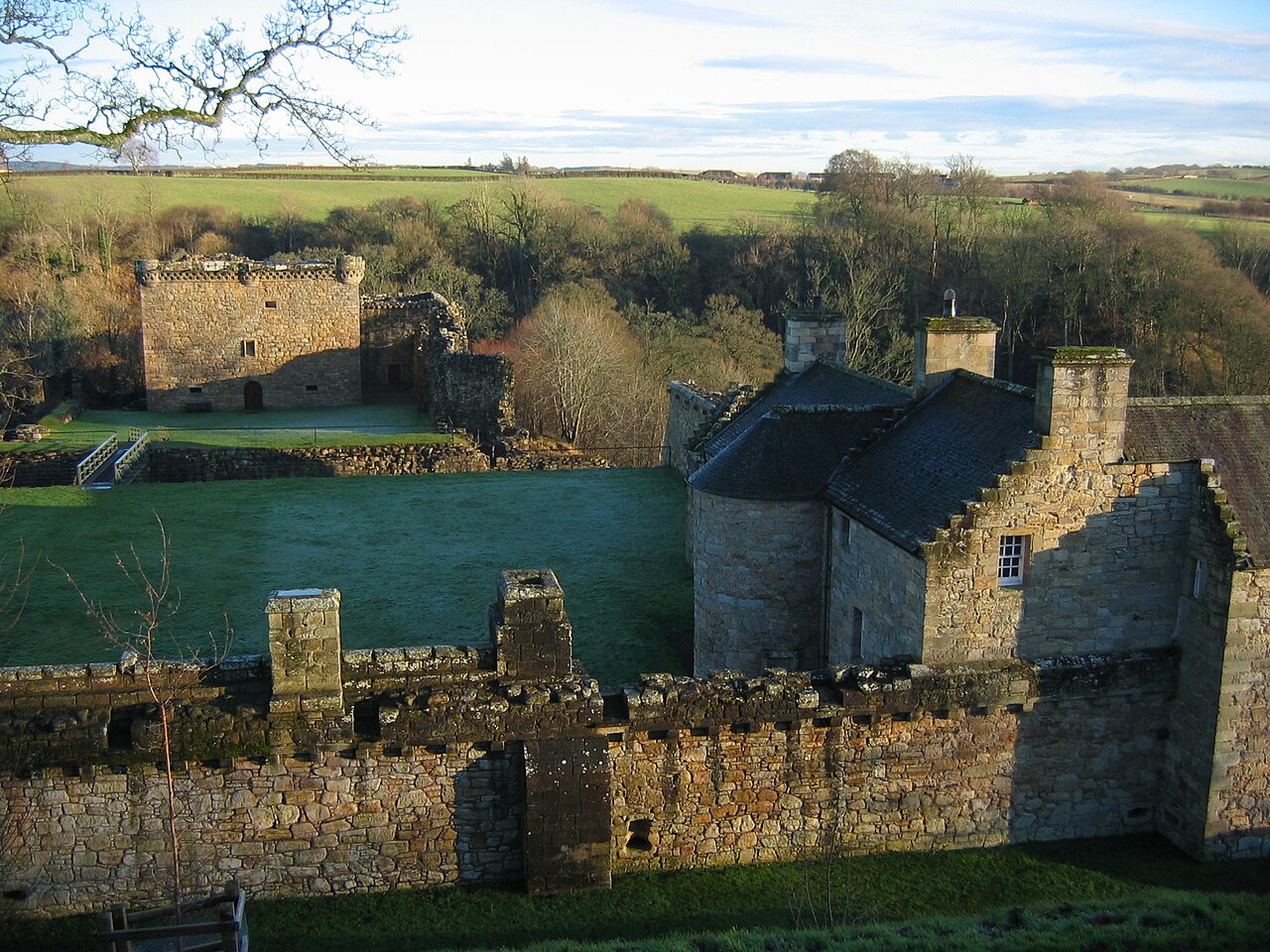
Douglas Castle
Douglas Castle, located in the town of Douglas in Scotland, is a site steeped in rich history and architectural evolution. Established before 1288 by the medieval Scottish Douglas family, the castle began as a fortified stronghold combining wood and stone. It served as the family’s principal seat through the Middle Ages, witnessing significant historical events and transformations over several centuries.
Medieval origins and wars of independence
The original Douglas Castle was a strategic fortress during the turbulent Wars of Scottish Independence. In 1307, English forces led by Lord Clifford captured the castle. However, the castle was famously recaptured by Sir James Douglas, a loyal ally of Robert the Bruce, in a daring surprise attack known as "Douglas’ larder." This assault took place during Palm Sunday services, where Douglas and his men caught the English garrison unprepared, killed them inside the castle chapel, and set the fortress ablaze. This act of loyalty to Robert the Bruce was rewarded with extensive lands granted to the Douglas family, solidifying their power in the region. By 1357, Sir William Douglas, nephew of Sir James, was titled the 1st Earl of Douglas.
Reconstruction and the rise of the black douglas
In the late 14th century, under Archibald Douglas, 3rd Earl of Douglas, the castle underwent significant reconstruction, transforming it into a more formidable stone fortress. The powerful "Black" Douglas faction, dominant in the 15th century, amassed considerable influence, rivaling the Scottish crown. This culminated in King James II's campaign against them in 1455, leading to the castle’s sacking and the forfeiture of Douglas lands and titles. This marked a turning point in the castle's history, as the "Red" Douglas line, supporters of the crown, took over the estate.
Post-1455 rebuilding and marquess era
Following the downfall of the Black Douglases, the "Red" Douglas line, known as the Earls of Angus, acquired the estate and likely initiated rebuilding efforts shortly after 1455. The castle did not immediately become their main residence, but by 1574, Regent Morton inspected the property with intentions for repair and habitation. The early 18th century saw a major revival under Archibald Douglas, 3rd Marquess of Douglas, who was elevated to Duke in 1703. He rebuilt Douglas Castle as a tower house featuring an enclosed courtyard and a distinctive corner tower. Unfortunately, a devastating fire in 1755 destroyed much of the structure, sparing only the corner tower.
Adam brothers’ grand mansion project
From 1757, the Duke commissioned the famed Adam Brothers to design an ambitious castellated mansion intended to be the largest castle in Scotland. The grand five-storey building featured a mix of round and square towers and was set within extensive landscaped grounds along the Douglas Water valley. However, construction halted abruptly after the Duke’s death in 1761, leaving only half the mansion completed. No visible remains of this mansion survive above ground today.
The douglas cause and 20th-century decline
The estate later became the center of the "Douglas Cause," a famous legal dispute resolved in favor of Archibald James Edward Douglas, who was ennobled Baron Douglas in 1790. Ownership eventually passed to the Earls of Home. In the 1930s, Charles Douglas-Home, 13th Earl of Home, permitted coal mining in the park to alleviate local unemployment. This mining caused ground subsidence, severely damaging the mansion and leading to its demolition in 1938.
Architectural remnants and cultural significance
The most prominent surviving feature of Douglas Castle is the early 18th-century corner tower built during the Marquess’s reconstruction. This sturdy three-storey stone tower, about nine meters high, stands on a raised position south of the Douglas Water river. It was preserved as a garden folly during the mansion’s later years. The tower’s foundations include a small cellar lined internally with glazed tiles, an unusual detail that reflects refined finishing uncommon in purely military structures. Today, it holds Category C listed building status, recognizing its cultural and architectural importance.
Additionally, a former lodge associated with the castle estate has been preserved and relocated to the Cairn Lodge service area on the M74 motorway, serving as a tangible link to the estate’s former extent.
Historical legacy and literary inspiration
Douglas Castle is notable not only as the ancestral seat of the Douglas family but also as the family home of Sir Alec Douglas-Home, who served as Prime Minister of the United Kingdom. Its dramatic history and evocative setting inspired the renowned Scottish author Sir Walter Scott to write the novel "Castle Dangerous," a name sometimes used as an alternative for the site. The castle’s story reflects Scotland’s complex medieval and early modern history, marked by noble power struggles, architectural ambition, and cultural resonance.
Frequently asked questions (FAQ)
- How do I visit Douglas Castle and what are the opening hours?
- Douglas Castle is privately owned and not generally open to the public. Visitors can view the exterior and surrounding grounds at any time, but access inside the ruins is restricted for safety reasons.
- What is the historical significance of Douglas Castle?
- Douglas Castle was a major stronghold of the medieval Douglas family and played a key role in the Wars of Scottish Independence. It later became the site of ambitious 18th-century architectural projects and was linked to notable historical figures including Sir Alec Douglas-Home.
- Are there any visible remains of the original medieval castle?
- The most visible remains are the early 18th-century corner tower from the Marquess of Douglas’s reconstruction. No significant medieval structures survive above ground today, as the castle underwent multiple rebuildings and partial demolitions.
- Why was the grand mansion project by the Adam Brothers never completed?
- The grand castellated mansion designed by the Adam Brothers was left unfinished after the death of the Duke of Douglas in 1761. Construction ceased abruptly, and only about half the intended structure was built.
- Is the castle accessible for photography and sightseeing?
- Yes, the exterior and surrounding landscape of Douglas Castle can be viewed and photographed freely. However, interior access to the ruins is restricted for safety, so visitors should respect signage and barriers.
Information
Sources & official resources
Verify the information above using these authoritative references.
Loading map...
Visitor reviews
No reviews yet. Been here? Write the first review and help other travelers!
Write the first reviewVisited this castle? Share your experience
Your review helps other travelers and adds first-hand knowledge to our encyclopedia.