Craignethan Castle
Craignethan Castle is a remarkable example of a 16th-century artillery fortification located in South Lanarkshire, Scotland. Perched on a commanding site above a bend in the River Nethan, the castle's strategic position takes advantage of steep slopes on three sides, offering natural defense, while its western side, overlooked by higher ground, was heavily fortified to compensate for vulnerability. Built primarily from locally sourced stone, Craignethan combines domestic comfort with cutting-edge military architecture of the Renaissance period, reflecting the evolving nature of warfare in Scotland during the mid-1500s.
The castle's origins date back to around 1532, when James Hamilton of Finnart, an illegitimate son of the 1st Earl of Arran and a skilled architect and military engineer, undertook its construction. Hamilton of Finnart held the prestigious position of King's Master of Works and was responsible for other notable projects such as Blackness Castle and Linlithgow Palace. His design for Craignethan was innovative, integrating the latest artillery defenses, including thick walls, gunloops, and a rare caponier for ditch defense, demonstrating advanced understanding of siege warfare. Despite its formidable defenses, the castle was never fully tested in battle during Hamilton of Finnart's lifetime.
Architectural design and defensive features
Layout and keep
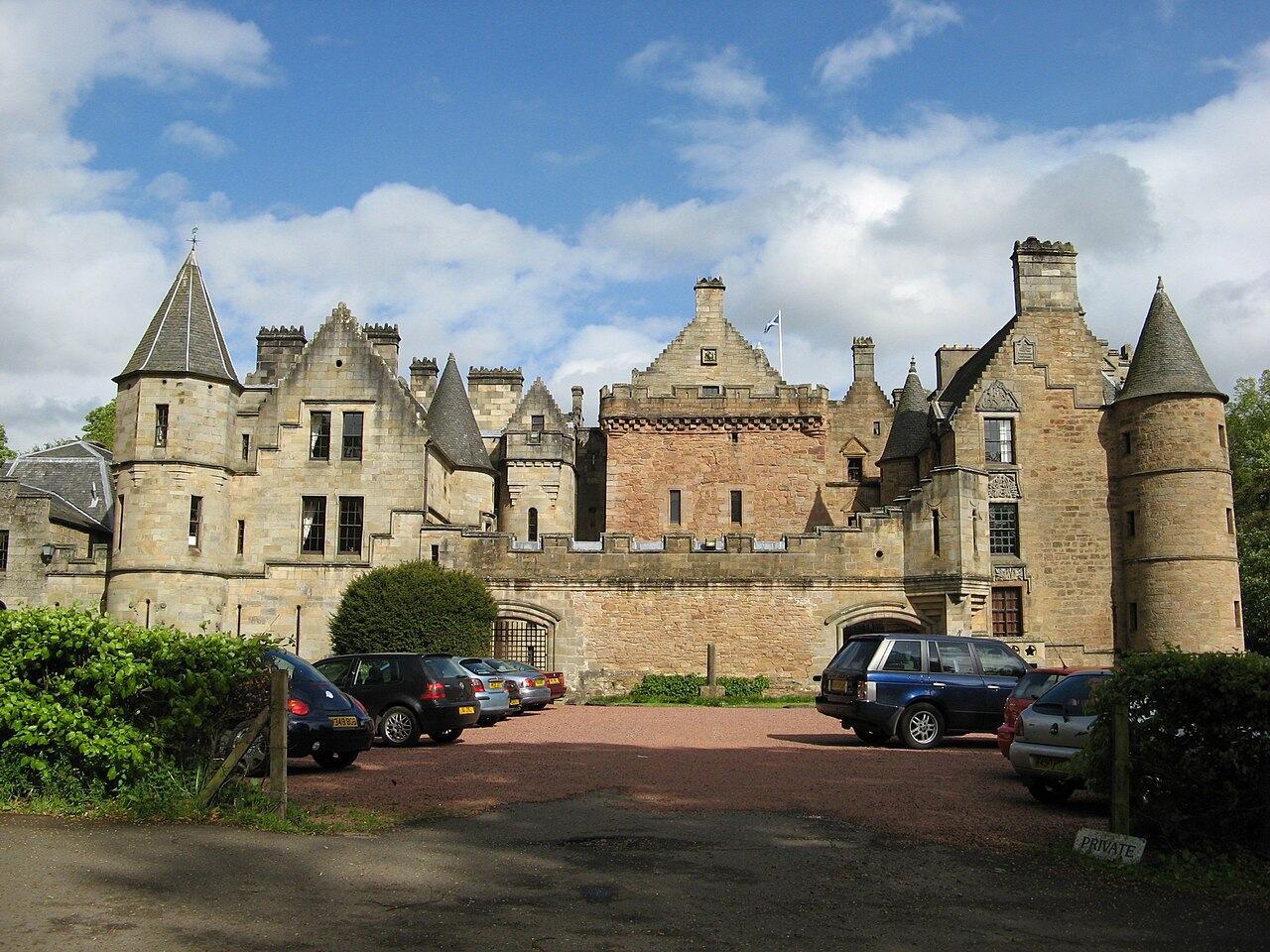
The castle's core is a low rectangular keep measuring approximately 21 by 16 meters, originally rising two stories with an attic above. Though the roof no longer survives, the stone walls remain intact up to the level of decorative corbels that once supported a parapet walkway. Each corner of the keep is marked by round bartizans, small overhanging turrets that provided vantage points for defenders. The main entrance was protected by machicolations, openings that allowed defenders to drop projectiles or pour boiling liquids on attackers.
Inside, the keep is divided by a wall running west to east. The southern section houses a spacious hall with a high stone vaulted ceiling spanning the full height of the keep. This hall was illuminated by three large windows and featured a fireplace and a minstrel's gallery, indicating the castle's role as a residence as well as a fortress. The northern section contained the kitchen and private chambers, with additional rooms above and in the attic. Beneath ground level are vaulted cellars, including storage rooms, a prison, and a well accessible from the entrance or kitchen area.
Courtyards and outer defenses
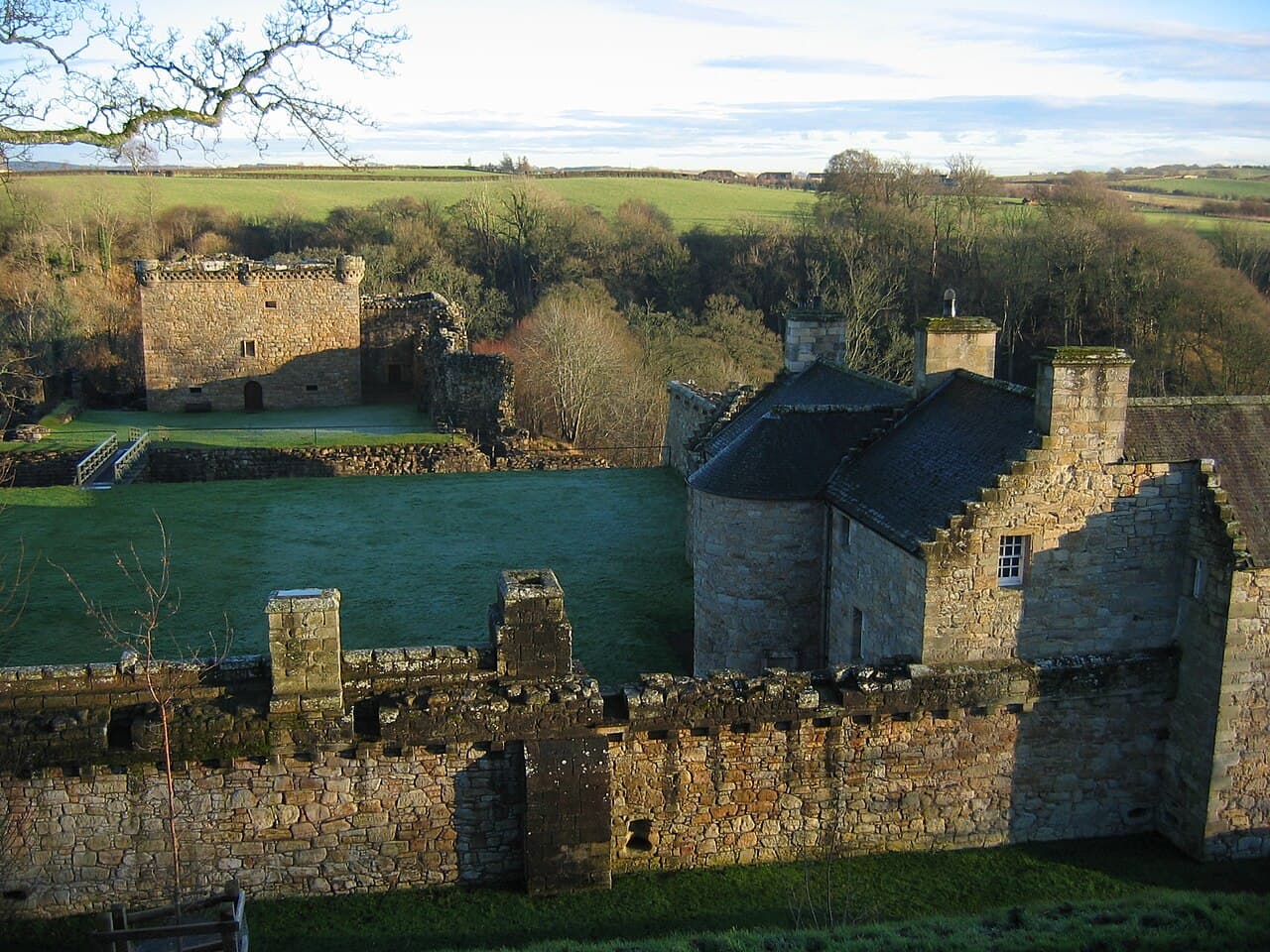
Surrounding the keep is a rectangular inner courtyard approximately 49 by 25 meters, enclosed by defensive walls reinforced with rectangular towers at the corners. The main entrance passes through a gated tower on the north wall, designed as a dog-leg passage to create a defensive turn against intruders. The western wall of the inner courtyard was constructed to withstand artillery attack, with thickness reaching up to 5 meters. This wall was partially destroyed during the castle's slighting in the late 16th century, and only its foundations remain visible today.
An outer courtyard was added in the 1540s by the 2nd Earl of Arran to the west of the inner courtyard, featuring less formidable defenses and likely containing service buildings and gardens. Towers flank the north-west and south-west corners; the north-west tower includes a dovecot for housing pigeons, while the south-west tower was incorporated into a 17th-century two-storey house built by Andrew Hay. Gunloops along the west wall of the outer court provided additional defensive coverage, and the main gate is situated roughly midway along this facade.
Unique defensive elements
One of Craignethan's most distinctive features is its caponier, an enclosed passage projecting into the deep defensive ditch on the western side. This structure, accessible from the south-west tower, contains gunports allowing defenders to fire along the length of the ditch, preventing attackers from approaching unseen. Craignethan is one of only two Scottish castles retaining an original caponier, the other being Blackness Castle.
The deep ditch itself measures about 3.5 meters deep and 9 meters wide and was originally crossed by a drawbridge. Though filled in after the castle's defenses were slighted, it was re-excavated during the 1960s, restoring an important element of the castle's defensive system.
Historical context and ownership
Construction and early history
Construction began around 1532 under the direction of James Hamilton of Finnart, who sought to create a residence that was both comfortable and militarily advanced. Hamilton's expertise in fortification design is evident in the castle's sophisticated artillery defenses, which were innovative for their time. However, his career ended abruptly when he was executed for treason in 1540, resulting in the forfeiture of Craignethan to the Scottish crown.
Hamilton family and political turmoil
In 1542, James Hamilton, 2nd Earl of Arran, regained possession of Craignethan and expanded its defenses by adding the outer courtyard to the west. The castle played a role in the turbulent political struggles of mid-16th century Scotland, particularly during the Marian civil war following the abdication of Mary, Queen of Scots. Mary herself stayed at Craignethan shortly before the Battle of Langside in 1568. Control of the castle shifted multiple times between factions supporting Mary and those opposing her, with several sieges marking its contested status.
Decline and slighting
After the Hamilton family's involvement in the assassinations of regents Moray and Lennox, they were outlawed in 1579, and royal forces seized Craignethan. To prevent its further military use, the government ordered the castle's slighting, which included demolishing the northwest tower and the thick western wall, effectively disabling its defenses.
Post-medieval use and preservation
The castle later returned to Hamilton ownership but was sold in 1659 to Andrew Hay, who built a two-storey house within the outer courtyard, blending domestic architecture with the existing ruins. Ownership changed again in 1730 to Archibald Douglas, Duke of Douglas, and eventually passed to the Earls of Home. Stabilization efforts were made in the late 19th century, and the site entered state care in 1949, now protected as a Scheduled Ancient Monument.
Cultural significance and literary connections
Craignethan Castle holds a special place in Scottish cultural heritage, partly due to its association with the renowned author Sir Walter Scott. Scott visited the castle in 1799 and linked it to his fictional Tillietudlem Castle in the novel Old Mortality (1816). This literary connection enhanced the castle's prominence and contributed to its enduring appeal as a historic site.
Visitor experience and current condition
Today, Craignethan Castle stands as a partially preserved ruin, offering visitors a tangible glimpse into 16th-century Scottish military architecture. The surviving stonework, including the keep, corner towers, and defensive walls, illustrate the castle's sophisticated design and strategic intent. The re-excavated ditch and rare caponier provide unique insights into artillery fortifications of the period.
The castle's location above the River Nethan provides scenic views of the surrounding landscape, while the layout invites exploration of both the inner and outer courtyards, the vaulted halls, and the defensive features. Informational signage and preservation efforts help contextualize the site for visitors interested in Scottish history, architecture, and the turbulent era of the 16th century.
Frequently asked questions (FAQ)
- What is the historical significance of Craignethan Castle?
- Craignethan Castle, built in the 16th century, is a remarkable example of Scottish Renaissance architecture. It served as a stronghold for the powerful Hamilton family and played a role in the turbulent history of Scotland during the Wars of the Three Kingdoms.
- When was Craignethan Castle built?
- Construction of Craignethan Castle began in the late 15th century, with significant additions made in the early 16th century. The castle showcases the evolution of medieval fortifications into more refined Renaissance styles.
- Can I visit Craignethan Castle year-round?
- Yes, Craignethan Castle is open to visitors throughout the year; however, opening hours may vary seasonally. It is advisable to check the official website for the most current information on visiting times.
- What are the opening hours for Craignethan Castle?
- The castle typically opens at 10 AM and closes at 5 PM during the peak season from April to October. In the winter months, the hours may be reduced, so it's best to confirm before planning your visit.
- Is it possible to access Craignethan Castle with a wheelchair?
- While Craignethan Castle has some accessible paths, the terrain can be challenging due to its historic structure and location. Visitors with mobility concerns should contact the site in advance to discuss accessibility options.
- What is the best time to visit Craignethan Castle?
- The best time to visit Craignethan Castle is during the spring and summer months when the weather is milder and the gardens are in full bloom. Additionally, the longer daylight hours provide ample time to explore the castle and its surrounding grounds.
- Are there any nearby attractions to Craignethan Castle?
- Yes, nearby attractions include the picturesque villages of Blackwood and Lanark, as well as the stunning Falls of Clyde. These sites offer beautiful landscapes and additional historical insights for a full day of exploration.
- What are the ticket prices for Craignethan Castle?
- Ticket prices for Craignethan Castle vary, with discounts available for children, students, and seniors. It's recommended to check the official website for the latest ticket pricing and any special promotions before your visit.
Photo gallery

Photo by No machine-readable author provided. Supergolden assumed (based on copyright claims).•CC BY-SA 3.0
Information
Website
Visit websiteSources & official resources
Verify the information above using these authoritative references.
Loading map...
Visitor reviews
No reviews yet. Been here? Write the first review and help other travelers!
Write the first reviewVisited this castle? Share your experience
Your review helps other travelers and adds first-hand knowledge to our encyclopedia.