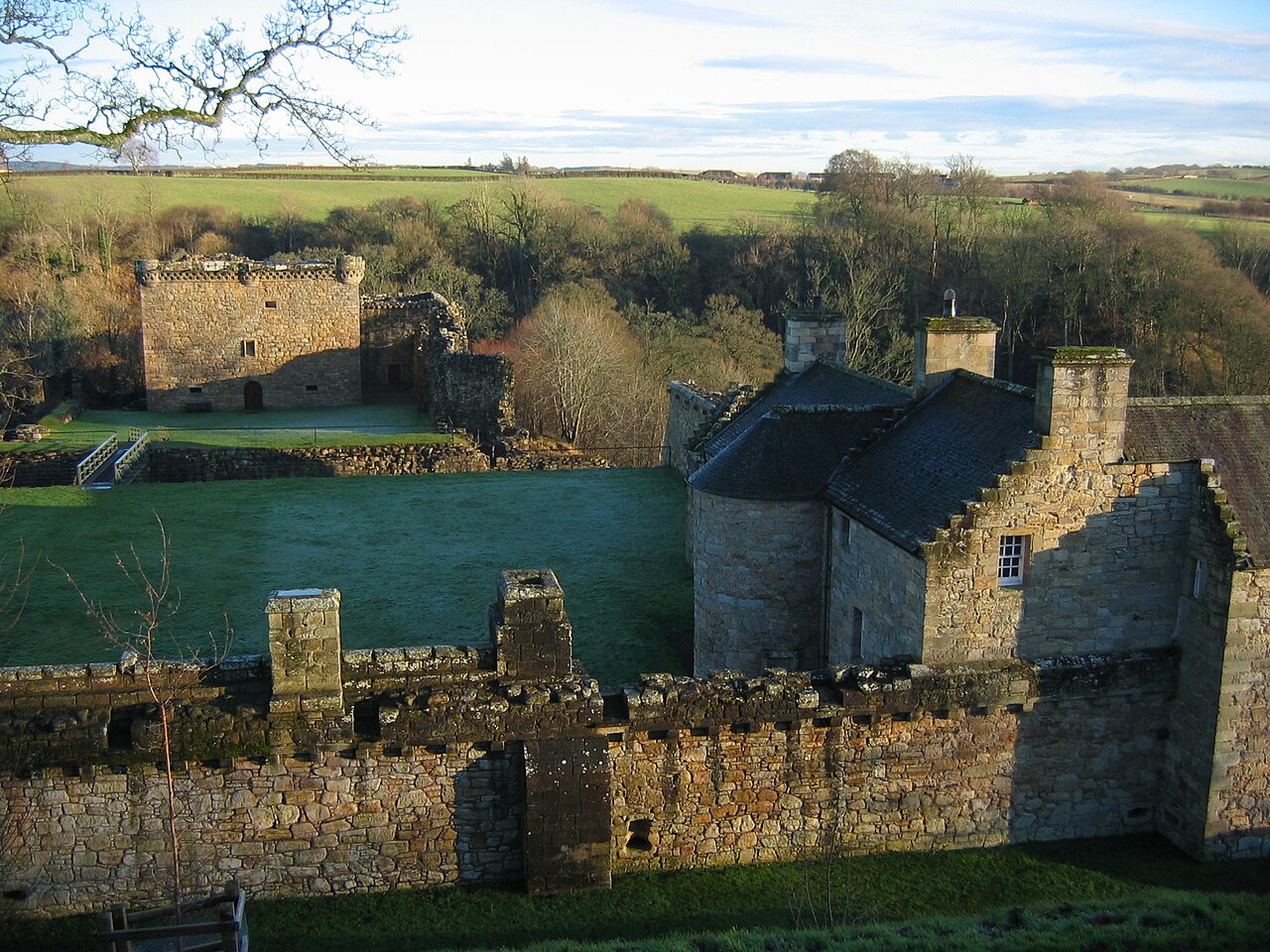
Corra Castle
Corra Castle is a historically significant Scottish tower house located near the village of New Lanark in Scotland. Perched on a natural promontory above the dramatic Corra Linn waterfall—one of the famed Falls of Clyde—the castle commands a strategic and scenic outlook over the surrounding landscape. This 16th-century structure served as a fortified residence for the local gentry during the late medieval and early modern periods, reflecting the architectural and defensive trends of its time.
Historical background and significance
The main construction of Corra Castle dates primarily to the 16th century, a period marked by the widespread erection of tower houses throughout Scotland. These buildings combined domestic comfort with defensive features, catering to the needs of the Scottish nobility and lairds amid ongoing regional conflicts and social upheaval. The castle's thick stone walls, nearly one meter in thickness, and elevated position on a cliff-edge promontory underscore its defensive purpose.
Archaeological finds near the site, including an Irish coin bearing the image of Edward I (reigned late 13th to early 14th century), suggest that the location may have earlier historical associations predating the existing ruins. This hints that the site was of strategic importance well before the current tower house was built, possibly serving as a fortified position or settlement in the medieval period.
The castle was historically occupied by a branch of the Somerville family, a notable Scottish lineage with deep roots in the Lanarkshire region. The Somervilles were significant local landowners and figures in Scottish history. Tradition holds that Mary, Queen of Scots stayed at Corra Castle during her journey to the Battle of Langside in 1568, linking the castle to a pivotal event in Scotland’s tumultuous 16th-century history.
Over the centuries, the castle’s importance diminished due to changing political circumstances and land use. Agricultural development in the area led to the partial demolition of some castle walls, particularly on the north and west sides, to accommodate farm buildings. Despite these alterations, the castle remains a scheduled monument since 1967, recognized for its archaeological and cultural significance. It was previously classified as a Category A listed building, a status reserved for structures of national importance, though this designation was later removed.
Architectural features and site layout
Corra Castle is a classic example of a Scottish tower house, occupying a rectangular footprint measuring approximately 13.7 by 4.9 meters. The surviving structure likely rose to two main floors with an additional attic or roof space. The walls, built of local stone, are notably thick—around one meter—to provide substantial defense against attack.
The most intact portion of the castle is the southwest corner, which still stands to a height of about five meters. This fragment preserves vertical stonework that offers insight into the castle’s original height and construction techniques. Other walls, especially on the north and west sides, have been removed or reduced due to later agricultural use.
The castle’s location on a promontory surrounded on three sides by steep cliffs provided natural defenses, reducing the need for extensive artificial fortifications on those sides. The remaining accessible side would have been protected by a defensive wall and possibly a gatehouse, typical features of tower houses of this era.
A distinctive landscape feature near the castle is a ha-ha, a recessed barrier that creates a physical boundary without obstructing views. This design element allowed the castle occupants to maintain clear sightlines over the surrounding countryside while preventing livestock or intruders from approaching too closely, blending security with aesthetic considerations.
Relationship to the surrounding landscape
The castle overlooks the Falls of Clyde, specifically the Corra Linn waterfall, which adds dramatic natural beauty to the site. The proximity to water and steep cliffs enhanced the defensibility of the castle and provided a reliable water source. The nearby Corehouse mansion estate, constructed in the early 19th century, complements the historic landscape and reflects the evolving land use in the area.
Historical context and cultural importance
The construction of Corra Castle fits within the broader context of Scottish tower house building during the 16th century, a time when local families fortified their residences to protect against feuding clans and political instability. Tower houses were a common feature of the Scottish countryside, combining residential, defensive, and symbolic functions.
The Somerville family’s occupation of the castle ties it to a lineage with longstanding influence in Lanarkshire. The reputed visit of Mary, Queen of Scots in 1568 connects the castle to a significant episode in Scottish history, the Battle of Langside, after which Mary’s forces were defeated, leading to her eventual imprisonment and abdication.
Though the castle fell into decline and partial ruin, its status as a scheduled monument ensures protection and recognition of its heritage value. The ruins provide tangible links to Scotland’s medieval and early modern past, offering insights into the lifestyle, defense strategies, and architectural practices of the time.
Present condition and visitor experience
Today, Corra Castle stands as a partially preserved ruin, with the southwest corner being the most prominent surviving feature. The site remains in its original location, allowing visitors to appreciate the castle’s strategic siting and commanding views over the Falls of Clyde and surrounding landscape.
While the castle itself is in a ruinous state, the natural setting and nearby historic estates create a compelling destination for those interested in Scottish history, architecture, and scenic beauty. The presence of the ha-ha and the castle’s integration with the landscape highlight the blend of defense and aesthetics in Scottish tower house design.
Access to the site is typically from the nearby village of New Lanark, a UNESCO World Heritage Site known for its industrial heritage. Visitors can combine a trip to Corra Castle with exploration of New Lanark’s historic mills and the natural beauty of the Falls of Clyde.
Frequently asked questions (FAQ)
- How do I get to Corra Castle from New Lanark?
- Corra Castle is located about one kilometer southeast of New Lanark village. Visitors can reach the site by walking or driving along local paths and roads that lead towards the Falls of Clyde. The castle is situated on a promontory above Corra Linn waterfall, so some uneven terrain is involved.
- What is the historical significance of Corra Castle?
- Corra Castle was a fortified residence for the Somerville family during the 16th century and is linked to Mary, Queen of Scots, who is said to have stayed there in 1568. The castle reflects Scottish tower house architecture and local defensive strategies of the late medieval period.
- Is Corra Castle accessible to the public?
- Yes, the ruins of Corra Castle are accessible to the public. However, as the site is a ruin on uneven ground near cliffs, visitors should exercise caution. There are no formal visitor facilities on site, so preparation and suitable footwear are recommended.
- When is the best time to visit Corra Castle?
- The best time to visit Corra Castle is during the late spring to early autumn months when the weather is milder and the surrounding landscape is at its most vibrant. This period also offers better walking conditions around the site and the Falls of Clyde.
- Are there any nearby attractions to visit along with Corra Castle?
- Visitors often combine a trip to Corra Castle with a visit to New Lanark, a UNESCO World Heritage Site known for its historic mills and social history. The Falls of Clyde nature reserve nearby also offers scenic walks and opportunities to see local wildlife.
Information
Website
Visit websiteSources & official resources
Verify the information above using these authoritative references.
Loading map...
Visitor reviews
No reviews yet. Been here? Write the first review and help other travelers!
Write the first reviewVisited this castle? Share your experience
Your review helps other travelers and adds first-hand knowledge to our encyclopedia.