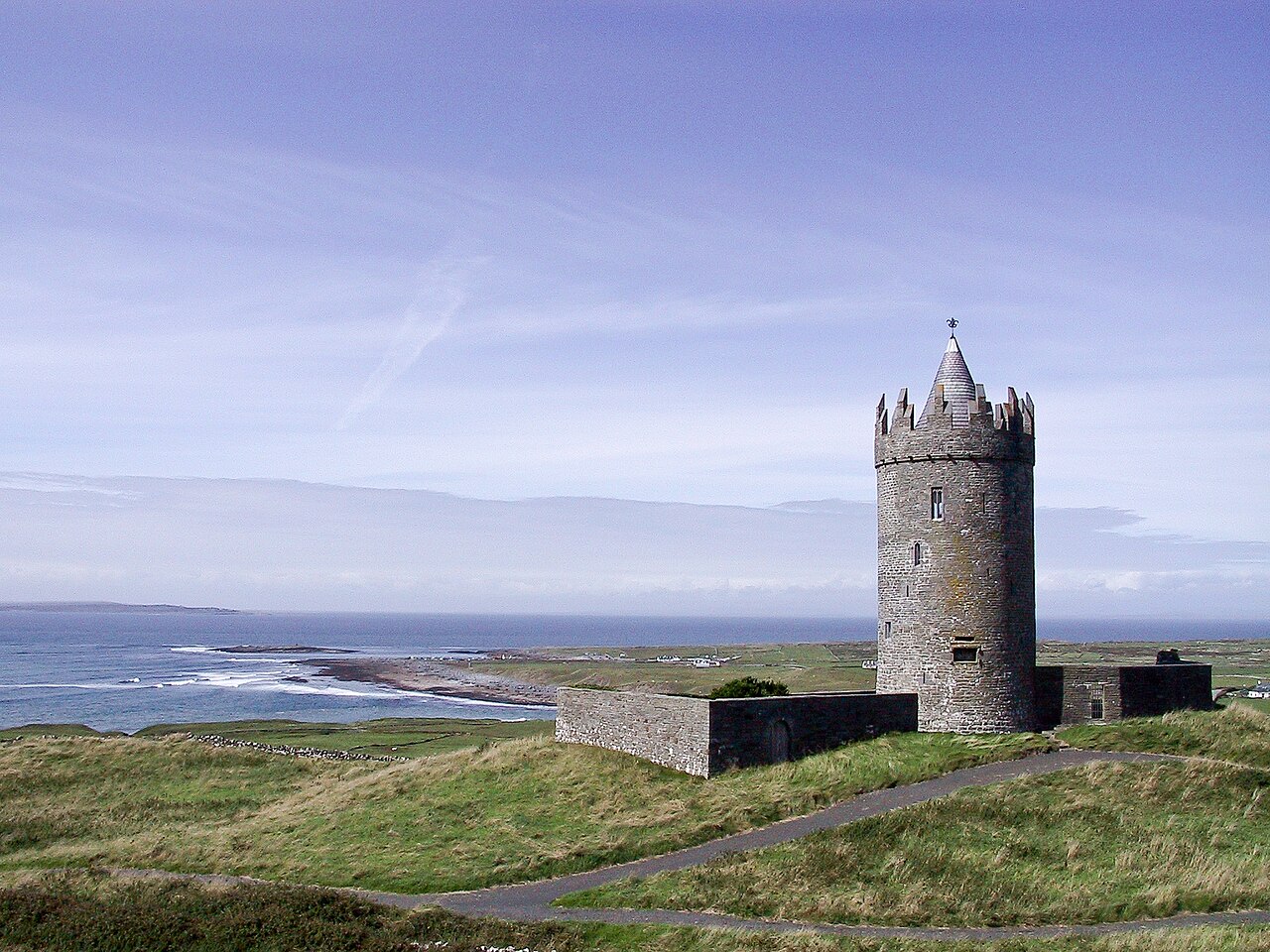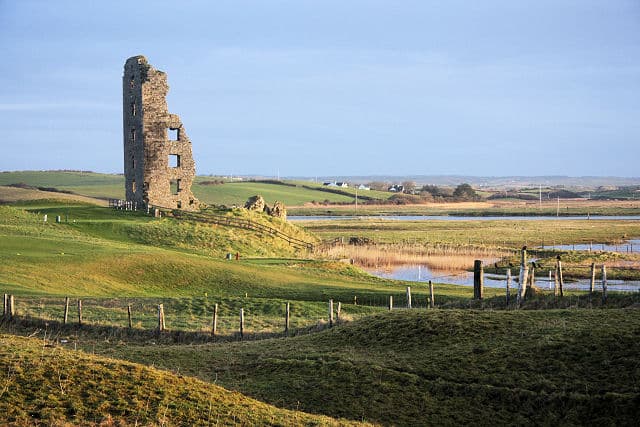
Dough Castle (Irish: Dumhach Ui Chonchuir – "sandbank of the O'Connors") is a ruined tower house situated near Lahinch in County Clare, western Ireland. This castle dates back to the 14th century and was originally established by the O'Connor clan, a prominent Gaelic family in the region. Although the castle is now in a state of ruin, it remains an important historical site reflecting the late medieval period of Irish fortifications.
Historical background and significance
The site of Dough Castle was strategically chosen due to its proximity to the Atlantic coast and the sandy terrain, which is reflected in its Irish name meaning "sandbank of the O'Connors." The castle was constructed during the late medieval period, around the 14th century, a time when tower houses were commonly built across Ireland as fortified residences for Gaelic chieftains and Anglo-Norman lords.
The O'Connor family played a significant role in the history of the region, and Dough Castle served as a stronghold for their control over the surrounding lands. The castle's location near Lahinch allowed the O'Connors to oversee important coastal routes and maintain influence in County Clare.
Architectural features and layout
Originally, Dough Castle was a tower house, a type of fortified residence typical of late medieval Ireland. Tower houses were usually multi-storey stone structures with defensive features such as thick walls, narrow windows, and battlements. However, much of the original structure of Dough Castle has been lost over time, and today only ruins remain.
The castle likely featured a rectangular plan with several floors, including a great hall, private chambers, and storage areas. Defensive elements such as a bawn (a walled courtyard) and possibly a moat or ditch would have enhanced its protection. The castle's construction would have utilized locally sourced stone, typical of Irish tower houses of the period.
Current condition and preservation
Today, Dough Castle stands as a ruined archaeological site. The remains are fragmentary, with little of the original tower house still visible above ground. The site is of interest to historians and archaeologists studying the medieval fortifications of Ireland and the social history of Gaelic clans.
Despite its ruined state, Dough Castle contributes to the cultural heritage of County Clare and attracts visitors interested in Ireland's medieval past. Preservation efforts focus on protecting the site from further decay while allowing public access to appreciate its historical context.
The castle's role in local history and culture
Dough Castle's importance extends beyond its physical remains. It symbolizes the power and territorial control of the O'Connor clan during a turbulent period in Irish history marked by clan rivalries and Anglo-Norman expansion. The castle's location near Lahinch connects it to local maritime activities and coastal defense strategies.
Local folklore and historical records mention Dough Castle in the context of regional conflicts and alliances. Although it never became a large or heavily fortified fortress, its presence reflects the typical defensive architecture employed by Gaelic lords to assert dominance and protect their lands.
Visiting dough castle
Visitors to Dough Castle can explore the site and surrounding landscape, which offers views of the nearby coast and countryside. While the ruins are limited in scale, they provide a tangible link to Ireland's late medieval period and the legacy of Gaelic lordship.
Access to the site is generally open, but visitors should be prepared for uneven terrain and limited facilities. The castle is often included in heritage trails and tours of County Clare's historical sites.
Frequently asked questions (FAQ)
- How do I get to Dough Castle from Lahinch?
- Dough Castle is located just a short drive from Lahinch, making it easily accessible by car. You can also reach the castle by walking along scenic coastal paths that offer stunning views of the surrounding landscape.
- What is the historical significance of Dough Castle?
- Dough Castle, built in the 16th century, is a testament to Ireland's rich history and architectural heritage. It served as a defensive stronghold during turbulent times and is an excellent example of medieval Irish fortifications.
- When was Dough Castle constructed?
- Dough Castle was constructed in the early 1500s, showcasing the defensive architectural style of the period. Its historical significance lies not only in its age but also in its role in the local power struggles of that era.
- Can I visit Dough Castle year-round?
- Yes, Dough Castle is open to visitors throughout the year, but it’s advisable to check specific opening hours before your visit. Seasonal events and guided tours may also be available, enhancing your experience.
- Why is Dough Castle a popular tourist attraction?
- Dough Castle is popular among tourists for its stunning location and historical relevance. Visitors enjoy exploring its architecture, taking in panoramic views, and learning about its fascinating past.
- Is it possible to enter the castle grounds?
- Yes, visitors can enter the castle grounds, and guided tours may be available to provide deeper insights into its history and architecture. Be sure to respect the site and follow any posted guidelines during your visit.
- What are the ticket prices for Dough Castle?
- Admission to Dough Castle is generally very affordable, with reduced rates for children and seniors. Check the official website for the most current prices and any special offers that may be available.
- What are the opening hours for Dough Castle?
- Dough Castle typically opens at 9 AM and closes at 5 PM, but hours may vary depending on the season. It's best to confirm the current opening hours on the official website before your visit to ensure you have ample time to explore.
- What are some nearby attractions to Dough Castle?
- Nearby attractions include the beautiful Lahinch Beach, known for its surfing and scenic walks, and the Cliffs of Moher, which offer breathtaking views of the Atlantic Ocean. Visitors can easily spend a full day exploring both historical and natural sites in the area.
Photo gallery

Information
Loading map...
Visitor reviews
No reviews yet. Been here? Write the first review and help other travelers!
Write the first reviewVisited this castle? Share your experience
Your review helps other travelers and adds first-hand knowledge to our encyclopedia.