Ballinalacken Castle
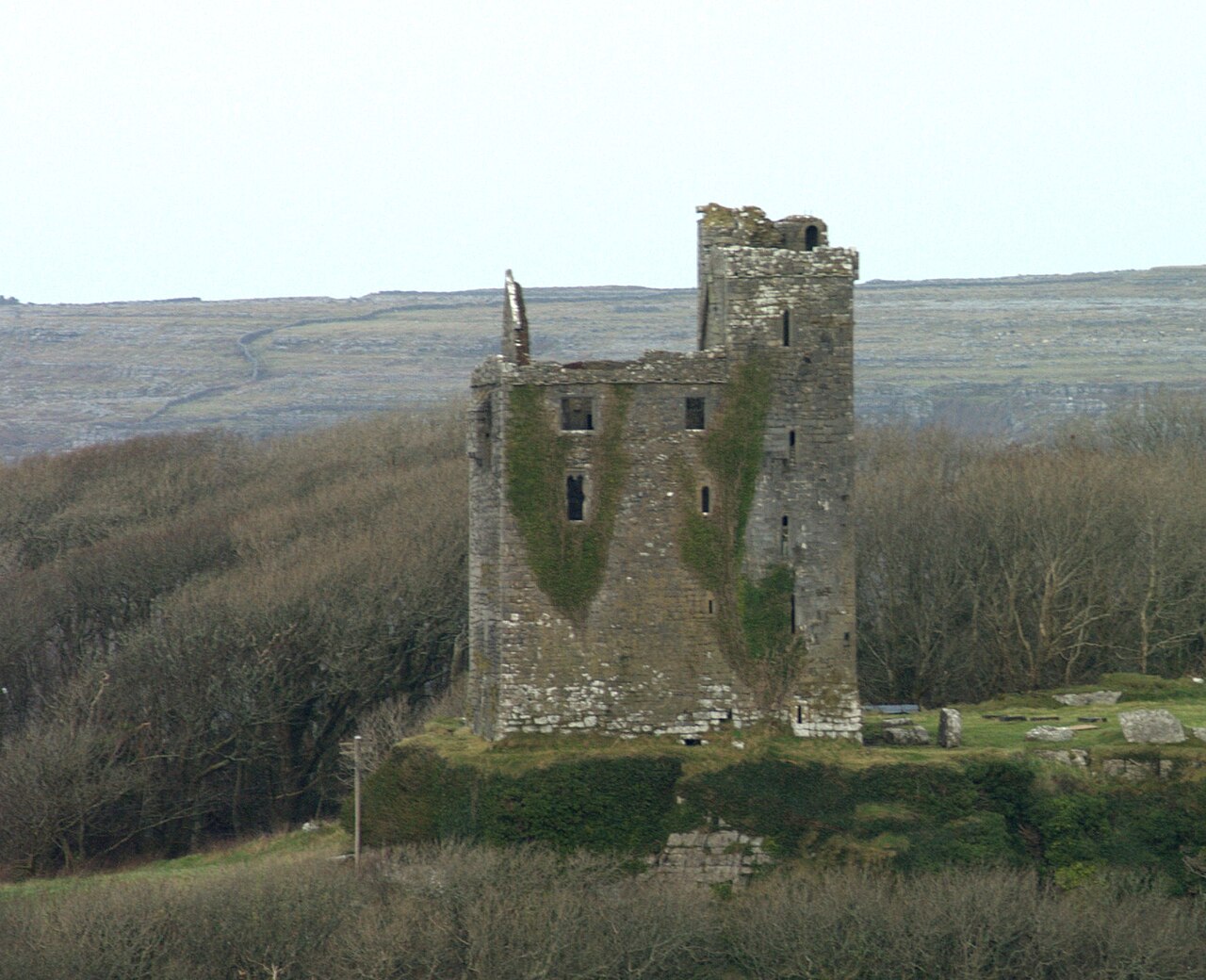
Ballinalacken Castle is a striking example of a Gaelic Irish tower house located in the parish of Killilagh, County Clare, Ireland. Perched on a limestone outcrop in the distinctive Burren region, this castle has a rich history stretching back to the late medieval period. It was originally constructed as a defensive residence by Gaelic families during a time of frequent conflict and shifting power dynamics in western Ireland.
The earliest known fortifications on the site likely date to the late 14th century, attributed to Lochlan MacCon O’Connor of the O’Connor clan, though no physical remains of this initial structure survive. The existing castle primarily reflects construction from the 15th or early 16th century, built as a tower house—a common fortified dwelling type for Gaelic lords of the period. The castle's strategic location on elevated limestone terrain provided natural defense advantages in the rugged Burren landscape.
Historical ownership and conflicts
The castle remained under the control of the O’Connor clan until 1564, when the territory was lost amid regional power struggles. By the 1580s, ownership had transferred to the O’Brien family, another prominent Gaelic dynasty with deep roots in County Clare. The O’Briens maintained possession through various branches well into the 18th century, despite interruptions such as the brief tenure of Captain Hamilton, a Cromwellian officer who held the castle in 1667 during the turbulent aftermath of the 1641 Irish Rebellion.
The 1641 rebellion marked a significant period when Irish insurgents seized control of the castle amid widespread resistance to English rule. Following Oliver Cromwell's conquest of Ireland, Daniel O’Brien petitioned in 1654 to prevent the castle's destruction, underscoring its continued strategic and symbolic importance. Either Daniel or his son Teigue O’Brien undertook expansions and reinforcements during this post-rebellion era, adapting the castle to evolving military needs. The family’s connection to the site is further evidenced by Teigue’s son Donough O’Brien, who adopted the designation "of Ballyneleackan," cementing the castle’s role as a familial seat.
Architectural features and defensive elements
Ballinalacken Castle is composed of a two-part tower house enclosed within a defensive bawn or courtyard wall. The castle’s entrance is particularly notable for its corbelled and machicolated gate, a defensive architectural feature allowing defenders to target attackers directly below through openings in the parapet. This gatehouse exemplifies the blend of military utility and residential function typical of Irish tower houses.
The castle’s structure comprises two connected sections: the eastern wing is narrower and rises one storey higher than the adjoining western part. The main doorway, located on the eastern section, is crowned with a prominent machicolation, enhancing its defensive capabilities. Inside, a porter’s lodge is situated opposite a circular staircase that provides access to three floors of modest bedrooms. These chambers feature small windows designed to balance natural light with defensive protection.
The uppermost floor opens onto a wall walk, a protected battlement walkway allowing sentries to patrol and defend the perimeter. The main wing contains an intricately carved Tudor-style chimney dated 1641, demonstrating the castle’s adaptation to more comfortable residential living while retaining military readiness. Defensive features also include multiple musket holes integrated into the machicolations, reflecting the growing importance of gunpowder weaponry in castle defense during the 17th century.
Originally, the castle was surrounded by a wall and moat system that included a drawbridge and mechanically operable gates, enhancing its defensive strength. Although these outer defenses have not survived, their former presence indicates the castle’s role as a fortified stronghold designed to withstand sieges and attacks.
19th-century modifications and modern use
In the 19th century, the castle’s setting evolved with the addition of a bow-fronted bungalow attached to the tower house. Built during the 1840s, this domestic residence was likely commissioned by John O’Brien, Member of Parliament, and served as the home of Lord O’Brien. The bungalow features distinctive elements such as a marble fireplace carved from a single stone slab, stained-glass windows, and the O’Brien family crest prominently chiseled into stone, reflecting Victorian tastes and the family’s status.
In 1938, the residence was adapted for use as a guest house, marking a new chapter in the castle’s long history. Today, Ballinalacken Castle stands in a ruined state, with surviving elements that bear witness to its layered history of construction, residence, and defense spanning several centuries.
Cultural significance and visitor experience
Ballinalacken Castle offers visitors a tangible connection to the turbulent history of medieval and early modern Ireland. Its combination of defensive architecture and residential features illustrates the dual role of tower houses as both military bastions and noble homes. The castle’s location in the Burren, a unique karst landscape, adds to its allure and historical context.
Visitors can explore the remains of the machicolated gatehouse, climb the circular staircase to the battlements, and appreciate the craftsmanship of the Tudor chimney. The adjacent 19th-century bungalow provides insight into the evolution of the site from a medieval fortress to a Victorian residence. Although the castle is in ruins, its evocative atmosphere and architectural features make it a significant heritage site within County Clare.
Frequently asked questions (FAQ)
- How do I get to Ballinalacken Castle?
- Ballinalacken Castle is located in County Clare, Ireland, near the Cliffs of Moher. You can reach it by car or public transport, with the nearest town being Doolin, which is just a short drive away. Parking is available nearby for visitors.
- What is the historical significance of Ballinalacken Castle?
- Ballinalacken Castle, dating back to the 15th century, was built by the O'Brien family, an influential clan in Irish history. The castle played a vital role in the region's feudal system and offers a glimpse into the medieval lifestyle and architecture of the time.
- When was Ballinalacken Castle constructed?
- Construction of Ballinalacken Castle began in the late 1400s and was completed in the early 1500s. It has stood the test of time, and its architectural features reflect the strength and style of medieval fortifications.
- Can I explore the inside of Ballinalacken Castle?
- Access to the interior of Ballinalacken Castle may be limited, as it is primarily in ruins. However, visitors can explore the exterior and enjoy the stunning views of the surrounding landscape, which is equally captivating.
- Why is Ballinalacken Castle a popular tourist attraction?
- Ballinalacken Castle is popular due to its rich history, stunning architecture, and breathtaking views of the Cliffs of Moher. It attracts history enthusiasts and nature lovers alike, making it a must-visit destination in County Clare.
- Is it possible to visit Ballinalacken Castle year-round?
- Yes, Ballinalacken Castle can be visited throughout the year, although the best time to visit is during the spring and summer months when the weather is milder. Be sure to check for any local events or potential restrictions that may affect your visit.
- What are the opening hours for Ballinalacken Castle?
- Ballinalacken Castle does not have specific opening hours as it is an outdoor site. Visitors are welcome to explore the area at their convenience, but it is advisable to visit during daylight hours for the best experience.
- Are there any ticket prices for visiting Ballinalacken Castle?
- There are no ticket prices for visiting Ballinalacken Castle, as it is an open historical site. However, donations to preserve the site are appreciated and can help support its maintenance.
- What nearby attractions can I visit while at Ballinalacken Castle?
- While visiting Ballinalacken Castle, you can also explore the nearby Cliffs of Moher, which offer stunning coastal views and walking trails. Additionally, the charming village of Doolin is just a short drive away, known for its traditional Irish music and vibrant culture.
Information
Website
Visit websiteSources & official resources
Verify the information above using these authoritative references.
Loading map...
Visitor reviews
No reviews yet. Been here? Write the first review and help other travelers!
Write the first reviewVisited this castle? Share your experience
Your review helps other travelers and adds first-hand knowledge to our encyclopedia.