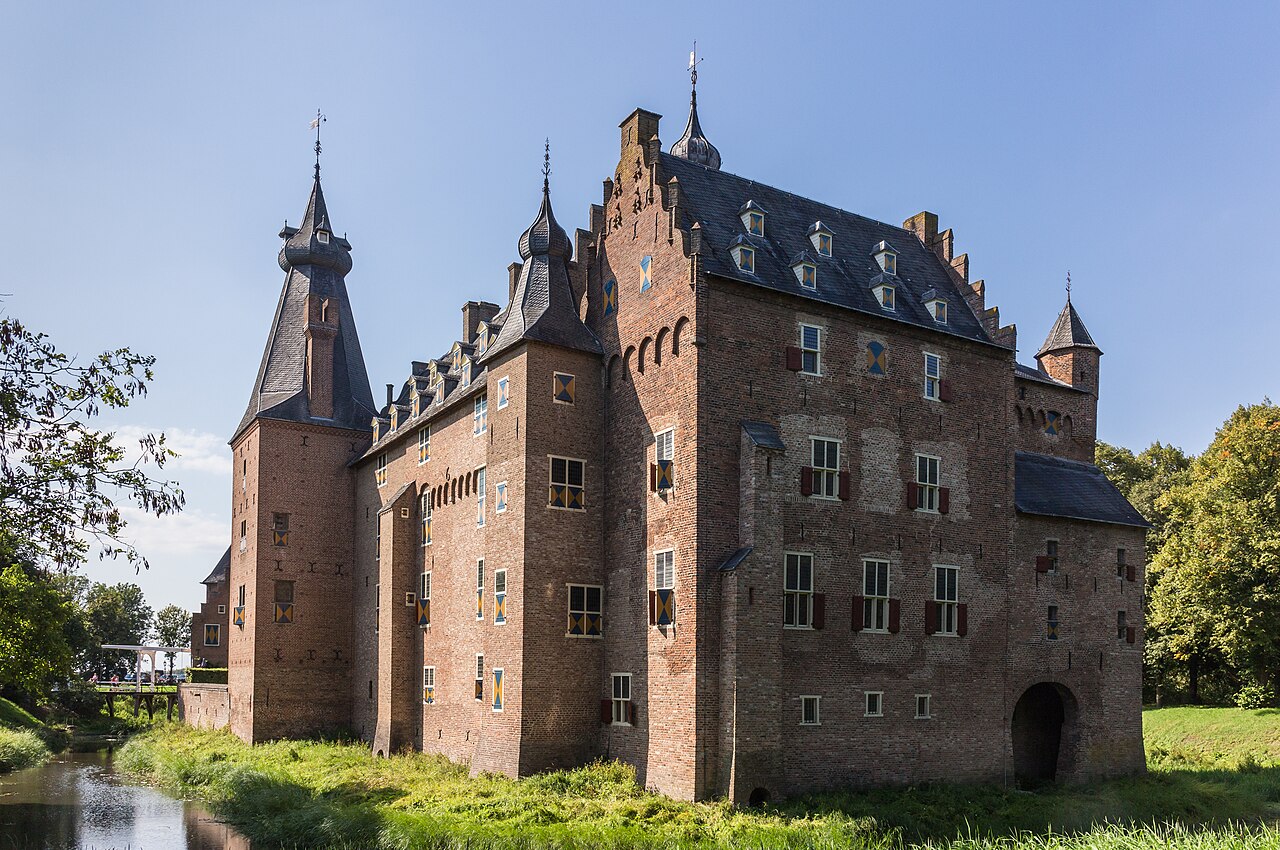
Doorwerth Castle
Doorwerth Castle, locally known as Kasteel Doorwerth, is a remarkable medieval fortress situated at the foot of the wooded hills south of the village of Doorwerth in the province of Gelderland, Netherlands. This castle stands as a testament to centuries of architectural evolution, noble ownership, and historical events that shaped the region.
The castle was historically known as the castle of Dorenweerd, with the modern spelling "Doorwerth" becoming standard around the year 1800. Its origins trace back to the mid-13th century, with the first mention of a wooden fortification in 1260. This original structure was besieged and destroyed by fire, leading to a significant reconstruction in stone shortly thereafter.
Early construction and medieval fortifications
The initial stone castle, referenced in records from 1280, was again attacked, resulting in the burning of the prison. This early castle likely featured a simple two-storey pavilion with walls approximately 1.20 meters thick, surrounded by a moat fed by the nearby Rhine River. The strategic location and defensive design were typical of medieval fortifications aimed at controlling river access and local territory.
Expansion and noble ownership in the 14th and 15th centuries
Throughout the 14th century, Doorwerth Castle underwent continuous expansion, reflecting the growing importance and wealth of its owners. Until 1402, the castle was held by the Van Dorenweerd family. That year, ownership transferred to Reinald IV, Count of Gelre, through a feudal arrangement with Robert van Dorenweerd, who retained the castle as a fief.
In the mid-15th century, the castle saw further enlargement under the direction of Reinald van Homoet, the tenth lord of Dorenweerd and owner of the nearby Doornenburg Castle. These expansions likely included the addition of defensive walls, towers, and residential buildings, adapting the castle to the evolving needs of its noble occupants.
Renaissance transformation and architectural unification
The most significant transformation of the castle occurred in the mid-16th century under Daem Schellart van Obbendorf, the 15th Lord of Dorenweerd. He unified the castle and the surrounding bailey into a cohesive complex, adapting the structures to provide increased space and comfort. By 1560, the castle had largely taken on the appearance it retains today.
Around 1637, the bailey was rebuilt to its current form, and a dam was constructed around the castle to protect it from flooding by the Rhine. These modifications highlight the castle's adaptation to both defensive needs and environmental challenges.
Ownership changes and decline
Following financial difficulties, the castle was granted in fief to Anton I van Aldenburg, a German count. His successors expanded the estate but made no significant alterations to the castle itself. By the late 18th century, the castle was no longer inhabited and was managed by an administrator on behalf of absentee owners residing in England, leading to neglect and deterioration.
19th and early 20th century restorations
In 1837, Baron JAP. van Brakell purchased Doorwerth Castle and undertook a careful restoration and modernization. Unfortunately, this revival was short-lived; after the baron's death in 1844, the castle again fell into disuse.
In 1910, a retired artillery officer named Does Hoefer acquired the castle and initiated another comprehensive restoration, reversing some 19th-century changes. By 1913, the castle was repurposed as a Dutch artillery museum, marking its transition from noble residence to cultural institution.
Damage and post-war restoration
During World War II, in 1944, Doorwerth Castle suffered extensive damage due to German military actions and Allied bombing, reducing it to a devastating ruin. A prolonged restoration effort began immediately after the war and continued until 1983. The restoration aimed to return the castle to its 18th-century appearance, preserving its historical integrity.
Today, the castle is owned by the foundation Friends of the Castles of Gelderland, which operates it as a museum. The surrounding bailey buildings have been converted into hotels, integrating heritage tourism with preservation efforts.
Architectural features and historical significance
Doorwerth Castle exemplifies the evolution of medieval fortifications into comfortable noble residences. Its stone walls, moat, and defensive towers reflect its original military purpose, while the later additions reveal Renaissance influences focused on habitation and aesthetics.
The castle's location near the Rhine River was strategically important for controlling trade and movement. Its repeated sieges and reconstructions mirror the turbulent history of the Gelderland region during the Middle Ages and Renaissance.
The castle's survival through centuries of conflict, neglect, and restoration underscores its cultural and historical value. It remains a prominent example of Dutch medieval architecture and a symbol of regional heritage.
Visiting doorwerth castle today
Visitors to Doorwerth Castle can explore its well-preserved halls, towers, and courtyards, gaining insight into medieval life and military architecture. The museum showcases artifacts related to the castle's history and its role as an artillery museum in the early 20th century.
The surrounding natural landscape enhances the visitor experience, with wooded hills and the Rhine River providing a scenic backdrop. The bailey's hotel accommodations offer a unique opportunity to stay within a historic setting.
Doorwerth Castle stands as a compelling destination for those interested in medieval history, architecture, and Dutch cultural heritage.
Frequently asked questions (FAQ)
- When was Doorwerth Castle originally built?
- Doorwerth Castle was originally built in the 13th century, with the first mention of a wooden castle dating back to 1260.
- What architectural styles are present in Doorwerth Castle?
- The castle features a mix of medieval defensive architecture and Renaissance modifications, reflecting its development from the 13th to the 17th centuries.
- Is Doorwerth Castle open to visitors?
- Yes, Doorwerth Castle operates as a museum managed by the Friends of the Castles of Gelderland foundation, welcoming visitors interested in history and architecture.
- How was Doorwerth Castle affected during World War II?
- The castle suffered severe damage in 1944 due to German military actions and Allied bombing but was restored to its 18th-century appearance by 1983.
- Are there accommodations available at Doorwerth Castle?
- The bailey buildings surrounding the castle have been converted into hotels, offering visitors a chance to stay in a historic setting.
Information
Current owner
Friends of the Castles of Gelderland
Loading map...
Visitor reviews
No reviews yet. Been here? Write the first review and help other travelers!
Write the first reviewVisited this castle? Share your experience
Your review helps other travelers and adds first-hand knowledge to our encyclopedia.