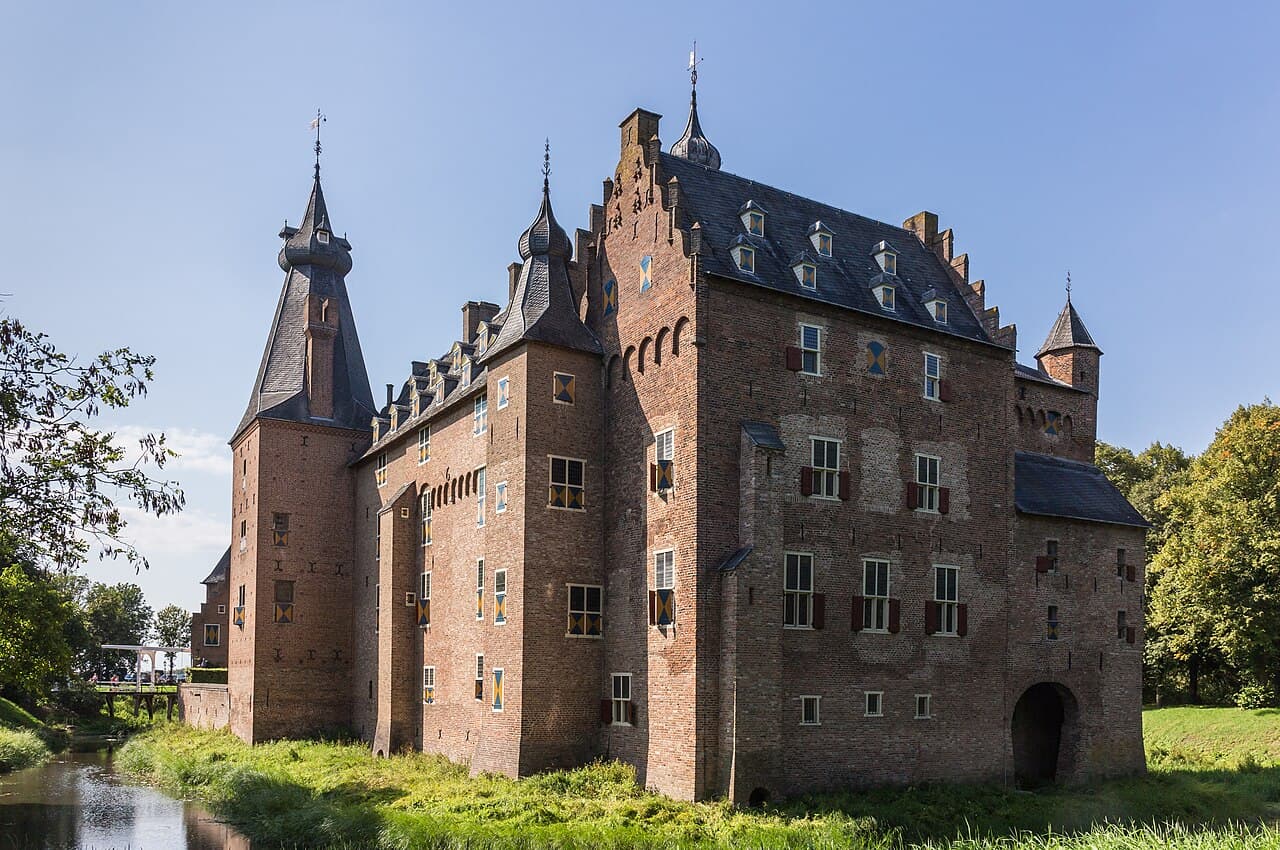
Doorwerth Castle
Doorwerth Castle, known locally as Kasteel Doorwerth, is a remarkable medieval water castle located near the village of Doorwerth in the province of Gelderland, Netherlands. Situated on the floodplains of the river Rhine, this castle has a rich history spanning over seven centuries, marked by multiple phases of construction, destruction, and restoration. It stands today as a well-preserved example of late medieval fortification adapted through the ages to meet changing defensive and residential needs.
The castle's origins trace back to the mid-13th century, first mentioned in 1260 when the original, likely wooden, fortress was besieged and burned during regional conflicts. This early structure was rebuilt in stone by the late 13th century, transitioning from a simple wooden fortification to a more durable stone hall-keep with thick walls and a surrounding moat fed by the Rhine. The castle's strategic location on a natural elevation near the river made it a significant defensive site in the region.
Medieval origins and early expansions
The earliest stone castle, built around 1280 under the direction of the Van Dorenweerd family, consisted of a rectangular residential tower approximately 10 by 15 meters, surrounded by its own moat. This tower formed the eastern wing of the present castle and is the oldest surviving part of the complex. The castle was originally owned by the Van Dorenweerd family until 1402, when Robert van Dorenweerd dedicated it to the Count of Guelders, Reinald IV, receiving it back as a fief, which reflected the feudal practices of the time.
Throughout the 14th century, the castle was continually enlarged to improve its defensive capabilities and residential comfort. The southern wing was added during this period, expanding the living quarters and fortifications. In the 15th century, under the ownership of knight Reinald van Homoet, the 10th Lord of Dorenweerd and also owner of Doornenburg Castle, the castle underwent significant enlargement. Notably, a large residential tower with small corner turrets was constructed in the northern wing, enhancing both defense and status.
Renaissance modifications and unification
By the mid-16th century, Doorwerth Castle reached its largest and most unified form under Daem Schellart van Obbendorf, the 15th Lord of Dorenweerd. Around 1560, he undertook extensive renovations that integrated the castle proper with the group of buildings on the outer bailey, creating a cohesive complex designed for increased space and comfort. This period saw the raising of the southern wing and the construction of a large southwest tower, although the latter was later demolished and rebuilt in the 19th century.
In the early 17th century, around 1637, the outer bailey was rebuilt to its present form, and a protective dike was constructed around the castle to prevent flooding from the Rhine. These improvements reflected the ongoing need to adapt the castle's defenses to environmental challenges and evolving military technology.
Ownership changes and decline
Following financial difficulties, the castle was granted in fief to Anton I van Aldenburg, a German count, whose family retained ownership but rarely resided there. This led to a gradual decline in the castle's condition. By the late 18th century, Doorwerth Castle was no longer inhabited and was maintained only by a steward, as the owners lived abroad in England.
In 1837, Baron Jacob Adriaan Prosper van Brakell purchased the castle and initiated a thorough restoration and modernization, preserving the facades and moat while updating the interiors for residential use. However, this revival was short-lived; after the baron's death in 1844, the castle again fell into neglect.
20th-century restoration and wartime damage
In 1910, retired artillery officer Frederic Adolph Hoefer acquired Doorwerth Castle and undertook another significant restoration, reversing some 19th-century alterations. From 1913, the castle served as the Dutch Artillery Museum, highlighting its military heritage.
During World War II, Doorwerth Castle suffered severe damage in 1944 due to German defensive actions and Allied shelling. The castle was transformed into a ruin, with much of its structure heavily damaged. Unexploded ordnance, including hand grenades, has been found near the site even in recent decades, underscoring the intensity of the conflict in the area.
Post-war restoration and current use
After the war, a lengthy restoration process began around 1950 and continued until 1983. The goal was to restore the castle to its 18th-century appearance while stabilizing its structure and preserving its historical integrity. Today, Doorwerth Castle is owned and maintained by the "Friends of the Castles of Gelderland" foundation and operates as a museum showcasing the region's history, nature, and hunting traditions.
The castle complex includes the main castle, an outer bailey with wide moats, a drawbridge, and a gatehouse rebuilt in 1640 by Johan Vincent Schellaert van Obbendorf. The castle's architecture reflects its evolution from a medieval fortress to a Renaissance residence, with stone construction, thick walls, towers, and defensive moats fed by the Rhine.
Notable features and cultural significance
Among the castle's notable features is a historic robinia tree near the grounds, possibly planted in the late 16th or early 17th century, making it the oldest of its kind in the Netherlands with a trunk circumference of about seven meters.
Doorwerth Castle also has a reputation for being haunted, with a famous ghost photograph taken in 2004 attracting visitors interested in paranormal history. The castle's layered history, architectural evolution, and cultural importance make it a prominent heritage site in the Netherlands.
Visitor information and accessibility
Today, Doorwerth Castle is accessible to the public as a museum and cultural venue. The buildings on the outer bailey have been repurposed as a hotel, offering visitors a unique experience of staying within a historic castle complex. The castle is also used for official events such as weddings by the municipality of Renkum.
Its location near Arnhem and proximity to the Rhine make Doorwerth Castle a popular destination for those interested in medieval architecture, Dutch history, and natural landscapes.
Frequently asked questions (FAQ)
- What is Doorwerth Castle known for?
- Doorwerth Castle is known for its stunning medieval architecture and picturesque setting along the banks of the Rhine River. Originally built in the 13th century, it showcases a blend of historical styles and has been well-preserved, making it a fascinating site for visitors interested in history and architecture.
- When was Doorwerth Castle built?
- Doorwerth Castle was constructed in the early 13th century, with its foundation dating back to around 1260. Over the centuries, it has undergone numerous renovations and expansions, reflecting the architectural styles of various periods.
- What are the opening hours for Doorwerth Castle?
- Doorwerth Castle is typically open to visitors from Tuesday to Sunday, with varying hours depending on the season. During the summer months, the castle often opens earlier and closes later, while winter hours may be more limited, so it's wise to check the official website for the most current information before your visit.
- Can I take a guided tour of Doorwerth Castle?
- Yes, guided tours are available at Doorwerth Castle, providing visitors with in-depth knowledge about its history, architecture, and the stories of its inhabitants. These tours are led by knowledgeable guides who can enhance your experience and answer any questions you may have.
- Is Doorwerth Castle accessible for visitors with disabilities?
- Doorwerth Castle strives to be accessible to all visitors, with wheelchair-friendly paths and facilities available. However, some areas of the castle may have limited accessibility due to their historic nature, so it’s advisable to contact the castle’s administration in advance for specific accessibility information.
- What is the best time to visit Doorwerth Castle?
- The best time to visit Doorwerth Castle is during the spring and early autumn when the weather is mild, and the surrounding gardens are in full bloom. Additionally, visiting during these seasons often means fewer crowds, allowing for a more enjoyable experience.
- Are there any nearby attractions to visit along with Doorwerth Castle?
- Yes, nearby attractions include the beautiful Hoge Veluwe National Park, which offers stunning landscapes and a variety of outdoor activities. Additionally, the city of Arnhem, known for its rich history and cultural sites, is just a short drive away, making it a perfect complement to your visit to Doorwerth Castle.
- What are the ticket prices for Doorwerth Castle?
- Ticket prices for Doorwerth Castle are generally reasonable, with discounts available for students, seniors, and children. It's best to check the official website for the most up-to-date pricing and any special promotions that might be available during your visit.
Photo gallery

Information
Sources & official resources
Verify the information above using these authoritative references.
Loading map...
Visitor reviews
No reviews yet. Been here? Write the first review and help other travelers!
Write the first reviewVisited this castle? Share your experience
Your review helps other travelers and adds first-hand knowledge to our encyclopedia.



