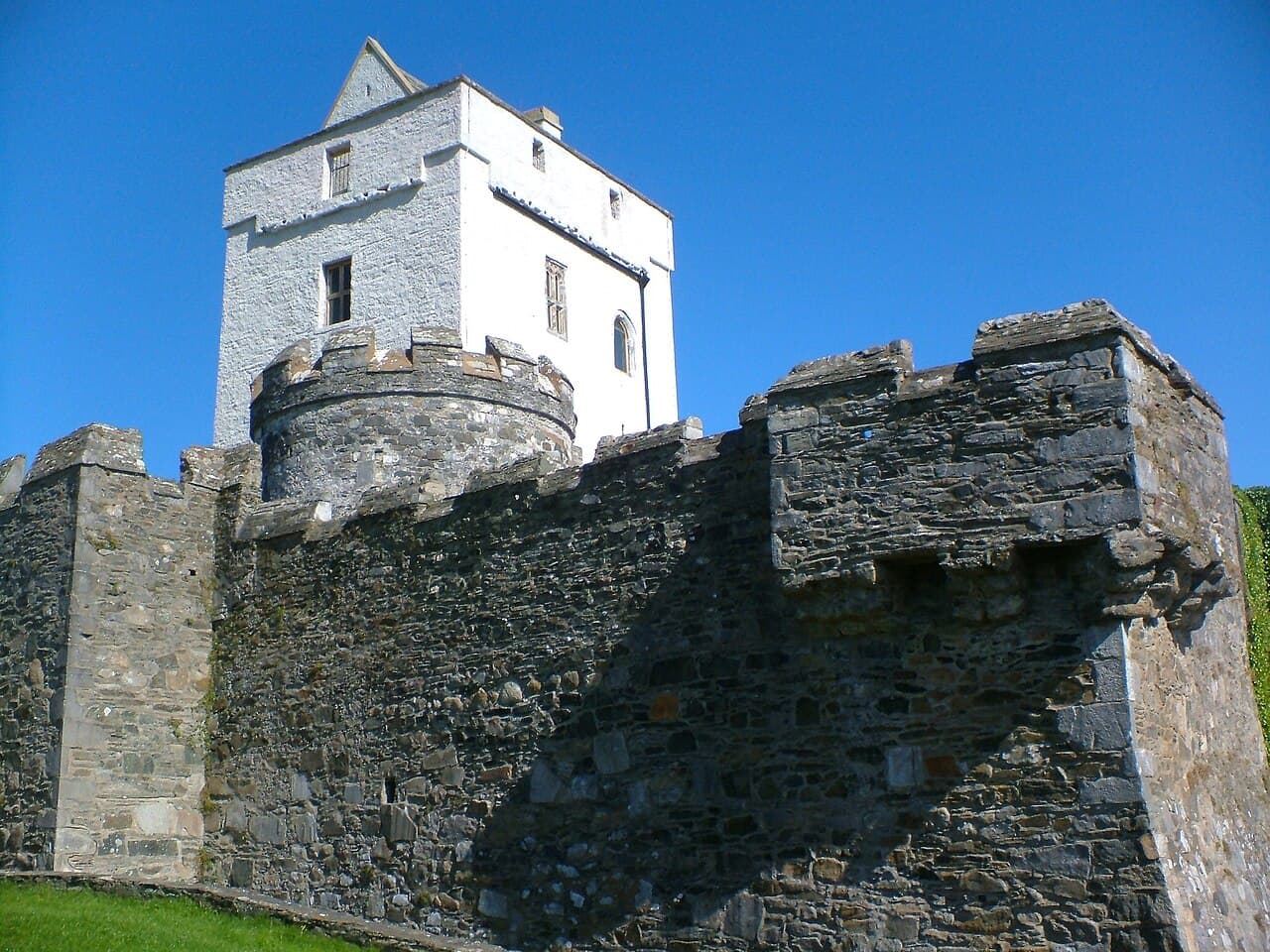
Doe Castle, known in Irish as Caisleán na dTuath, is a significant late-medieval fortress located near Creeslough, County Donegal, Ireland. This castle served as the stronghold of the Clan tSuibhne (Clan McSweeney), a Gaelic family with close ties to Scottish heritage, reflected in the castle's architectural resemblance to the Scottish tower house style. Constructed in the early 15th century, Doe Castle stands as one of the most substantial and well-preserved fortalices in the north-west of Ireland.
Strategic location and defensive features
Doe Castle occupies a commanding position on a small peninsula, naturally protected by water on three sides. This strategic siting enhanced its defensibility, with the landward side further secured by a moat cut into the rock, a rare and impressive defensive feature in Irish castles of this period. The castle's setting on a rocky promontory overlooking the Doe River estuary allowed control over local waterways and access routes, crucial for both defense and trade.
Architectural layout and design
The castle's core is dominated by a four-storey tower house or keep, which served as the main residential and defensive structure. Surrounding the tower house is a high curtain wall enclosing an interior bawn—an enclosed courtyard typical of Irish tower houses. The walls are robust, built of local stone, and feature narrow slit windows and battlements that allowed defenders to repel attackers effectively.
The moat on the landward side was ingeniously cut directly into the rock, creating a formidable barrier against siege engines and infantry assaults. Access to the castle was controlled by a fortified gatehouse, which would have been equipped with defensive mechanisms such as a portcullis and murder holes.
Comparison with Scottish tower houses
Doe Castle shares many architectural characteristics with Scottish tower houses, including its vertical emphasis, compact footprint, and the integration of living quarters with defensive features. This reflects the cultural and familial connections between the McSweeneys and their Scottish counterparts. The castle’s design balances comfort and security, with thick walls providing insulation and protection, and internal spaces arranged around a central hall.
Historical significance and clan association
The castle was the ancestral seat of the Clan tSuibhne, who were prominent Gaelic lords in the region. The McSweeneys were known as skilled warriors and seafarers, and Doe Castle was both a military stronghold and a symbol of their power and status. Throughout the 15th and 16th centuries, the castle played a role in regional conflicts and served as a base for clan activities.
In the turbulent history of Ireland, Doe Castle witnessed various sieges and occupations, including involvement in the Nine Years' War (1594–1603), when Gaelic lords resisted English rule. The castle’s robust fortifications allowed it to withstand several attacks, although it eventually fell under English control.
Later history and preservation
Following the decline of the Gaelic order, Doe Castle changed hands multiple times and was eventually abandoned as a military fortress. Despite this, it remained remarkably intact compared to many other Irish castles, thanks to its solid construction and remote location.
Today, Doe Castle is well-preserved and accessible to the public. Its impressive walls, tower house, and moat attract visitors interested in medieval architecture and Irish history. The castle’s setting offers picturesque views of the surrounding landscape, enhancing its appeal as a heritage site.
Visitor experience
Visitors to Doe Castle can explore the interior bawn, climb the tower house to view defensive features, and appreciate the craftsmanship of the stonework. Informational displays provide context about the castle’s history, architecture, and the McSweeney clan. The site is an important cultural landmark in County Donegal, offering insight into Ireland’s medieval past.
Architectural details and construction techniques
The masonry of Doe Castle demonstrates skilled craftsmanship typical of late-medieval Irish fortifications. The walls are constructed from locally sourced stone, laid in irregular courses but tightly fitted to provide strength and durability. The tower house features vaulted ceilings on the lower floors, which enhanced fire resistance and structural integrity.
Defensive elements include battlements with crenellations, narrow arrow slits for archers, and a strategically positioned gatehouse that controlled access. The moat, cut into solid rock, is a distinctive feature that significantly increased the castle’s defensibility.
Interior arrangements
Inside the tower house, rooms were arranged vertically with a great hall, private chambers, and storage areas. The great hall served as the main social and administrative space, while upper floors provided accommodation. Fireplaces and latrines were incorporated into the design, reflecting the needs of a noble household.
Doe Castle in the context of Irish medieval castles
Doe Castle is an excellent example of a late-medieval Irish tower house, a common castle type built by Gaelic and Anglo-Norman lords from the 14th to 17th centuries. Its combination of natural defenses, stone construction, and vertical living quarters typifies this genre.
Compared to other castles in Ireland, Doe Castle’s preservation and distinctive moat make it a valuable site for understanding regional variations in castle architecture and clan history. It illustrates the adaptation of Scottish architectural influences in an Irish context, highlighting cultural exchanges across the Irish Sea.
Frequently asked questions (FAQ)
- How do I get to Doe Castle?
- Doe Castle is located in Creeslough, Ireland, and is accessible by car. The nearest major town is Letterkenny, which is approximately 30 minutes away. There are also local bus services available that can take you close to the castle.
- What is the historical significance of Doe Castle?
- Doe Castle has a rich history dating back to the 16th century and was once the stronghold of the O’Donnell clan. It played a crucial role in the region's power dynamics and has been a site of many historical events throughout the centuries. Today, it stands as a testament to Ireland's medieval heritage.
- When was Doe Castle built?
- Doe Castle was constructed in the 16th century, specifically around the year 1550. Its architecture reflects the military needs of the time, showcasing features typical of defensive structures. Over the years, it has undergone various restorations to preserve its historical significance.
- Can I take guided tours of Doe Castle?
- Yes, guided tours are available at Doe Castle, providing visitors with an in-depth look at its history and architecture. Tours typically run during the main tourist season, and it's advisable to check in advance for availability. Self-guided tours are also permitted for those who prefer exploring at their own pace.
- Why is Doe Castle a popular tourist destination?
- Doe Castle is popular for its stunning location overlooking Sheephaven Bay and its fascinating historical background. Visitors are drawn not only by the castle's architectural beauty but also by the picturesque surroundings and the opportunity to explore the rich cultural heritage of the region. It offers a unique glimpse into Ireland's past.
- Is it possible to hold events at Doe Castle?
- Yes, Doe Castle can be rented for events, including weddings and corporate gatherings. The castle's breathtaking views and historic ambiance provide a memorable setting for any occasion. It's recommended to contact the management for details on availability and arrangements.
- What are the opening hours for Doe Castle?
- Doe Castle typically opens to visitors from April to September, with varying hours throughout the week. During peak season, the castle is usually open daily from 10 AM to 6 PM. Always check the official website for the most current opening hours and any special events.
- What are the ticket prices to visit Doe Castle?
- Ticket prices for Doe Castle are generally affordable, with discounts available for children and seniors. Adults can expect to pay around €5, while children under 12 may enter for free. It's best to verify the latest pricing on the official site before your visit.
- What is nearby Doe Castle that I can visit?
- Nearby attractions include the stunning beaches of Sheephaven Bay and the scenic Slieve League Cliffs, known for their breathtaking views. The village of Creeslough also offers charming shops and local eateries. Exploring these nearby sites can enrich your visit to Doe Castle.
Photo gallery

Information
Loading map...
Visitor reviews
No reviews yet. Been here? Write the first review and help other travelers!
Write the first reviewVisited this castle? Share your experience
Your review helps other travelers and adds first-hand knowledge to our encyclopedia.



