Diyarbakır Fortress
Diyarbakır Fortress is a monumental example of ancient military architecture located in the historic city of Diyarbakır, southeastern Turkey. This extensive fortification complex encloses the old city district of Sur and includes a massive citadel along with an imposing outer ring of city walls. These fortifications are among the most significant and best-preserved defensive structures from antiquity and the early medieval period.
Historical background and construction phases
The origins of Diyarbakır Fortress trace back to the 6th century BC, a period when the city was known as Amid or Amida. According to the Armenian historian Movses Khorenatsi, the earliest fortifications were constructed under the Armenian King Tigranes during the Yervanduni (Orontid) dynasty. This early phase laid the foundations for what would become one of the most formidable defensive walls in the ancient Near East.
The current structure of the walls largely dates from the Roman period, specifically the mid-4th century AD, under the reign of Emperor Constantius II. The Romans rebuilt and expanded the walls, incorporating advanced military architectural techniques of the time, including bastioned fortifications designed to withstand siege warfare. The fortress served as a critical defensive stronghold on the empire's eastern frontier.
Architectural features and defensive design
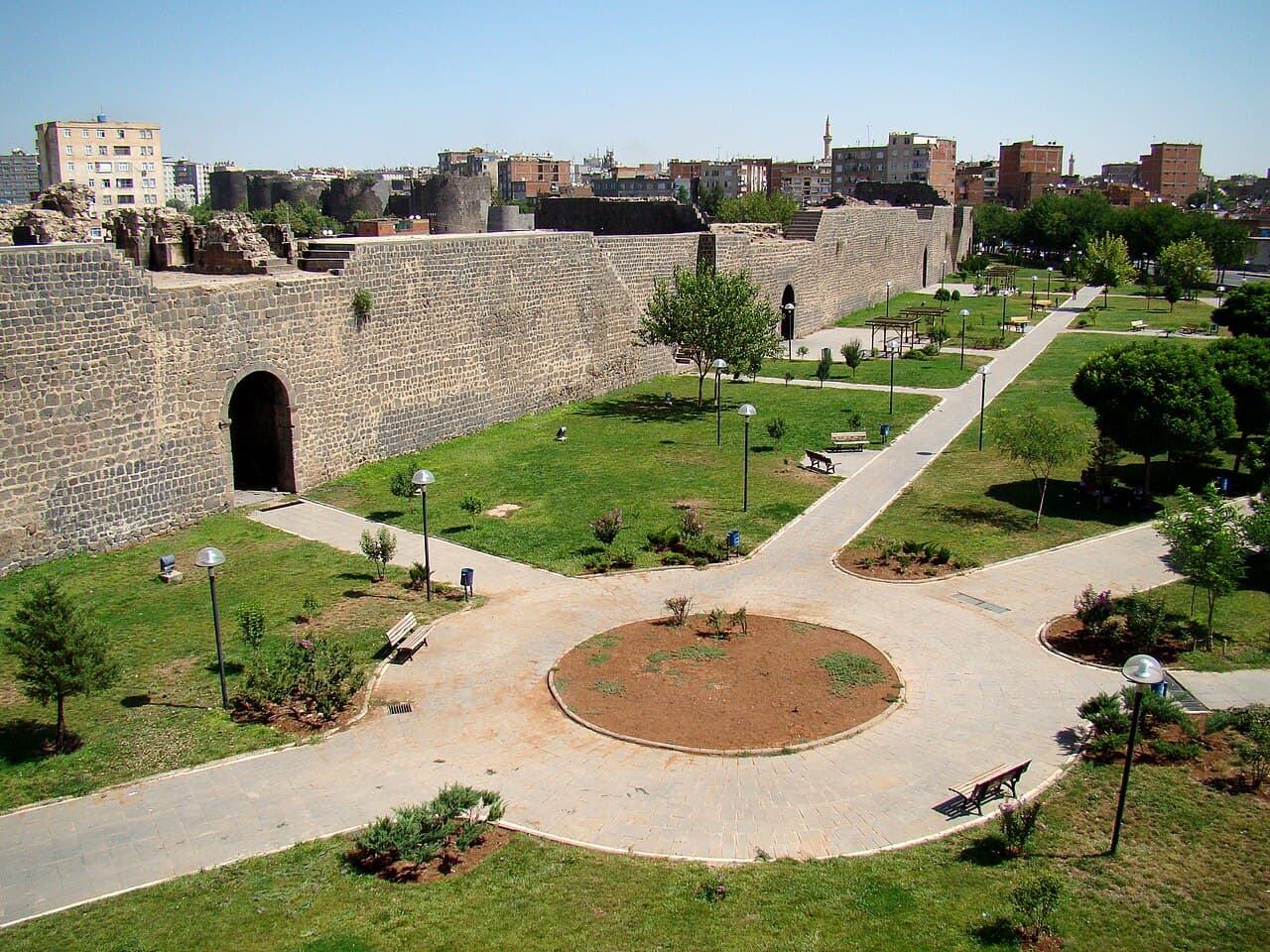
The Diyarbakır city walls extend approximately 5.8 kilometers, making them the longest complete defensive walls in the world after the Great Wall of China. Their construction uses large black basalt stones, giving the walls a distinctive dark appearance. The walls are remarkably thick, reaching up to 5 meters in width in some sections, and rise to heights of 10 to 12 meters.
The fortifications include numerous bastions and towers spaced at regular intervals, designed to provide overlapping fields of fire for defenders. The walls are punctuated by four main gates: the Dağ (Mountain) Gate, Urfa Gate, Mardin Gate, and Yeni (New) Gate. Each gate features complex defensive mechanisms such as multiple doorways, murder holes, and arrow slits to repel attackers.
The inner citadel is a heavily fortified area that served as the last line of defense and the residence of the city's rulers. It contains several historic buildings and military installations, including barracks, armories, and watchtowers.
Cultural and historical significance
Diyarbakır Fortress is not only a military monument but also a cultural symbol of the city and region. The walls have witnessed numerous historical events, including sieges and battles during Roman, Byzantine, Islamic, and Ottoman periods. The fortress reflects the diverse cultural influences that have shaped southeastern Anatolia over millennia.
In recognition of its outstanding universal value, the fortress along with the adjacent Hevsel Gardens was inscribed as a UNESCO World Heritage Site in 2015. This designation highlights the site's exceptional preservation and its importance as a cultural landscape illustrating the interaction between urban settlement and natural environment.
Preservation and visitor experience
The walls and fortress are well preserved considering their age, with ongoing conservation efforts to maintain structural integrity and historical authenticity. Visitors can explore the extensive circuit of walls, walk along the ramparts, and enter through the historic gates to experience the scale and defensive ingenuity of the fortifications.
The fortress area offers panoramic views of Diyarbakır and the surrounding plains. Interpretive signage and guided tours provide insights into the architectural features and historical context. The site remains an active part of the city's cultural heritage and attracts scholars, tourists, and history enthusiasts alike.
Frequently asked questions (FAQ)
- What are the main gates of Diyarbakır Fortress?
- The fortress has four main gates: Dağ (Mountain) Gate, Urfa Gate, Mardin Gate, and Yeni (New) Gate, each featuring complex defensive structures.
- When was Diyarbakır Fortress originally built?
- The earliest fortifications date back to the 6th century BC under Armenian King Tigranes and were later expanded by the Romans in the 4th century AD.
- What makes Diyarbakır Fortress architecturally significant?
- It is one of the longest and most complete ancient defensive walls, built with black basalt stones and featuring numerous bastions and towers for defense.
- Is Diyarbakır Fortress a UNESCO World Heritage Site?
- Yes, it was inscribed as a UNESCO World Heritage Site in 2015 along with the Hevsel Gardens due to its cultural and historical importance.
- Can visitors walk along the city walls?
- Yes, visitors can explore the walls, walk on the ramparts, and enter through historic gates to experience the fortress's scale and design.
Photo gallery

Information
Loading map...
Visitor reviews
No reviews yet. Been here? Write the first review and help other travelers!
Write the first reviewVisited this castle? Share your experience
Your review helps other travelers and adds first-hand knowledge to our encyclopedia.