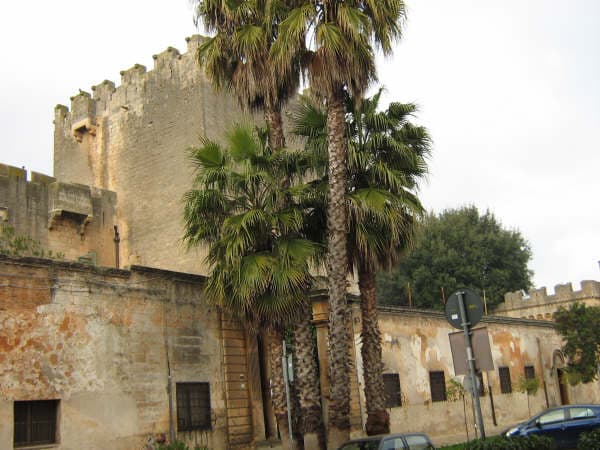
Dentice Frasso Castle
Dentice Frasso Castle stands prominently in San Vito dei Normanni, Italy, overlooking the town's main piazza opposite the Town Hall. This medieval hill castle is distinguished by its ancient square tower, which is a defining feature of the structure and a testament to its Norman origins. The castle's strategic location along the old road connecting San Vito to Oria highlights its historical importance as a defensive and residential stronghold.
The origins and historical context
The castle was initially constructed in the 11th century, attributed to Bohemond of Hauteville, a notable Norman leader. The earliest part of the castle is the tower, believed to date from the 12th century, which served as a key defensive feature. This tower was originally accessible via a drawbridge connected to the chapel door, emphasizing the castle's fortified nature. The Norman architectural influence is evident in the tower's design, featuring battlements and narrow openings that provided both protection and indoor lighting.
Architectural features and layout
The castle's layout includes a large courtyard surrounded by a series of elegant rectangular buildings constructed in the 16th century (Cinquecento). These structures form a residence around the tower, combining defensive and domestic functions. The entrance is marked by a pointed arch topped with the Dentice family crest, symbolizing the family's long-standing ownership and influence.
A notable architectural element is the stone porch column supporting three round arches, which leads from the stairway into the interior spaces. Inside, the castle retains richly decorated suites featuring historic paintings and hunting trophies, reflecting its original use as a residence for hunters. The presence of the town archive within the castle underscores its ongoing cultural and administrative significance.
Historical function and significance
Originally, Dentice Frasso Castle likely served as a residence for hunters, given that the surrounding territory of San Vito was once densely forested. This function is supported by the hunting trophies preserved inside and the castle's location on a strategic route. Over time, the castle evolved into a symbol of feudal authority and noble residence, maintaining its role in the local community through centuries.
Preservation and current status
The castle is well preserved and remains a private residence inhabited by descendants of the Dentice Frasso family. Its intact condition, especially the tower and courtyard, offers valuable insights into Norman military architecture and Renaissance residential adaptations. The castle's proximity to the town hall and its commanding view over the piazza make it a prominent landmark in San Vito dei Normanni.
Architectural details of the tower
The tower's battlements and narrow slit windows are characteristic of Norman defensive structures, designed to provide protection while allowing archers to defend the castle effectively. The tower's robust masonry and elevated position underscore its role as a lookout and last line of defense.
The courtyard and residential buildings
The courtyard is surrounded by rectangular buildings dating from the Renaissance period, which contrast with the medieval tower but harmonize through their elegant proportions. These buildings likely served as living quarters and service areas, reflecting the castle's transition from purely military use to a noble residence.
Interior decorations and cultural heritage
The interior decorations include paintings and hunting trophies that provide a glimpse into the lifestyle of the castle's inhabitants. The preservation of the town archive within the castle highlights its continuing importance to the local community and its role as a custodian of regional history.
Frequently asked questions (FAQ)
- How do I visit Dentice Frasso Castle?
- Dentice Frasso Castle is privately owned and inhabited, so public access may be limited. Visitors should check with local tourism offices in San Vito dei Normanni for any special tours or events that allow entry.
- What is the historical significance of Dentice Frasso Castle?
- Built in the 11th century by Bohemond of Hauteville, the castle served as a strategic Norman fortress and later a noble residence, reflecting the region's medieval and Renaissance history.
- What architectural styles are present in Dentice Frasso Castle?
- The castle features a mix of Norman medieval military architecture in the tower and Renaissance elements in the surrounding residential buildings, illustrating its evolution over centuries.
- Is Dentice Frasso Castle well preserved?
- Yes, the castle is well preserved with its original tower intact, elegant Renaissance courtyard buildings, and interior decorations including paintings and hunting trophies.
- Can I see the Dentice family crest at the castle?
- Yes, the entrance features a pointed arch topped with the Dentice family crest, a prominent symbol of the castle's historical ownership.
Photo gallery

Photo by Zappuddu at Italian Wikipedia•Public domain
Information
Current owner
Private owner
Loading map...
Visitor reviews
No reviews yet. Been here? Write the first review and help other travelers!
Write the first reviewVisited this castle? Share your experience
Your review helps other travelers and adds first-hand knowledge to our encyclopedia.


