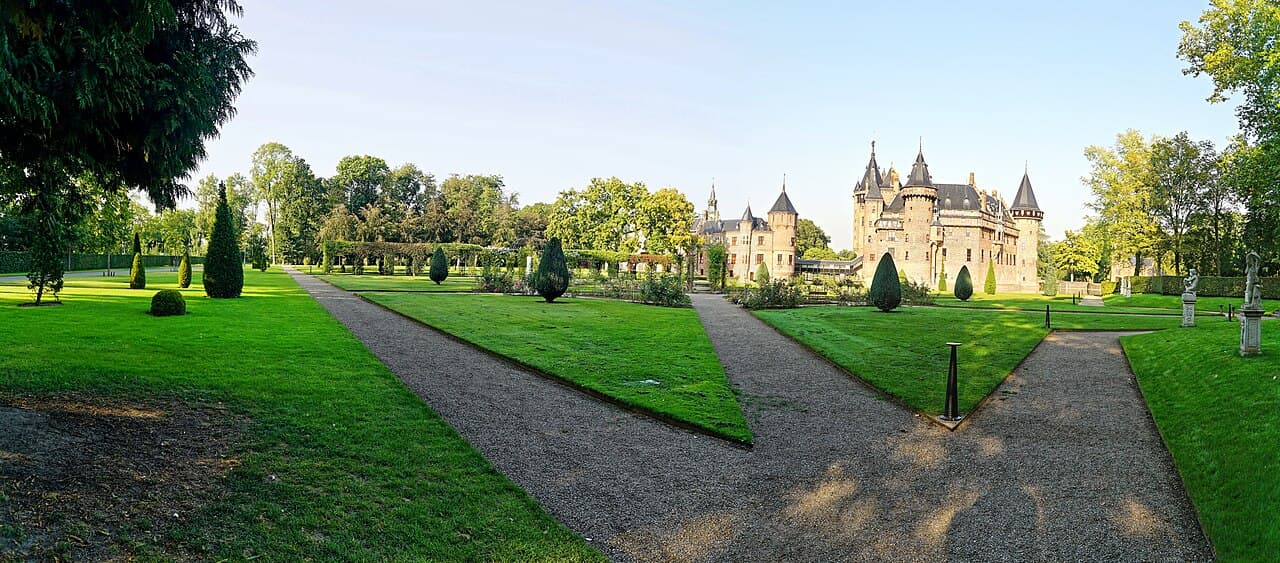
De Haar Castle
De Haar Castle, locally known as Kasteel de Haar, is a striking example of neo-Gothic architecture and the largest castle in the Netherlands. Situated near the village of Haarzuilens in the province of Utrecht, this castle blends the romantic vision of the late 19th and early 20th centuries with the medieval heritage of the original fortress founded in the 14th century.
The site of De Haar Castle has a rich history dating back to its first mention in 1391. Originally built by the Van de Haar family, who held a prestigious position as manservants to the Prince-bishop of Utrecht, the castle served as a fortified residence. The exact appearance of the initial structure is unknown, but it was likely a modest fortified manor. In 1449, the castle passed through marriage to the Van Zuylen family, who would own it for centuries.
The castle suffered destruction in 1482 during conflicts between the bishop and the city of Utrecht, leading to a reconstruction that gave it a distinctive pentagonal shape with heavy round towers at two corners and smaller towers elsewhere. This medieval fortress was moated and included living quarters arranged around a central courtyard. Over the following centuries, the castle endured damage, notably during the French incursions in 1672-1673, and gradually fell into ruin by the 18th century.
Rebirth as a neo-Gothic masterpiece
The dramatic transformation of De Haar Castle began in 1892 when Baron Etienne van Zuylen van Nijevelt inherited the dilapidated ruins. His marriage to Baroness Helene de Rothschild, heiress of the wealthy Rothschild family, provided the financial means to rebuild the castle on a grand scale. The project was entrusted to the eminent Dutch architect Pierre Cuypers, renowned for designing the Rijksmuseum and Amsterdam Central Station.
Cuypers undertook a neo-Gothic restoration that lasted until 1912, carefully following the original castle's foundations while introducing his own idealized medieval elements. The resulting castle features towers, ramparts, moats, gates, and drawbridges, creating a fairy-tale fortress that captures the imagination. The castle contains approximately 200 rooms and 30 bathrooms, equipped with cutting-edge technology for the time, including electric lighting powered by its own generator and central heating.
Architectural and interior highlights
Exterior features
The castle's layout preserves the pentagonal shape of the medieval fortress, with massive round towers and square gate towers guarding the entrance. The moat surrounds the castle, accessed by drawbridges that enhance its defensive appearance. Cuypers distinguished the new construction from the old by using different brick types, making the historic walls visible alongside the neo-Gothic additions.
Interior design and decoration
The interiors are lavishly decorated with richly ornamented woodcarvings reminiscent of Roman Catholic church art, crafted in Cuypers' workshop in Roermond. The castle houses an eclectic collection of valuable antiques collected by the Van Zuylen and Rothschild families, including exquisite porcelain from Japan and China, Flemish tapestries, and religious paintings.
A notable highlight is the 18th-century Japanese palanquin that belonged to the wife of a Shogun, one of only two such palanquins in the world, attracting visitors from Japan and beyond. The Main Hall impresses with an 18-meter-high wooden vault that combines elements of a Gothic cathedral with the grandeur of a luxury hotel lobby.
The Dining Room preserves a century-old tradition where guests dine at the same table in a setting that reflects aristocratic splendor. The Knights' Hall welcomes visitors with its imposing atmosphere and heraldic decorations, including symbols of the Rothschild family, such as the Star of David and family motto.
Surrounding park and village relocation
The castle is set within an extensive park designed by landscape architect Hendrik Copijn. To create this grand landscape, the entire village of Haarzuilens was relocated about 1.5 kilometers away in the late 19th century, preserving only the village chapel, which was integrated into the park. Remarkably, 7,000 mature trees were transported from across Utrecht province to establish the park swiftly.
The park features formal gardens inspired by the gardens of Versailles, complete with waterworks and meticulously planned landscaping. Although the gardens suffered damage during World War II due to wartime hardships, they have since been restored to their former glory.
Historical significance and current use
De Haar Castle stands as a symbol of aristocratic heritage and architectural revivalism. It represents the ambitions of the Van Zuylen family and the Rothschilds to preserve and celebrate their lineage through a monumental structure. The castle is now a popular museum and tourist attraction, offering guided tours that showcase its rich history, luxurious interiors, and remarkable collections.
While the castle is open to the public for most of the year, it remains a private residence for the Van Zuylen van Nijevelt family during September. Its blend of medieval foundations and neo-Gothic grandeur makes it a unique destination for those interested in castle architecture, European aristocracy, and cultural heritage.
Visitors to De Haar Castle can explore its moats, towers, halls, and courtyards, gaining insight into both its medieval origins and its 19th-century rebirth. The castle's story exemplifies how historical preservation can be combined with artistic vision to create a living monument that continues to captivate audiences.
Frequently asked questions (FAQ)
- When was De Haar Castle originally built?
- De Haar Castle was originally founded in the 14th century, with the first historical mention dating to 1391.
- Who was responsible for the neo-Gothic restoration of De Haar Castle?
- The famous Dutch architect Pierre Cuypers led the neo-Gothic restoration from 1892 to 1912, commissioned by Baron Etienne van Zuylen van Nijevelt.
- Can visitors tour the interior of De Haar Castle?
- Yes, guided tours are available daily, showcasing the castle's luxurious interiors, historic rooms, and unique collections.
- Is De Haar Castle still a private residence?
- The castle is privately inhabited by the Van Zuylen van Nijevelt family during September each year; otherwise, it operates as a museum.
- What makes the castle's park unique?
- The park was created by relocating an entire village and transporting 7,000 mature trees, designed in a style reminiscent of Versailles gardens.
Photo gallery

Information
Opening hours
10:00-17:00, daily
Ticket prices
€15 adult, €10 child
Architect
Pierre Cuypers
Current owner
Van Zuylen van Nijevelt family
Website
Visit websiteAddress
Kasteellaan 1, Netherlands
Sources & official resources
Verify the information above using these authoritative references.
Loading map...
Visitor reviews
No reviews yet. Been here? Write the first review and help other travelers!
Write the first reviewVisited this castle? Share your experience
Your review helps other travelers and adds first-hand knowledge to our encyclopedia.


