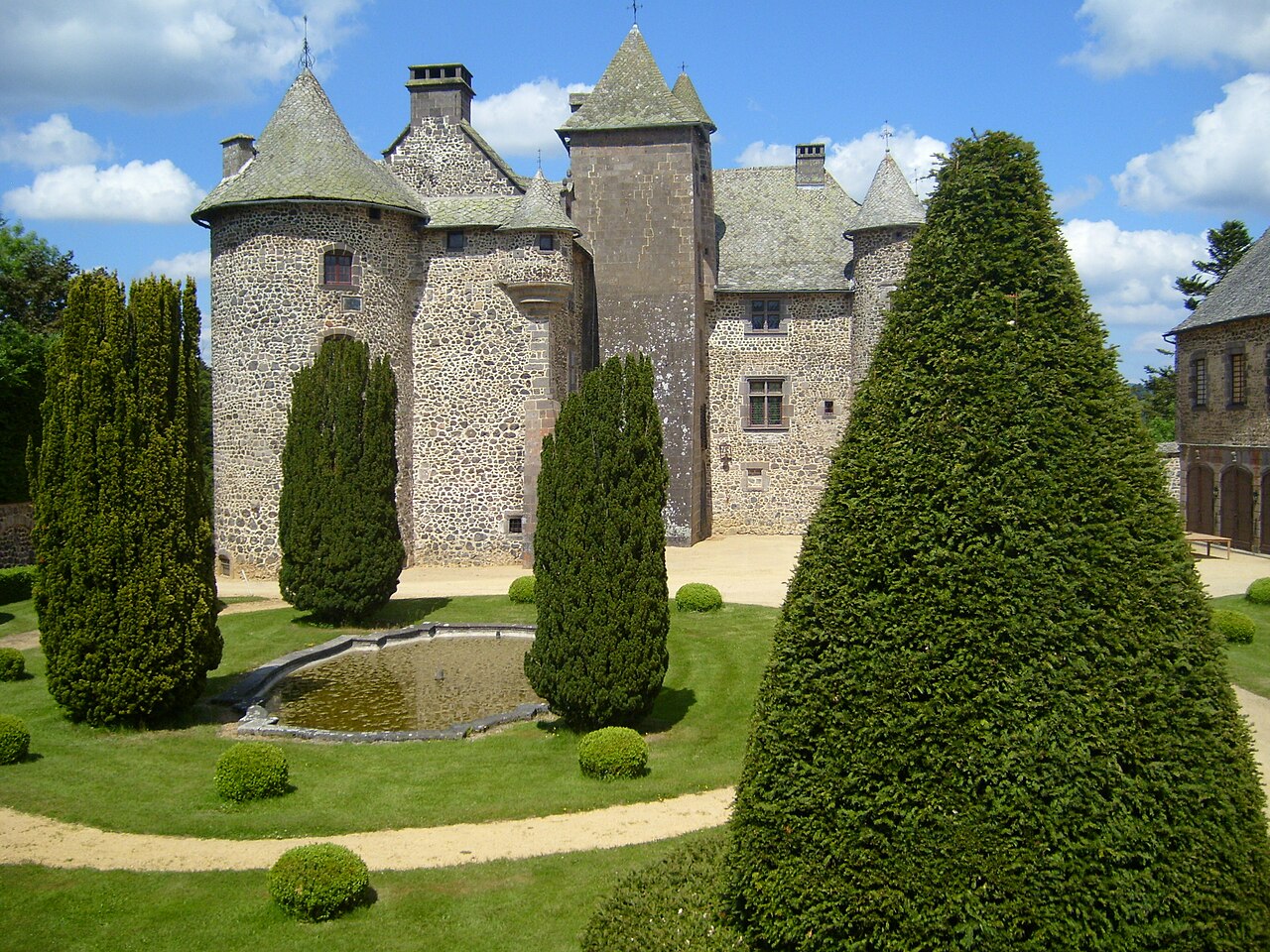
Dauphin Castle
Dauphin Castle, locally known as Château Dauphin, is a remarkable medieval fortress located in the village of Pontgibaud, within the Auvergne region of central France. Founded in 1190 by Robert I, Count of Auvergne, also called Robert Dauphin for the dolphin emblem on his coat of arms, the castle was strategically positioned to defend a vital bridge over the river Sioule. Built primarily from volcanic rock, the castle's origins reflect the typical high medieval fortification style, designed to control important transit routes and assert noble power in the region.
Early history and foundation
The establishment of Dauphin Castle in the late 12th century coincides with a period of territorial consolidation and feudal conflict in medieval France. Robert I, bearing the honorific title "Dauphin," constructed the fortress to secure his domain and protect the crossing over the Sioule River. The castle's name directly derives from his heraldic dolphin, symbolizing his lineage and authority.
In 1213, the castle was seized by forces loyal to Philip II of France, specifically under the command of Archambaud de Bourbon, as part of a regional conflict involving the bishopric of Clermont. This military action integrated Dauphin Castle more closely into the royal domain. By 1229, the castle was restored to its original owners under the regency of Blanche of Castile, with the condition it no longer harbored enemies of the crown, marking its political significance within the kingdom.
Fifteenth-century reconstruction and military enhancements
The 15th century was a pivotal era for Dauphin Castle, marked by extensive reconstruction and fortification under Gilbert III Motier de La Fayette, a notable Marshal of France and lord of Pontgibaud. Having fought alongside Joan of Arc during the Hundred Years' War, Gilbert La Fayette received royal permission from King Charles VII in 1438 to enlarge the castle's defenses.
His renovations included the enlargement of the castle's square keep and the strengthening of its curtain walls, culminating in a formidable fortress with seven towers arranged in a rectangular enclosure. These enhancements reflected the evolving military architecture of the late medieval period, designed to withstand artillery and prolonged sieges.
Sixteenth and seventeenth centuries: decline and transformation
During the turbulent French Wars of Religion in the 16th century, Dauphin Castle was captured in 1566 by Matthieu Merle, a Huguenot captain, underscoring its strategic importance. By the early 17th century, the castle's medieval keep was deemed uncomfortable and outdated by its owners, the Daillon family. Consequently, a new residence known as the "Louis XIII Castle" was constructed in front of the original fortress, leading to the demolition of one of the seven towers and parts of the curtain wall to accommodate this addition.
The keep was repurposed for agricultural use, signaling a decline in its military function. However, the Daillon family's rise in prominence led them to abandon the castle in favor of the royal court at Versailles, further diminishing the site's significance as a noble residence.
Eighteenth and nineteenth centuries: restoration and modern use
In 1756, the castle was acquired by César I de Moré, a King's musketeer, whose family has maintained ownership ever since. The French Revolution inflicted considerable damage on the castle, with ransacking and confiscation as national property. Despite this, the Moré family regained possession and undertook significant restoration efforts between 1886 and 1891 under the direction of architect Jean-Bélisaire Moreau, a disciple of the renowned restorer Viollet-le-Duc.
This restoration made the keep habitable once more and involved the demolition of the 17th-century Louis XIII residence in 1897. The castle was modernized with 19th-century amenities, including electricity generated by a hydraulic turbine on the Sioule River and running hot and cold water, reflecting a blend of medieval heritage and modern comfort.
Architectural features and layout
Dauphin Castle is distinguished by its double keep design, consisting of a large square tower and an adjoining round tower at one corner. These two keeps are structurally independent and rest on solid bedrock, emphasizing the fortress's robust construction. The square keep, approximately 22 by 25 meters, originally enclosed an open courtyard, which was later covered with a glass canopy in the 19th century.
The round keep contains a heavily fortified lower chamber known as a cul de basse-fosse, likely used as a prison, with walls nearly four meters thick. The castle's defensive curtain wall originally enclosed the lower courtyard and connected seven towers, six of which remain today. The seventh tower, Clapiers, is undergoing restoration due to structural damage.
The estate encompasses about 45 hectares of wooded parkland, cultivated fields, and meadows, although historically it extended to roughly 3,000 hectares in the 18th century. The castle's kitchen garden, documented since the 16th century and remodeled in the 18th, features terraced levels with straight intersecting paths and retaining walls made from trachyandesite lava stone, which aids in heat retention for plant growth. Water features include 18th-century fountains fed by a distant spring, with overflow channels designed to maintain ambient temperatures for irrigation.
Interior decoration and cultural heritage
Inside, Dauphin Castle boasts several rooms decorated with 19th-century artistic work. A large salon features frescoes by Italian painter Maioli and a local artist, complemented by oak paneling crafted by Martin and ironwork by Larchevêveque. Other notable interiors include a dining room with oak paneling, a vaulted library with a painted ceiling, a chamber of honor adorned with wood and fabric from Riom, and a chapel decorated by Maioli.
The castle also houses a museum dedicated to the region's silver mining heritage, reflecting the area's long history of mining dating back to Roman times. Mining activity peaked between 1853 and 1897, producing significant quantities of lead and silver, and the museum preserves this industrial legacy alongside the castle's medieval and early modern history.
Current status and visitor information
Today, Dauphin Castle remains the private residence of the descendants of César I de Moré, specifically the Count and Countess Gabriel de Germiny. Visitors can explore the castle grounds, gardens, and museum, with guided tours available for the castle's interior, which includes two rooms on the ground floor. The rest of the castle and its extensive gardens are accessible for self-guided visits, offering a rich experience of medieval architecture, historical evolution, and cultural heritage in the heart of France.
As a classified historic monument since 1995, Dauphin Castle stands as a testament to the layered history of French nobility, military architecture, and regional identity, making it a significant destination for enthusiasts of medieval castles and French history alike.
Frequently asked questions (FAQ)
- What is the historical significance of Dauphin Castle?
- Dauphin Castle, located in Pontgibaud, France, dates back to the 14th century and played a crucial role in the region's defense during the Middle Ages. It served as a stronghold for local lords and reflects the architectural styles and military strategies of its time.
- When was Dauphin Castle built?
- Construction of Dauphin Castle began in the early 14th century, with significant developments occurring over the years. The castle's architecture showcases the evolving designs of fortifications during the medieval period, making it a fascinating site for history enthusiasts.
- Can I visit Dauphin Castle?
- Yes, Dauphin Castle is open to visitors, offering guided tours that delve into its rich history and architectural features. Be sure to check the official website for any updates on visiting hours and special events.
- What are the opening hours of Dauphin Castle?
- Dauphin Castle typically opens to the public from 10 AM to 6 PM during the summer months, with shorter hours in winter. It's advisable to verify the current schedule before planning your visit, as hours may vary seasonally.
- Is it possible to access Dauphin Castle with limited mobility?
- While Dauphin Castle is a historical site and some areas may present challenges for those with limited mobility, efforts have been made to improve accessibility. Visitors should contact the castle management in advance to inquire about specific accommodations available during their visit.
- What is the best time to visit Dauphin Castle?
- The best time to visit Dauphin Castle is during the spring and early autumn when the weather is mild and the surrounding landscape is vibrant. Additionally, visiting during these seasons may allow you to avoid the peak tourist crowds.
- Are there any nearby attractions to Dauphin Castle?
- Yes, there are several nearby attractions, including the picturesque village of Pontgibaud and the stunning natural landscapes of the Auvergne region. Visitors can also explore local museums and historical sites that enhance the cultural experience of the area.
- What are the ticket prices for Dauphin Castle?
- Ticket prices for Dauphin Castle are generally affordable, with discounts available for students, seniors, and children. Check the official website for the latest pricing information and any special offers that may be available during your visit.
Information
Website
Visit websiteSources & official resources
Verify the information above using these authoritative references.
Loading map...
Visitor reviews
No reviews yet. Been here? Write the first review and help other travelers!
Write the first reviewVisited this castle? Share your experience
Your review helps other travelers and adds first-hand knowledge to our encyclopedia.