Daorson
Daorson served as the capital of the Illyrian tribe known as the Daorsi, who inhabited the valley of the Neretva River between approximately 300 BC and 50 BC. This ancient settlement is notable for its early and significant contact with Greek traders, which led to a considerable degree of Hellenization in its culture and urban development. The Daorsi adopted many aspects of Greek civilization, including architectural styles, coinage, and trade practices, reflecting the cultural exchange that occurred in this region during the Hellenistic period.
The site of Daorson is located near the modern village of Ošanjići, close to the town of Stolac in Bosnia and Herzegovina. Today, it stands as an archaeological ruin that offers valuable insights into Illyrian urbanism and their interactions with Mediterranean cultures. The remains reveal a fortified settlement with remnants of defensive walls, towers, and terraces that illustrate the town's strategic importance and sophisticated construction techniques.
Historical significance and cultural context
The Daorsi were among the Illyrian tribes who played a crucial role in the geopolitics of the western Balkans during the late Iron Age and early Classical Antiquity. Their location in the fertile Neretva valley allowed them to control important trade routes connecting the Adriatic coast with the interior Balkans. The peace treaty they signed with Rome in 168/167 BC marked a turning point, after which they gained the right to mint their own coins, symbolizing a degree of autonomy and economic development.
Daorson's coinage often featured Greek motifs and inscriptions, underscoring the strong Hellenistic influence on the Daorsi society. This cultural blend is also evident in the town's urban plan and architectural elements, which combine native Illyrian traditions with imported Greek styles.
Architectural features and urban layout
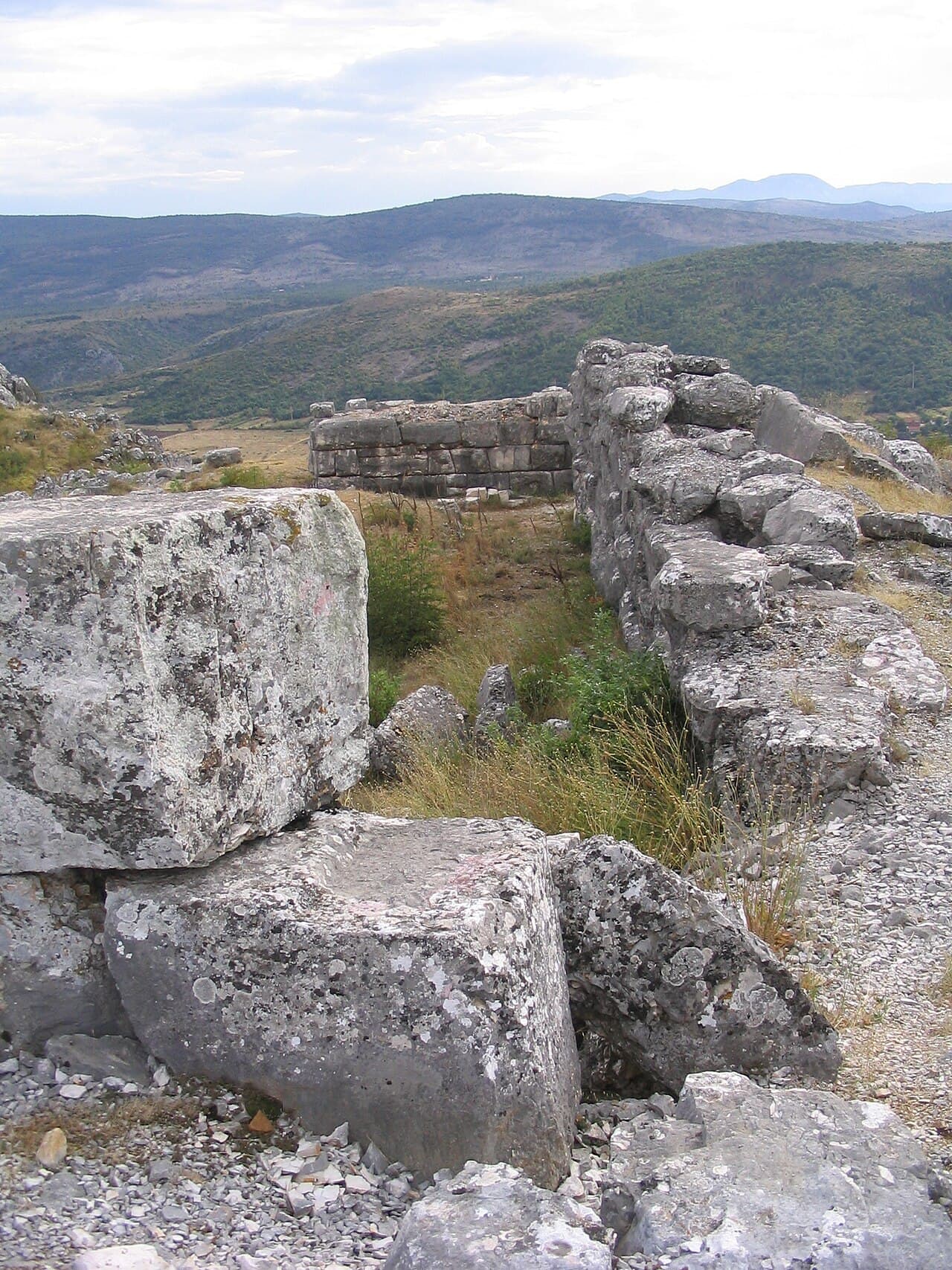
The archaeological remains of Daorson reveal a fortified settlement characterized by massive cyclopean walls constructed from large, unworked limestone blocks. These walls, typical of Illyrian fortifications, were designed to protect the city from invasions and raids. The fortifications include bastions and towers positioned strategically along the walls to enhance defense.
Inside the walls, the urban layout suggests a well-organized settlement with terraced construction adapted to the hilly terrain. The terraces supported residential buildings, public spaces, and possibly sanctuaries. Although much of the superstructure has not survived, the foundations and wall bases indicate the use of both native building techniques and Hellenistic architectural influences.
Defensive structures
The defensive system of Daorson is one of its most remarkable features. The cyclopean masonry walls, some reaching up to several meters in thickness, were constructed without mortar, relying on the precise fitting of massive stones. This technique provided durability and resistance against siege weapons of the period.
Additional fortifications included towers that allowed defenders to monitor approaches and repel attackers effectively. The positioning of these towers and the layout of the walls demonstrate an advanced understanding of military architecture for the time.
Urban and religious structures
Excavations have uncovered evidence of public buildings and religious sanctuaries within Daorson. The presence of Greek-style temples or shrines indicates the religious syncretism that occurred due to Hellenization. These structures likely served as focal points for civic and religious life, reinforcing the town's cultural identity.
Archaeological research and preservation
Daorson has been the subject of archaeological interest since the 19th century, with systematic excavations revealing its extensive fortifications and urban remains. The site provides crucial information about Illyrian civilization, their interactions with Greek culture, and the broader dynamics of the ancient Balkans.
Today, Daorson is classified as an archaeological ruin in a state of ruins. Conservation efforts focus on stabilizing the remaining structures and protecting the site from natural and human threats. Visitors to the site can observe the impressive cyclopean walls and explore the terraces that once formed the urban fabric of this ancient capital.
Visiting Daorson and cultural importance
Located near Stolac, Daorson is accessible to visitors interested in ancient history and archaeology. The site offers a glimpse into the life of the Illyrian tribes and their cultural exchanges with the Mediterranean world. Its well-preserved defensive walls and archaeological remains make it a significant heritage site in Bosnia and Herzegovina.
Daorson contributes to understanding the complexity of Illyrian societies and their role in the historical development of the Balkans. It remains an important destination for scholars and tourists alike, highlighting the rich cultural tapestry of the region during antiquity.
Frequently asked questions (FAQ)
- Where is Daorson located?
- Daorson is located near the village of Ošanjići, close to Stolac in the Herzegovina-Neretva Canton of Bosnia and Herzegovina.
- What is the historical significance of Daorson?
- Daorson was the capital of the Illyrian tribe Daorsi, known for its early contact with Greek traders and Hellenization during 300-50 BC.
- What remains can be seen at Daorson today?
- Visitors can see the remains of massive cyclopean walls, defensive towers, terraces, and foundations of public and religious buildings.
- Is Daorson accessible to tourists?
- Yes, Daorson is accessible to visitors interested in archaeology and ancient history, offering a unique insight into Illyrian civilization.

Information
Loading map...
Visitor reviews
No reviews yet. Been here? Write the first review and help other travelers!
Write the first reviewVisited this castle? Share your experience
Your review helps other travelers and adds first-hand knowledge to our encyclopedia.