Dankwarderode Castle
Dankwarderode Castle stands as a prominent medieval fortress located on a natural island formed by the Oker River within the historic city of Braunschweig, Germany. This hill castle holds a significant place in the region’s history, originally established by the Brunonen dynasty in the 11th century as a Saxon lowland fortification. Its strategic location and architectural grandeur reflect the political and cultural importance it held during the High Medieval period.
The earliest documented mention of the site appears in 1134 under the name castrum Tanquarderoth, confirming its role as a fortified settlement. Between 1160 and 1175, Duke Henry the Lion, one of the most influential rulers of the Welf dynasty, initiated a comprehensive reconstruction that transformed the castle into a large palatinate residence. This phase introduced a remarkable two-story palas featuring a double chapel inspired by the imperial palace at Goslar, illustrating the close ties between ducal authority and ecclesiastical power. The upper floor of the palas was uniquely connected to the north transept of Braunschweig Cathedral, which was under construction from 1173, emphasizing the castle’s religious and political significance.
Architectural features and medieval design
The castle originally occupied the entire island area bounded by present-day Münzstraße, Vieweghaus, Ruhfäutchenplatz, and Domplatz, underscoring its extensive size and defensive capabilities. Its fortifications replaced earlier earthworks with substantial stone walls, enclosing a fortified enclosure approximately 140 by 120 meters in dimension. The palas, measuring about 42 meters in length and 15 meters in width, remains the most significant surviving structure, showcasing Romanesque architectural elements such as original windows in the basement arcade and the rear wall facing Münzstraße.
A distinctive feature of the palas is its hypocaust underfloor heating system, a sophisticated technology borrowed from Roman designs and also found in the Goslar palace. This system circulated warm air beneath the floors, providing comfort uncommon in medieval residences. The double chapel within the palas, dedicated to St. George and St. Gertrude, highlights the integration of religious functions into the ducal residence, a rare architectural innovation of the time.
Defensive and residential structures
Dankwarderode Castle was initially surrounded by a moat fed by the Oker River, enhancing its defensive posture. This moat remained intact until 1798, when urban development led to its infill and conversion into underground channels. The castle’s walls, once formidable, were dismantled in the late 16th century as its military relevance waned due to the city’s expansion and changes in warfare technology.
The two-story hall building within the palas comprises the Knappensaal (Knights’ Hall) on the ground floor and the Rittersaal (Knight’s Hall) above. The Rittersaal underwent a historicist restoration in the late 19th and early 20th centuries, featuring interior paintings by Adolf Quensen that evoke medieval styles rather than preserving original medieval decoration. Adjacent rooms include unique features such as two open fireplaces supported by columns made of rare aqueduct marble, underscoring the castle’s luxurious appointments.
Historical events and transformations
Dankwarderode Castle’s history is marked by significant events, including a devastating fire in 1252 that damaged both the castle and much of Braunschweig’s old town. Despite this, the castle continued to serve as the ducal residence until 1282, when the court moved to Wolfenbüttel following the division of the Duchy of Brunswick. The castle then passed into joint ownership of the Welf ducal lines but gradually lost its military and residential functions as the city grew around it.
In the early 16th century, the palas suffered another fire, and due to political disputes and financial constraints among the dukes, it was not fully restored at that time. The 17th century saw a Renaissance-style rebuilding and southern extension of the palas between 1616 and 1640, reflecting changing architectural tastes and the castle’s evolving role. Later modifications included the demolition of the castle chapel dedicated to St. George and St. Gertrude after a fire at the end of the 17th century.
19th and 20th-century restoration efforts
By the 19th century, the castle had been repurposed for military use, serving as barracks from 1808 onwards. A fire in 1873 caused severe damage, prompting plans for demolition to make way for urban infrastructure. Public opposition led to the city purchasing the ruins in 1878, with state support, to preserve this important heritage site.
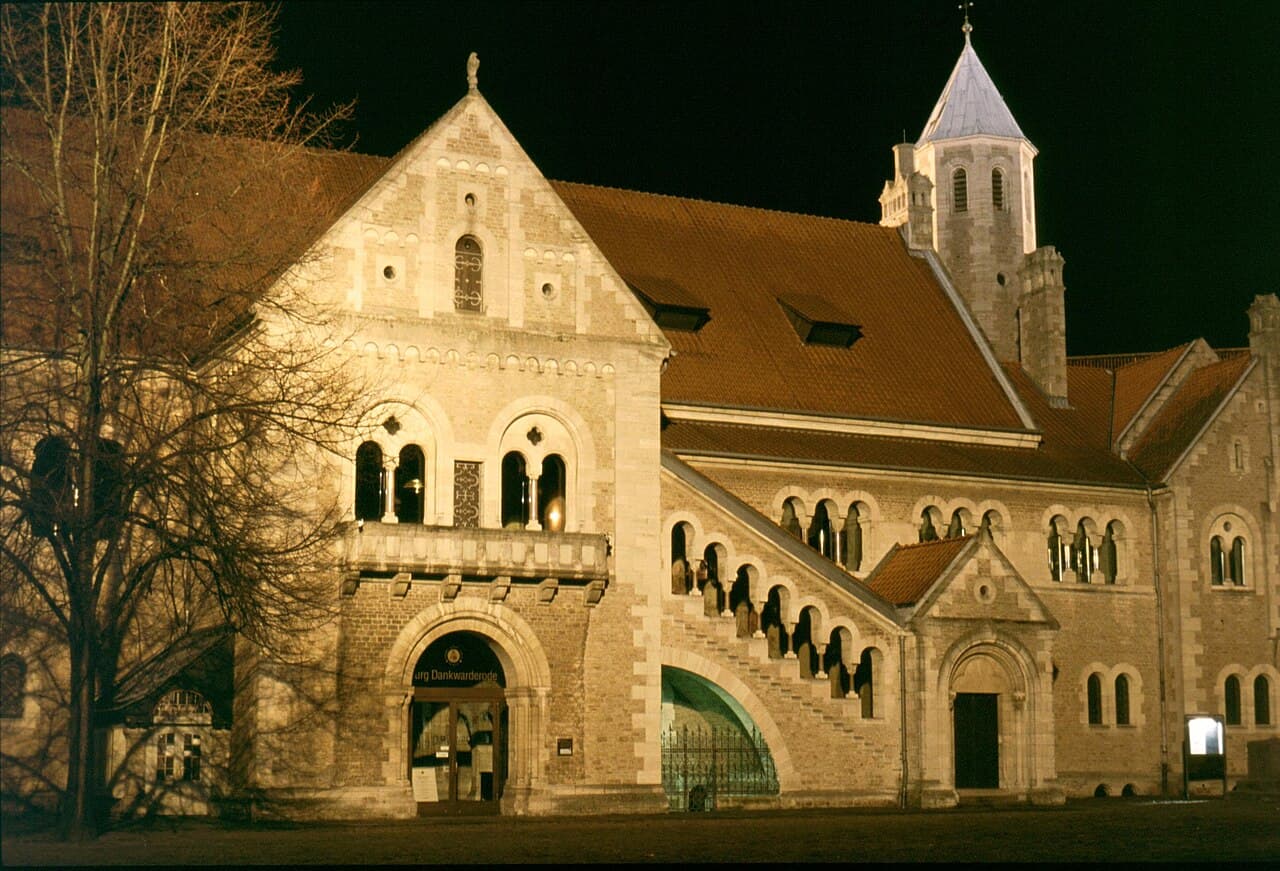
Between 1887 and 1906, city architect Ludwig Winter led a major restoration project that reconstructed the palas in a neo-Romanesque style. This restoration was informed by archaeological research and aimed to preserve medieval elements while incorporating historically inspired additions. The façade facing Burgplatz is a notable outcome of this work, blending authentic medieval features with 19th-century historicism.
During World War II, the castle sustained heavy damage from bombing, which destroyed the roof and the historicist interior paintings. Postwar repairs were pragmatic and focused on structural stability rather than aesthetic restoration. The ground floor’s former Knights’ Hall has housed a medieval collection from the Herzog Anton Ulrich Museum since 1963, including the famous 12th-century Braunschweig Lion sculpture and Emperor Otto IV’s imperial mantle.
The upper-level Rittersaal was carefully restored in the early 1990s, with paintings recreated in a medieval style to enhance its historic ambiance. Today, this hall is used for special events and exhibitions, although it is generally closed to daily visitors, preserving its delicate restoration.
Cultural significance and visitor experience
Dankwarderode Castle remains a key cultural monument in Braunschweig, representing a layered history that spans from the High Middle Ages through Renaissance modifications to 19th-century historicism. Its architectural features, such as the double chapel, hypocaust heating system, and connection to Braunschweig Cathedral, make it a unique example of medieval ducal residences in northern Germany.
Visitors to the castle can explore the ground floor exhibition that showcases medieval artifacts and learn about the castle’s role in regional history. While the upper halls are not regularly open, special events provide rare opportunities to experience the restored medieval interiors. The castle’s location on the Oker River island also offers picturesque views and a tangible connection to Braunschweig’s medieval urban landscape.
Dankwarderode Castle’s preservation and restoration efforts highlight the importance of protecting historical structures that embody the complex interplay of military, residential, and religious functions. Its enduring presence enriches Braunschweig’s cultural heritage and provides valuable insights into medieval architecture and noble life.
Frequently asked questions (FAQ)
- How do I get to Dankwarderode Castle?
- Dankwarderode Castle is located in the heart of Braunschweig, Germany. You can easily reach it by public transport, with several bus and tram lines stopping nearby. If you prefer driving, there are parking facilities available within walking distance of the castle.
- What is the historical significance of Dankwarderode Castle?
- Dankwarderode Castle dates back to the 11th century and is a significant example of medieval architecture in Germany. It served as a residence for the Dukes of Braunschweig and has been a symbol of the city's power and heritage. The castle now houses a museum that showcases its rich history and the region's cultural heritage.
- When was Dankwarderode Castle constructed?
- The construction of Dankwarderode Castle began in the early 11th century, making it one of the oldest structures in Braunschweig. Over the centuries, it underwent various renovations and expansions, particularly in the Gothic style. Today, visitors can appreciate its architectural evolution through the different styles represented in its structure.
- Can I visit the museum inside Dankwarderode Castle?
- Yes, the castle features a museum that is open to visitors throughout the year. The museum includes exhibits on the castle's history, medieval artifacts, and the history of Braunschweig. Be sure to check the museum's schedule for any special exhibits or events during your visit.
- Why is Dankwarderode Castle a popular tourist attraction?
- Dankwarderode Castle is popular for its stunning architecture and rich history, making it a must-visit for history enthusiasts and tourists alike. Its picturesque setting and well-preserved structures offer visitors a glimpse into the medieval past. Additionally, the castle's location within Braunschweig allows easy access to other local attractions.
- Is it possible to take guided tours of Dankwarderode Castle?
- Yes, guided tours are available at Dankwarderode Castle, providing an in-depth look at its history and architecture. These tours are led by knowledgeable guides who can share fascinating stories and insights about the castle. It is advisable to book your tour in advance, especially during peak tourist seasons.
- What are the opening hours of Dankwarderode Castle?
- Dankwarderode Castle is typically open from 10 AM to 6 PM, but hours may vary on holidays or special occasions. It is recommended to check the official website for the most current opening hours before your visit. Arriving early in the day can help you avoid crowds and enjoy a more leisurely experience.
- What are the ticket prices for visiting Dankwarderode Castle?
- Ticket prices for Dankwarderode Castle are generally affordable, with discounts available for students, seniors, and children. Admission fees help support the maintenance of the castle and its museum. Check the castle's official website for the latest pricing and any special offers.
- What is the best time to visit Dankwarderode Castle?
- The best time to visit Dankwarderode Castle is during the spring and early autumn months when the weather is mild and pleasant. These seasons also see fewer tourists, allowing for a more enjoyable experience. Summer can be busy, but it also offers special events and activities for visitors.
- Are there any nearby attractions to visit after Dankwarderode Castle?
- Yes, there are several nearby attractions worth exploring after your visit to Dankwarderode Castle. The historic city center of Braunschweig is just a short walk away, featuring beautiful architecture and charming shops. Additionally, you can visit the Brunswick Cathedral and the Happy Rizzi House for more cultural experiences.
Photo gallery

Photo by No machine-readable author provided. Mprinke assumed (based on copyright claims).•CC BY-SA 2.5
Information
Website
Visit websiteSources & official resources
Verify the information above using these authoritative references.
Loading map...
Visitor reviews
No reviews yet. Been here? Write the first review and help other travelers!
Write the first reviewVisited this castle? Share your experience
Your review helps other travelers and adds first-hand knowledge to our encyclopedia.