Damascus Citadel
Damascus Citadel, locally known as Qalaat Dimashq, is a monumental fortified complex situated in the heart of Damascus, Syria. This historic fortress stands as a testament to the city's strategic and military significance throughout the medieval period and beyond. Its origins date back to at least the 10th century, with earlier fortifications possibly established during the Roman era under Emperor Diocletian (284-305 AD), though those earlier structures had vanished by the 10th century. The citadel's enduring presence reflects centuries of architectural evolution, military innovation, and shifting political power in the region.
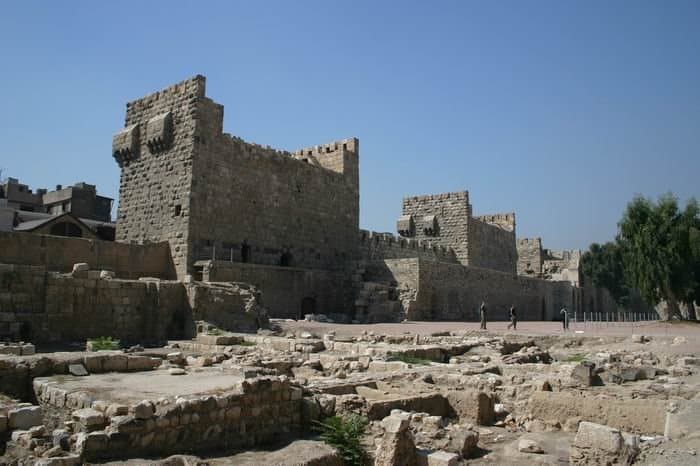
The citadel occupies a roughly rectangular plan on flat terrain within the old city, uniquely positioned at the same level as the surrounding urban fabric rather than atop a hill, which is uncommon for fortifications in Syria. It is bordered by the historic city gates of Bab al-Faradis and Bab al-Jabiyah, and was originally encircled by a wide moat fed by the Barada River. Over time, the moat was filled in during the Ottoman period, and urban development has encroached upon parts of the fortress, particularly along its southern walls.
Early history and seljuk foundation
The first significant construction of the citadel as it is known today began in 1076, initiated by the Seljuk Turkman warlord Atsiz ibn Uwak, who sought to consolidate power in Damascus. Following his assassination in 1078, the Seljuk ruler Tutush I, brother of Sultan Malik Shah I, completed the initial fortifications before his death in 1095. His son Duqaq continued to enhance the citadel, which endured a siege in 1096 by his brother Radwan but was not captured. The citadel's early fortifications reflect Seljuk military architecture, emphasizing robust walls and strategic towers to control access and defend against both internal rivals and external threats.
Burid and ayyubid enhancements
During the 12th century, the citadel underwent significant modifications under the Burid dynasty (1104-1154), who faced repeated attacks from Crusader and Muslim armies. Defensive upgrades were made to strengthen the fortress against these threats. In 1154, the powerful Zengid ruler Nur ad-Din Zengi captured Damascus and took residence in the citadel. He is credited with rebuilding residential quarters and possibly reinforcing the fortifications to meet the era's evolving military challenges.
Following Nur ad-Din's death in 1174, Saladin seized Damascus and made the citadel his residence. Saladin's tenure marked a period of further architectural development, including the addition of a new tower and refurbishment of the residential buildings. The citadel became a symbol of Ayyubid power and resilience during a time of regional conflict and Crusader incursions.
The rebuilding by al-adil
Between 1203 and 1216, Saladin's brother Al-Adil undertook a comprehensive reconstruction of the citadel, adapting it to withstand new siege technologies such as the counterweight trebuchet. This reconstruction involved strengthening walls, enlarging towers, and incorporating platforms designed to accommodate these powerful siege engines. The fortifications from this period are among the most significant surviving elements, showcasing advanced medieval military engineering.
Mamluk and mongol periods
In 1260, the Mongols under Hulagu Khan captured Damascus and severely damaged the citadel, dismantling much of its defensive works. However, the Mongol occupation was short-lived, as the Mamluk Sultanate under Sultan Qutuz expelled them later that year. Sultan Baibars, Qutuz's successor, undertook extensive rebuilding efforts, restoring and enhancing the citadel's fortifications.
The citadel faced further Mongol sieges around 1300 and again in 1401 under the infamous conqueror Timur. Each time, the fortress suffered damage but was rebuilt under Mamluk rule. The Mamluks also introduced architectural innovations such as the Blue Dome, notable for being the first Syrian structure adorned with colored tiles, reflecting a blend of military and aesthetic considerations.
Ottoman era to modern times
In 1516, the Ottoman Empire peacefully took control of Damascus and the citadel, marking a new chapter in its history. The fortress served various military and administrative functions over the centuries, including as barracks for Janissary troops. The citadel suffered damage from earthquakes, notably in 1759, but was repaired under Sultan Mustafa III.
By the 18th and 19th centuries, the citadel's military importance waned, and it was repurposed as a prison and barracks. During the Great Syrian Revolt in 1925, French colonial forces used the citadel to shell the city. It remained a military site until 1986, after which extensive archaeological excavations and restoration projects began, led by Syrian, French, and Italian teams. Today, the citadel is a cultural heritage site and part of the UNESCO World Heritage-listed Ancient City of Damascus.
Architectural features and layout
The citadel covers an irregular rectangular area approximately 230 meters long and 150 meters wide. It is surrounded by thick curtain walls up to 11.5 meters high and 3.65 to 4.9 meters thick, punctuated by thirteen large towers of varying shapes—square, L-shaped, and rectangular—each equipped with machicolations and arrow slits for defense. These towers feature large platforms designed to mount trebuchets, illustrating the adaptation to medieval siege warfare.
The fortress originally had a moat about 20 meters wide, supplied by channels from the Barada River, enhancing its defensive capabilities. Although the moat was filled in during the Ottoman period, its presence is a key aspect of the original design. The citadel's walls enclose vaulted galleries with arrow slits, allowing defenders to move protected while maintaining a line of fire against attackers.
Gates and access points
There are three main gates: the northern Bab al-Hadid (Iron Gate), the eastern gate opening into the city, and the western gate. The northern and eastern gates date from the early 13th century under Al-Adil's rule. The northern gate served primarily military functions and includes vaulted corridors that have been repurposed as a mosque. The eastern gate is architecturally elaborate, featuring a bent passageway, a square tower, a barbican, and a vaulted hall with a rare central dome supported by four columns. The western gate, likely constructed during Sultan Baibars' reign, was damaged in the 1759 earthquake and not rebuilt.
Materials and construction techniques
The citadel's construction utilized locally sourced carbonate rocks and basalt, materials chosen for their durability and availability. The masonry reflects the skilled craftsmanship of Seljuk, Ayyubid, and Mamluk builders, with careful attention to defensive features such as thick walls, machicolations, and arrow slits. The combination of stone types and construction methods contributed to the fortress's resilience against sieges and natural disasters.
Cultural significance and current status
Damascus Citadel stands as a powerful symbol of the city's rich history and cultural heritage. Its layered architectural elements tell the story of centuries of military innovation, political upheaval, and artistic expression. The citadel's integration within the bustling urban environment of Damascus highlights its enduring presence as a landmark and a reminder of the city's strategic importance in the medieval Islamic world.
Currently, the citadel is undergoing ongoing restoration and archaeological excavation efforts aimed at preserving its structures and uncovering further historical insights. While parts of the interior are accessible, the site is primarily valued for its architectural and historical significance rather than as a fully developed tourist attraction. As part of the Ancient City of Damascus, a UNESCO World Heritage Site, it continues to attract scholars, historians, and visitors interested in the complex history of Syria and the broader Middle East.
Frequently asked questions (FAQ)
- What is the historical significance of Damascus Citadel?
- Damascus Citadel is one of the oldest continuously inhabited castles in the world, dating back to the Roman period. It has served as a military fortress and a royal residence throughout various dynasties, reflecting the rich history of Damascus and its strategic importance in the region.
- When was Damascus Citadel built?
- The construction of the Damascus Citadel began in the 12th century, although its origins can be traced back to earlier fortifications, including Roman and Byzantine structures. Over the centuries, it has been modified and expanded, showcasing different architectural styles and influences.
- Can I visit Damascus Citadel?
- Yes, Damascus Citadel is open to the public, allowing visitors to explore its impressive architecture and historical exhibits. It is advisable to check for any specific visiting restrictions or guidelines before planning your trip.
- What are the opening hours of Damascus Citadel?
- Damascus Citadel is typically open from 9:00 AM to 5:00 PM daily, but hours may vary during holidays or special events. It is recommended to verify current hours prior to your visit to ensure you have ample time to explore.
- Is it possible to access Damascus Citadel with mobility challenges?
- While there are some pathways and areas within Damascus Citadel that can be navigated by those with mobility challenges, certain parts of the castle may have steep stairs and uneven surfaces. It is advisable to contact the site in advance to inquire about accessibility options and any available assistance.
- What is the best time to visit Damascus Citadel?
- The best time to visit Damascus Citadel is during the spring (March to May) and autumn (September to November) when the weather is mild and pleasant. These seasons provide an ideal environment for exploring the castle and its surroundings without the extreme heat of summer.
- Are there any nearby attractions to visit after exploring Damascus Citadel?
- Yes, nearby attractions include the Umayyad Mosque, the National Museum of Damascus, and the historic Old City, all of which are rich in culture and history. These sites can easily be added to your itinerary for a more comprehensive experience of Damascus.
- What are the ticket prices for visiting Damascus Citadel?
- Ticket prices for Damascus Citadel are generally affordable, allowing visitors to experience its historical significance without a hefty cost. It is advisable to check the official website or local resources for the most up-to-date pricing information before your visit.
Photo gallery

Photo by Mewes at German Wikipedia•Public domain
Information
Sources & official resources
Verify the information above using these authoritative references.
Loading map...
Visitor reviews
No reviews yet. Been here? Write the first review and help other travelers!
Write the first reviewVisited this castle? Share your experience
Your review helps other travelers and adds first-hand knowledge to our encyclopedia.