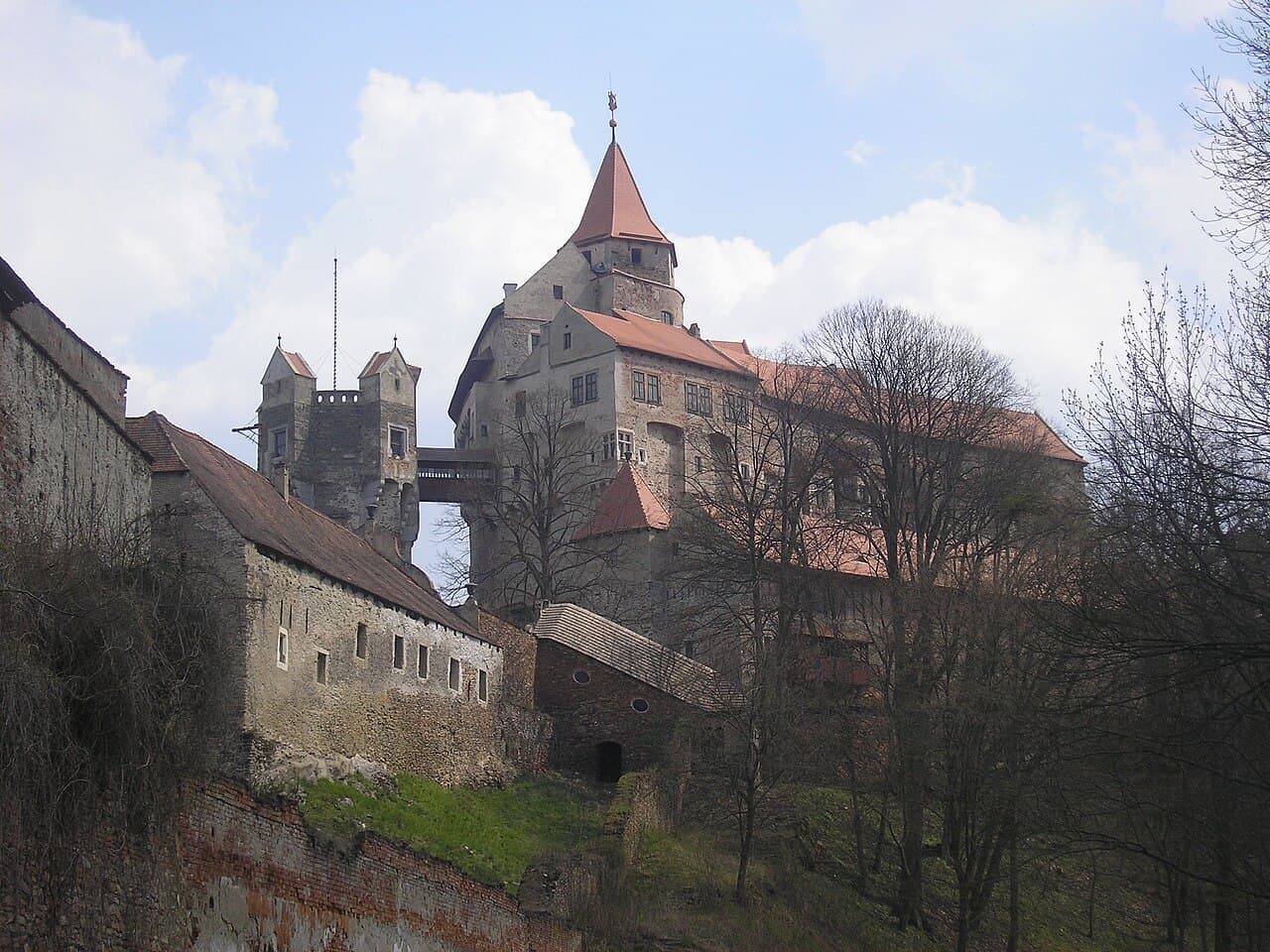
Pernstejn Castle
Pernstejn Castle stands as one of the most remarkable and well-preserved medieval hill castles in the Czech Republic. Known as the "Marble Castle" due to its extensive use of local Nedvědice marble in architectural details, this fortress embodies a unique historical evolution from a simple Gothic stronghold into an elegant Renaissance residence, with later Baroque and Rococo additions. The castle's position on a naturally defensive rocky spur with steep slopes on three sides emphasizes its military origins and strategic importance throughout centuries.
The castle was founded in the late 13th century by the noble Lords of Medlov, whose branch residing here adopted the name Pernštejn, derived from the German "Bärenstein" meaning "Bear Rock." This name reflects the castle's commanding location atop a rocky promontory overlooking the surrounding landscape. The earliest construction phase, dated between 1270 and 1285, established Pernstejn as a typical Gothic fortress designed primarily for defense, with a central bergfrit tower named Barborka Tower as its core defensive element.
Architectural evolution and layout
The original simple plan of the castle was gradually obscured by a series of reconstructions and expansions, especially during the late Gothic and early Renaissance periods. These transformations converted Pernstejn from a purely military fortress into a more comfortable and prestigious noble residence without compromising its defensive capabilities. The castle complex today features five interconnected courtyards surrounded by walls, gates, bastions, and outbuildings, forming a labyrinthine structure optimized for defense and habitation.
Defensive features
The castle's fortifications include multiple layers of protection. The approach to the main gate is narrow and heavily fortified, guarded by a central barbican with three-meter-thick walls. This barbican is equipped with crenellations and a machicolation, allowing defenders to fire upon and drop projectiles on attackers. The castle also has ramparts and moats crossed by several drawbridges, adding further defensive barriers.
Among the gates, a second settlement gate is notable for its Gothic-Renaissance marble portal, showcasing the blend of styles present in the castle. Accessing the third gate requires crossing a Gothic stone bridge leading to a projecting tower, enhancing the castle's layered defense. A semicircular Renaissance bastion guards the northern flank, emphasizing the castle's adaptation to evolving military technology.
Key architectural elements
The Barborka Tower remains a dominant feature, a five-story round bergfrit tower that served as the castle's original core. Other towers include a large mid-15th-century round tower, a Clock Tower accompanied by a Renaissance chapel, and the Tower of Four Seasons, named for its colorful stained glass windows. The castle's upper floors prominently feature jetties, where upper stories extend beyond the ground floor walls on cantilevered supports, a distinctive architectural trait.
Construction materials prominently feature the local Nedvědice marble, especially in door and window frames, which gives the castle its nickname. Inside, the castle retains many historic decorative elements, including the Knights' Hall with Renaissance vaulting and diamond-shaped ribs, Rococo paintings in rooms such as the bedroom and Chinese parlour, and Baroque frescoes in the chapel painted by František Řehoř Ignác Eckstein in 1716.
Historical significance and ownership
The castle was originally established by the Lords of Medlov in the late 13th century and became the seat of the Pernštejn family, who rose to prominence in Bohemia. Two significant figures, William I (1378–1422) and William II (1435–1521), were instrumental in expanding and enhancing the castle, reflecting their political and military power in the region.
During the Thirty Years' War (1618–1648), Pernstejn Castle played an active military role and withstood a Swedish siege in 1645. Although some upper parts were damaged, the castle's strategic importance was reaffirmed, and it remained a regional stronghold until the mid-18th century.
After 1596, ownership transitioned through several noble families, including the Lobkowicz, Stockhammer, and finally the Mitrovský family, who held the castle until the 20th century. The Mitrovský family notably preserved the castle's Gothic-Renaissance character, avoiding the Romantic-style renovations common in the 19th century.
Cultural heritage and preservation
Pernstejn Castle has been recognized as a national cultural monument since 1995, reflecting its outstanding historical and architectural value. Archaeological excavations have uncovered numerous inscriptions and paintings from the mid-16th century in Czech, German, and Latin, providing valuable insights into the castle's social and cultural life during the Renaissance.
The castle grounds also feature an ancient yew tree with a trunk circumference of about 4.5 meters. This tree is entwined with local foundation legends, adding a symbolic layer to the castle's history and cultural significance.
Interior highlights
The castle's interior includes a picture gallery on the first floor and a Renaissance palace connected to the original core by a vaulted passage known as the Black Gate. The Baroque chapel is adorned with frescoes by Eckstein, while rooms decorated in Rococo style showcase the castle's artistic evolution over centuries.
Preservation status
Despite damages sustained during the 1645 siege, including the loss of original high roofs and wooden shooting galleries, Pernstejn Castle remains exceptionally well-preserved. Post-siege repairs replaced damaged elements with simpler roofing by the late 18th century, but the castle's Gothic and Renaissance architectural essence remains intact, offering visitors a vivid window into its historic defensive and residential roles.
Today, the castle is open to the public and serves as a prominent tourist attraction in the Czech Republic, celebrated for its architectural beauty, historical depth, and cultural heritage.
Frequently asked questions (FAQ)
- What is the historical significance of Pernstejn Castle?
- Pernstejn Castle is a stunning example of Gothic and Renaissance architecture, constructed in the 13th century. It served as a vital fortress and residence for the Pernštejn family, one of the most influential noble families in Czech history. The castle's well-preserved state provides insight into medieval life and the evolution of architectural styles in the region.
- When was Pernstejn Castle built?
- Construction of Pernstejn Castle began in the 13th century, with significant expansions and modifications occurring over the following centuries. The castle reached its peak during the 16th century when it was transformed into a Renaissance residence. Today, it stands as a testament to the architectural innovations of its time.
- Can I visit Pernstejn Castle year-round?
- Yes, Pernstejn Castle is open to visitors throughout the year, but specific opening hours may vary by season. It's recommended to check the official website for the most current visiting hours and any seasonal events. Guided tours are available, providing a detailed exploration of the castle’s history and architecture.
- What are the ticket prices for visiting Pernstejn Castle?
- Ticket prices for Pernstejn Castle vary based on the type of tour and visitor age. Generally, adults can expect to pay a modest fee, while discounts are offered for students, seniors, and children. Group rates are also available, making it an affordable option for family and group visits.
- Is it possible to access Pernstejn Castle with a wheelchair?
- Pernstejn Castle has taken steps to improve accessibility, but due to its historical nature, some areas may be challenging for wheelchair users. The main visitor areas provide some level of accessibility, but it is advisable to contact the castle staff in advance for specific details on accessible routes and facilities.
- When is the best time to visit Pernstejn Castle?
- The best time to visit Pernstejn Castle is during the spring and early autumn months when the weather is mild and the surrounding landscapes are particularly beautiful. Additionally, the castle often hosts special events and guided tours during these seasons, enhancing the visitor experience. Summer can be busy, while winter offers a unique, quiet charm.
- What nearby attractions can I explore while visiting Pernstejn Castle?
- While visiting Pernstejn Castle, you can explore the picturesque village of Nedvědice and the surrounding countryside, which is ideal for hiking and nature walks. The nearby Moravian Karst region features stunning caves and rock formations worth discovering. Additionally, other historical sites in the area, such as the town of Brno, provide further cultural experiences.
- What architectural styles can be seen at Pernstejn Castle?
- Pernstejn Castle showcases a blend of Gothic and Renaissance architectural styles, reflecting the various periods of its construction. Visitors can admire the imposing towers and defensive walls characteristic of Gothic design, as well as the elegant Renaissance elements added during later renovations. This combination creates a unique aesthetic that captivates architecture enthusiasts.
Photo gallery

Photo by Dominik Tefert at de.wikipedia•Public domain
Information
Website
Visit websiteSources & official resources
Verify the information above using these authoritative references.
Loading map...
Visitor reviews
No reviews yet. Been here? Write the first review and help other travelers!
Write the first reviewVisited this castle? Share your experience
Your review helps other travelers and adds first-hand knowledge to our encyclopedia.



