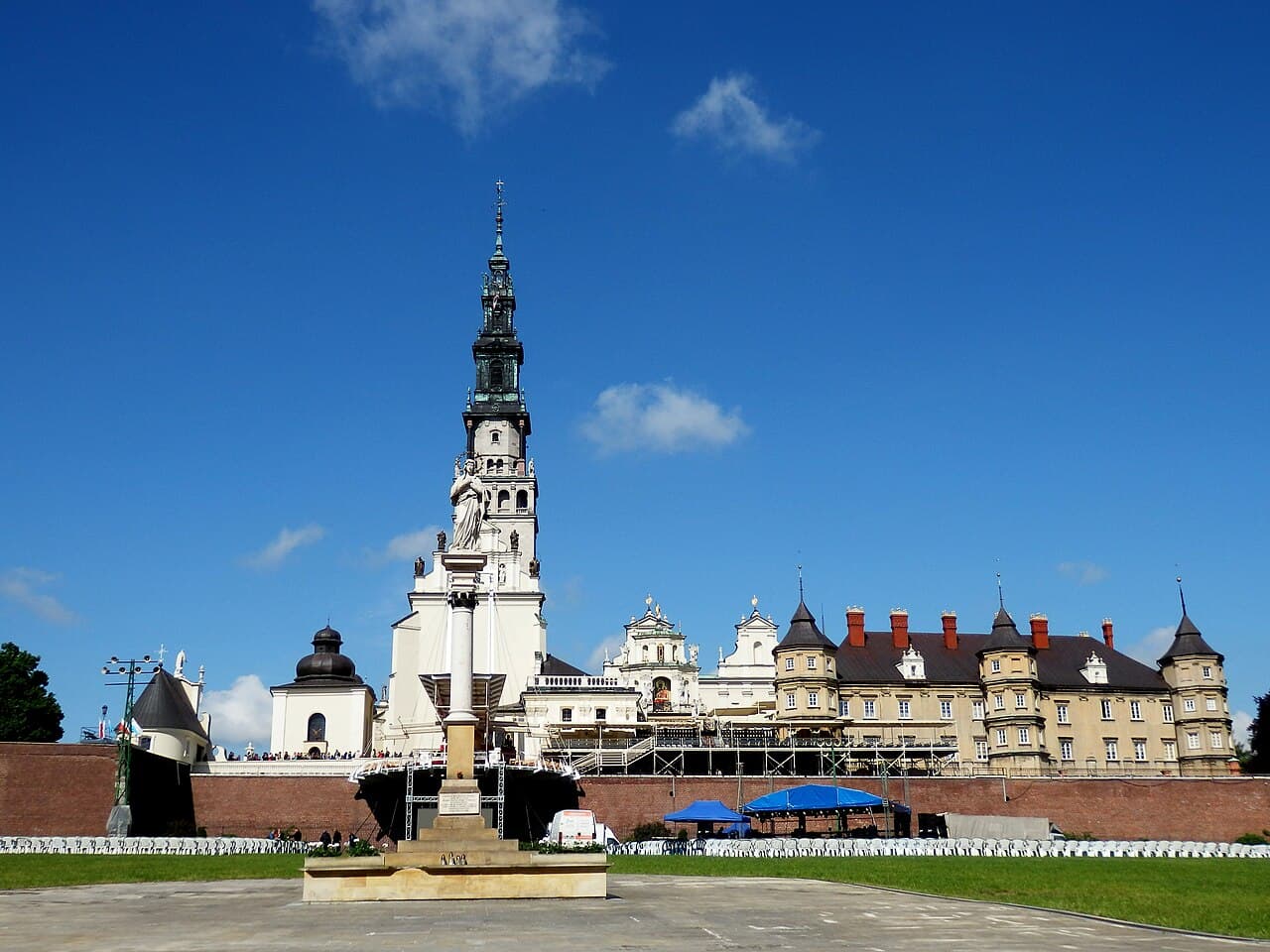
Częstochowa klasztor jasnogórski
The Jasna Góra Monastery in Częstochowa, Poland, stands as a remarkable example of a fortified religious complex with a rich history intertwined with the nation's cultural and military past. Although primarily a monastery, its bastioned fortress fortifications distinguish it architecturally and historically, making it a unique site that blends spiritual significance with defensive military architecture.
Located on a prominent limestone hill, the site of Jasna Góra has been associated with fortifications since at least the early 13th century, with the first mention of Częstochowa dating back to 1220. The strategic location provided natural defensive advantages, which were enhanced over time with man-made fortifications. Following the death of King Casimir the Great in 1370, the territory including Częstochowa was granted as a fief to Władysław Opolczyk by King Louis I of Hungary. In 1382, Władysław Opolczyk founded the monastery, endowing it generously and donating the revered icon of the Black Madonna, which would become central to the monastery's religious importance.
The foundation and early history
The monastery's foundation in the late 14th century marked the beginning of its dual role as a spiritual center and a fortified site. The early structures likely included defensive walls typical of medieval monastic complexes, designed to protect against raids and local conflicts. The monastery prospered under various patrons despite political tensions, including the conflict between Władysław Opolczyk and King Władysław Jagiełło, which resulted in the reintegration of Częstochowa into the Polish Crown.
Bastioned fortifications and military significance
The Thirty Years' War and the military conflicts in nearby Silesia during the early 17th century prompted significant enhancements to the monastery's defenses. Under the initiative of King Sigismund III Vasa and continued by his successor Władysław IV, Jasna Góra was fortified with a modern bastioned system. The fortifications were constructed on a rectangular plan featuring four corner bastions, a dry moat, and a drawbridge over the moat, reflecting the latest military architectural trends of the period.
These bastions allowed defenders to cover all approaches with overlapping fields of fire, a significant advancement over earlier medieval defenses. The fortifications included thick walls and artillery positions, enabling the monastery to withstand sieges and assaults effectively.
The 1655 Swedish siege
One of the most famous events in the monastery's history is the siege of 1655 during the Swedish Deluge. Swedish forces led by Burchard Müller laid siege to Jasna Góra for six weeks. The monastery's defenders, including the monks and a small military garrison, successfully resisted the assault despite being heavily outnumbered. This defense became a symbol of Polish resilience and patriotism, inspiring a nationwide uprising against the Swedish invaders. The siege is immortalized in Henryk Sienkiewicz's novel Potop (The Deluge).
Post-siege reconstruction and later military history
After the siege, the fortifications were promptly repaired and strengthened. A ravelin was added to reinforce the main gate, and an arsenal building was constructed to support the garrison. The monastery maintained a permanent military presence from 1652 onward, underscoring its strategic importance.
During the Bar Confederation in the late 18th century, Jasna Góra again became a military focal point. Russian forces attempted to storm the fortified monastery unsuccessfully, only occupying it after the confederation's collapse. In the Napoleonic era, the French recognized the fortress's strategic value and undertook modernization efforts, but following Napoleon's defeat in 1812, Russian forces occupied the site. Tsar Alexander I ordered the dismantling of many defensive works, effectively ending its military role.
Architectural and cultural significance today
Today, the Jasna Góra Monastery is a well-preserved monument of late medieval and early modern military architecture combined with religious heritage. It remains one of Poland's most important sites of Marian pilgrimage and cultural identity. The massive bastions and walls still surround the complex, serving as a tangible reminder of its turbulent history and its role as a symbol of Polish independence and faith.
The monastery's architecture reflects a blend of religious and military functions, with fortified walls, bastions, and gates integrated with chapels, living quarters, and halls. The site is not only a place of worship but also a museum of Poland's military and religious history, attracting visitors interested in architecture, history, and spirituality.
Visiting Jasna Góra
Visitors to Jasna Góra can explore the extensive fortifications, including the bastions, dry moat, and gate structures, alongside the monastery's religious buildings. The site offers insight into the evolution of fortress design from the medieval period through the early modern era. Its cultural significance and well-preserved architecture make it a must-visit destination in Poland.
Frequently asked questions (FAQ)
- When was Jasna Góra Monastery founded?
- Jasna Góra Monastery was founded in 1382 by Władysław Opolczyk, who generously endowed it and donated the icon of the Black Madonna.
- What type of fortifications surround Jasna Góra?
- The monastery is surrounded by a bastioned fortress system built in the early 17th century, featuring four corner bastions, a dry moat, and a drawbridge.
- Why is Jasna Góra significant in Polish history?
- Jasna Góra is a symbol of Polish resilience, especially due to its successful defense during the 1655 Swedish siege, which inspired a national uprising.
- Can visitors explore the fortifications at Jasna Góra?
- Yes, visitors can explore the bastions, walls, moat, and gates, gaining insight into the site's military and religious history.
- Who currently owns Jasna Góra Monastery?
- The monastery is currently owned and managed by the Pauline Fathers, who maintain its religious and cultural functions.
Photo gallery

Information
Current owner
Pauline Fathers
Loading map...
Visitor reviews
No reviews yet. Been here? Write the first review and help other travelers!
Write the first reviewVisited this castle? Share your experience
Your review helps other travelers and adds first-hand knowledge to our encyclopedia.