Olsztyn Castle Ruins
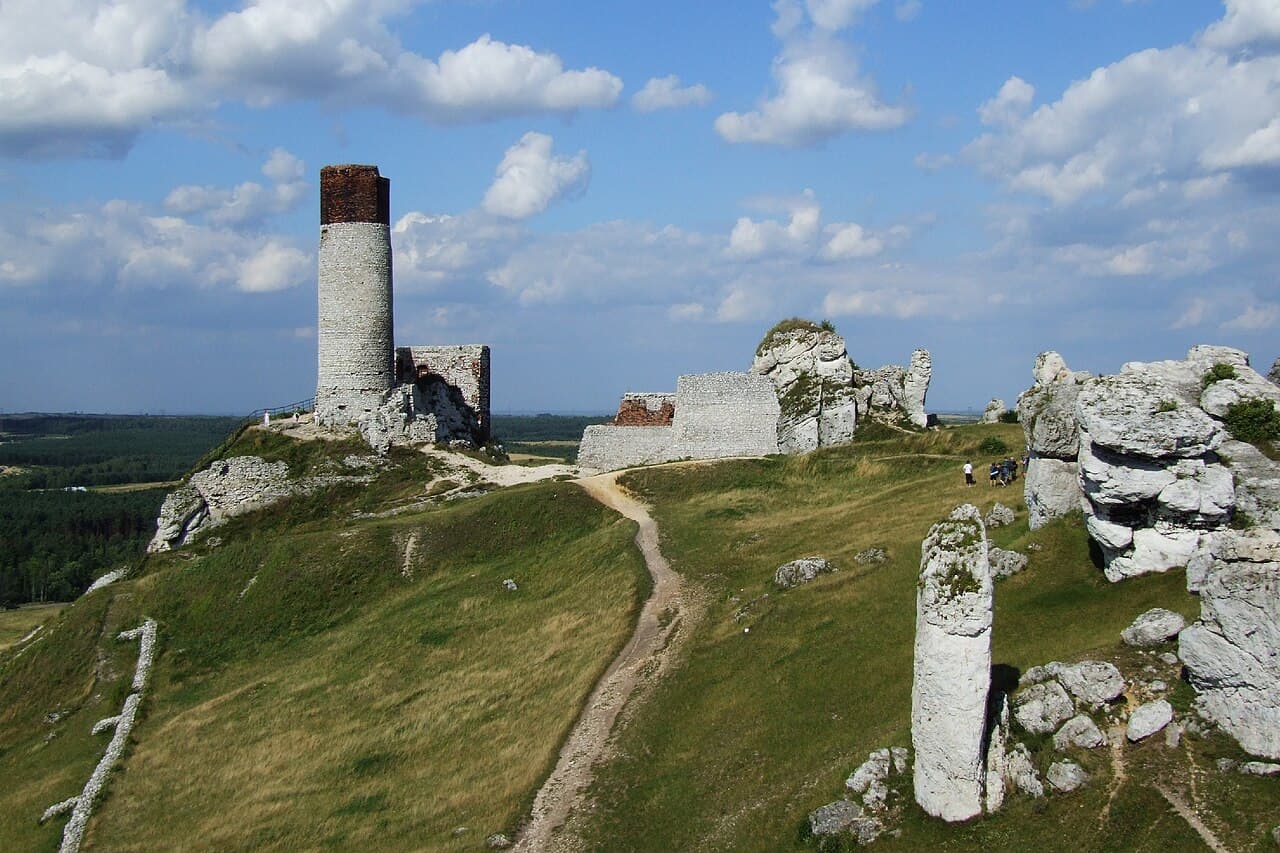
The Olsztyn Castle ruins stand as a testament to medieval fortification and regional history in Olsztyn, Poland. Perched atop a hill among distinctive limestone rocks, this castle is a prominent feature of the Trail of the Eagles' Nests, a chain of fortresses built to defend the borders of the Kingdom of Poland. Its origins date back to the late 13th century, with significant expansions and fortifications carried out during the 14th century under the reign of King Casimir III the Great, who fortified western Lesser Poland against threats from the neighboring Czech-controlled Silesia.
Medieval origins and strategic importance
Olsztyn Castle was initially established as a watchtower in the late 1200s, strategically located to oversee and protect the southern borderlands of the Polish kingdom. Archaeological research confirms its 13th-century foundation, with the castle evolving from a modest stronghold into a significant fortress by the mid-14th century. Its role was not only military but also administrative, serving as a royal seat by 1349, managed by a burgrave named Zbyszko.
Throughout the high medieval period, the castle was a key component of a defensive network designed to secure the region from incursions by Silesian princes and other external forces. The castle's position on a hill among natural limestone formations enhanced its defensive capabilities, making it a formidable obstacle for attackers.
Ownership and political history
The castle's ownership reflects the turbulent political landscape of medieval Poland. In 1370, King Louis I of Hungary granted Olsztyn Castle as a fief to Duke Władysław Opolczyk. This arrangement lasted until 1391 when Spytek of Melsztyn, acting on behalf of King Władysław Jagiełło, reclaimed the fortress for the Polish Crown. Subsequently, the castle was granted to local nobleman Jan Odrowąż of Szczekociny, marking its integration into the Polish noble estate system.
During the 15th century, the castle was repeatedly attacked by Silesian princes amidst ongoing regional conflicts. These military pressures led to structural enhancements, including the addition of the "lower castle," which improved the fortress's defensive depth.
Military engagements and decline
Olsztyn Castle witnessed significant military action over the centuries. Notably, in 1587, it withstood a siege by Austrian forces led by Archduke Maximilian during a contested Polish royal succession. The defense, led by starosta Kasper Karliński, was successful but costly, with the loss of Karliński's son becoming a poignant episode in local history.
Despite these efforts, the castle's fortifications gradually became obsolete due to advances in military technology. By the early 17th century, reports described the fortress as heavily damaged and in decline. The Swedish Deluge of 1655 brought further devastation when Swedish troops captured and partially destroyed the castle after a brief siege. Following this, the castle fell into ruin, with limited repairs undertaken.
In 1722, parts of the castle were dismantled to provide building materials for the construction of a parish church in Olsztyn, reflecting the site's diminished military and administrative importance.
Architectural features and archaeological discoveries
The surviving ruins of Olsztyn Castle reveal a complex layout combining an upper stronghold and a lower defensive section. The castle was constructed primarily from stone, with walls and towers adapted over centuries to meet evolving defensive needs.
Two prominent towers remain: a 35-meter cylindrical tower, known as a stołp, which served as a prison, and a square tower historically called the Starost's tower, which housed administrative offices. These towers not only provided defense but also symbolized local authority.
Recent archaeological excavations have uncovered foundations of economic buildings such as a smithy with evidence of bloomery furnaces, indicating metalworking activities on site. The discovery of three bridge pillars clarified the structure of the lower castle's gate and access routes, revealing a wooden or stone bridge that linked the lower and upper parts of the fortress.
Remarkably, a cave within the castle grounds yielded flint tools crafted by Neanderthals, highlighting the area's long history of human occupation. Further exploration revealed a network of tunnels and fissures beneath the castle, combining natural formations and medieval modifications.
The castle in modern times
Today, Olsztyn Castle stands as a partially preserved ruin, offering visitors insight into its layered history and medieval architecture. Although much of the structure has been lost or dismantled, the remaining walls and towers evoke the castle's former strength and significance.
In the late 20th century, the ruins served as a dramatic backdrop for public pyrotechnic and laser shows, though concerns about structural stability have since limited such events. The site remains an important cultural and historical landmark within the Kraków-Częstochowa Upland region and continues to attract tourists exploring the Trail of the Eagles' Nests.
Olsztyn Castle's enduring legacy lies in its embodiment of medieval Polish fortification, its role in regional power struggles, and the archaeological richness that connects it to both medieval and prehistoric times.
Frequently asked questions (FAQ)
- How do I get to Olsztyn Castle ruins?
- Olsztyn Castle ruins are located on a hill in Olsztyn, Poland. Visitors can reach the site by car or local transport, followed by a short walk uphill to the castle.
- What is the best time to visit Olsztyn Castle?
- The best time to visit Olsztyn Castle is during the warmer months from late spring to early autumn when the weather is pleasant and the surrounding landscape is vibrant.
- Is there an entrance fee to visit Olsztyn Castle ruins?
- Visiting the Olsztyn Castle ruins is free of charge, making it accessible for all visitors interested in history and architecture.
- What remains can I see at Olsztyn Castle ruins?
- Visitors can explore the partially preserved stone walls, the impressive 35-meter cylindrical prison tower, and the square Starost's tower, along with archaeological features like foundations of economic buildings and bridge pillars.
- Can I take guided tours at Olsztyn Castle?
- Guided tours may be available seasonally or by arrangement through local tourist offices, providing detailed historical and architectural insights.
- Are the ruins safe and accessible for visitors?
- The ruins are generally safe to explore, with some areas stabilized for visitor access. However, visitors should wear appropriate footwear and exercise caution on uneven terrain.
Photo gallery

Information
Opening hours
9:00-18:00, daily
Ticket prices
Free
Current owner
Municipality
Website
Visit websiteSources & official resources
Verify the information above using these authoritative references.
Loading map...
Visitor reviews
No reviews yet. Been here? Write the first review and help other travelers!
Write the first reviewVisited this castle? Share your experience
Your review helps other travelers and adds first-hand knowledge to our encyclopedia.