Czersk
Czersk Castle stands as a remarkable example of a Renaissance bastioned fortress with deep historical roots stretching back to early medieval times in the region of Mazovia, Poland. Perched on a high promontory overlooking the Vistula River valley, the castle occupies a site that has been continuously inhabited since antiquity, with archaeological evidence revealing a cemetery from the so-called Cloche culture dating back some two thousand years. This long history of settlement laid the foundation for the castle's strategic and political importance in the Middle Ages.
By the late 11th and early 12th centuries, the site was already recognized as a strong defensive grod (fortified settlement) under the control of the Masovian dukes, serving as a bulwark against frequent Lithuanian raids. Throughout the 13th century, Czersk emerged as a key political and religious center in southern Mazovia. The relocation of the archdeaconry seat from nearby Grójec to Czersk before 1252 underscored its ecclesiastical significance, while the elevation of the castle chapel to a collegiate church further enhanced its status. The town became the seat of the castellan and later the capital of the autonomous Duchy of Czersk until its incorporation into the Kingdom of Poland in the 16th century.
Medieval origins and gothic construction
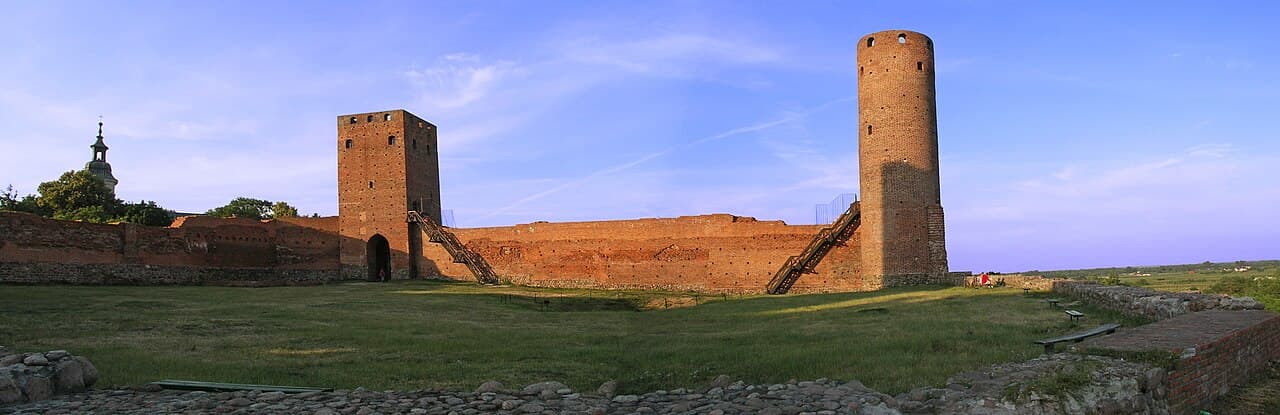
The first substantial stone fortifications at Czersk were commissioned by Prince Janusz I of Masovia at the turn of the 14th and 15th centuries. Between 1388 and 1410, the wooden fortifications were replaced by a formidable brick gothic castle constructed on a horseshoe-shaped plan, designed primarily for military defense. The castle's walls, originally 7 to 8 meters high and nearly 2 meters thick, were punctuated by three towers equipped with battlements and arrow slits to repel attackers. The most prominent of these was the imposing four-sided gate tower, which served as the main entrance and housed the burgrave's quarters. This tower, reaching 22 meters in height, featured distinctive Gothic brickwork with dark glazed bricks called zendrówki, marking its architectural character.
Inside the castle walls, the courtyard contained important structures including a residential building and the castle church of St. Peter, likely dating back to the 12th century. The church's foundations and remnants have been uncovered through archaeological research, providing valuable insight into the religious life of the castle's medieval inhabitants. The castle also functioned as a prison; one notable prisoner was Duke Henryk Brodaty, held captive in the eastern cylindrical tower's deep dungeon during a conflict with Duke Konrad Mazowiecki.
Renaissance transformations and royal ownership
Following the absorption of Mazovia into the Kingdom of Poland in 1526, Czersk Castle became a royal property. During this period, the castle underwent significant modifications reflecting Renaissance architectural influences and changing residential needs. Two cylindrical towers were heightened to improve defense, and the wooden buildings within the courtyard were replaced with masonry constructions. Notably, Queen Bona Sforza took possession of the castle as her widow's estate after the death of King Sigismund I the Old, residing there frequently from 1547 onward.
Under Queen Bona's patronage, a large palace building known as the Great House or Bona’s residence was constructed, measuring approximately 10 by 30 meters. The castle hill's slopes were cultivated with orchards, gardens, and vineyards, reflecting Renaissance ideals of integrating nature and comfort within fortified residences. Despite these enhancements, the castle's military importance waned as the Vistula River shifted its course away from the castle, depriving it of natural defensive advantages.
Destruction, decline, and partial restoration
The castle suffered devastating damage during the Swedish Deluge in 1656 when retreating Swedish forces, pursued by the army of Stefan Czarniecki, took refuge within its walls. After three days, the Swedes burned the town and blew up the castle’s internal buildings, leaving the fortress in ruins. Further destruction occurred during the mid-17th century due to the presence of Cossack and Hungarian troops allied with Rakoczy.
In the 18th century, Franciszek Bieliński, the marshal of the Crown, initiated restoration efforts between 1762 and 1766. These included replacing the original wooden bridge with a durable brick bridge featuring two arches and repairing parts of the fortifications. However, after Bieliński's death, restoration work ceased, and the castle fell into further disrepair. The Prussian authorities later demolished sections of the defensive walls and residential buildings, accelerating the castle's decline. By the late 19th century, local inhabitants scavenged bricks from the ruins for their own use, even partially reconstructing the church nave with these materials.
20th-century conservation and archaeological research
In 1904, the castle ruins were acquired by the Society for the Protection of Historical Monuments, which commenced conservation efforts to stabilize the remaining structures. However, World War I inflicted additional damage during military engagements in the area. After Poland regained independence, archaeological excavations and restoration projects resumed, including the reconstruction of the castle’s gate tower. Despite further damage during World War II, ongoing preservation work has continued to protect and interpret the site.
Architectural features and surviving structures
The castle's layout follows the contours of the original medieval fortifications, with a horseshoe-shaped curtain wall enclosing a triangular courtyard. The most prominent surviving feature is the Gothic gate tower, a four-sided structure with characteristic unplastered brickwork and decorative dark glazed bricks. This tower originally housed the main gate and a pedestrian postern, each secured by separate drawbridges. The tower’s interior included guard rooms and the burgrave’s residential chamber, with upper floors dedicated to defense, topped by a wooden roof with a hoarding.
Two cylindrical towers flank the curtain walls. The eastern tower served as a prison, accessible by a doorway at wall height, with a deep dungeon below where notable prisoners were confined. The western tower functioned as an armory and weapons storage. Both towers were originally crowned with pointed wooden roofs and raised in height after 1526 to enhance fortifications.
The curtain walls, originally 7 to 8 meters tall and nearly 2 meters thick, rest on deep foundations approximately 5 to 5.5 meters below ground level. These formidable defensive structures testify to the castle’s military significance during the medieval and Renaissance periods.
Within the courtyard, the foundations of the castle church of St. Peter remain visible, offering a glimpse into the site's religious heritage. The masonry buildings constructed under Queen Bona have largely not survived, but historical records and archaeological evidence provide insight into their scale and function.
Cultural significance and tourism today
Today, the ruins of Czersk Castle are an important cultural landmark and tourist attraction in the Masovian region. Visitors can explore the well-preserved curtain walls, climb the gate tower, and enjoy panoramic views of the Vistula valley. The castle hosts occasional exhibitions and events that highlight its rich history and architectural heritage.
The castle’s layered history—from an early medieval stronghold through Gothic and Renaissance transformations to its partial destruction and preservation—makes it a valuable site for understanding the evolution of Polish fortifications and noble residences. Its location on a high escarpment overlooking the Vistula River underscores its strategic importance over centuries of regional conflict and political change.
Efforts continue to maintain the ruins and enhance visitor access, ensuring that Czersk Castle remains a vivid testament to Poland's medieval and Renaissance past.
Frequently asked questions (FAQ)
- What is the historical significance of Czersk Castle?
- Czersk Castle, dating back to the 14th century, served as a key stronghold for the Mazovian dukes. Its strategic location allowed it to control trade routes and defend against invasions, making it an important site in Polish history.
- When was Czersk Castle built?
- Construction of Czersk Castle began in the early 14th century, around 1370, under the reign of Duke Janusz I. Its architectural style reflects the defensive needs of the time, transitioning from a wooden fort to a robust stone structure.
- What are the opening hours for Czersk Castle?
- Czersk Castle is open to visitors from April to October, typically from 10 AM to 6 PM on weekdays and until 8 PM on weekends. However, it's advisable to check the official website for any seasonal changes or special event schedules.
- Can I take a guided tour of Czersk Castle?
- Yes, guided tours are available at Czersk Castle, providing visitors with in-depth knowledge about its history and architecture. Tours are typically offered in multiple languages, ensuring an enriching experience for all guests.
- Is Czersk Castle accessible for visitors with disabilities?
- Czersk Castle has made efforts to improve accessibility, including designated paths for visitors with mobility challenges. However, some areas may still present difficulties due to the historical nature of the site, so it's best to contact the castle staff for specific accessibility information.
- What is the best time to visit Czersk Castle?
- The best time to visit Czersk Castle is during the late spring and early autumn months when the weather is mild and outdoor events are frequently held. This period also allows you to enjoy the beautiful surrounding landscapes in full bloom.
- Are there any nearby attractions to visit while at Czersk Castle?
- Visitors to Czersk Castle can explore nearby attractions such as the picturesque village of Czersk and the lush forests surrounding the area. Additionally, the Vistula Boulevards offer scenic walking paths and recreational opportunities.
- What are the ticket prices for visiting Czersk Castle?
- Ticket prices for Czersk Castle are generally affordable, with discounts available for students, seniors, and families. It's recommended to check the castle's official website for the most current pricing and any special promotions.
Photo gallery

Information
Website
Visit websiteSources & official resources
Verify the information above using these authoritative references.
Loading map...
Visitor reviews
No reviews yet. Been here? Write the first review and help other travelers!
Write the first reviewVisited this castle? Share your experience
Your review helps other travelers and adds first-hand knowledge to our encyclopedia.