Culcreuch Castle
Culcreuch Castle stands as a remarkable example of a Scottish high medieval hill castle with a history spanning over seven centuries. Located near the village of Fintry in central Scotland, close to the scenic Loch Lomond, this castle was originally constructed in 1296 by Maurice Galbraith. It served as the ancestral home and clan seat of the Clan Galbraith from the early 14th century until the early 17th century, marking it as a significant stronghold in Scottish clan history.
Architectural features and structure
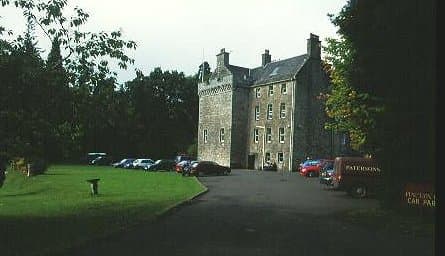
The castle is primarily a rectangular tower house, a common form of Scottish medieval fortification designed for both defense and residence. It comprises three stories and an attic, capped with a parapet and a traditional slate roof. The robust stone walls and narrow windows reflect its defensive purpose while providing living quarters within. Notably, the castle underwent expansions in the early 18th century; the north and east extensions were added after 1721 by the Napier family, who owned the estate at the time. These additions were carefully constructed to match the original tower's architectural style, preserving the castle's historic character.
Historical ownership and significance
Culcreuch Castle was the seat of Clan Galbraith from around 1320 to 1624. Financial difficulties led to its sale to a cousin, Alexander Seton of Gargunnock, in 1624. Shortly after, in 1632, the castle was purchased by Robert Napier, a younger son of John Napier, the 8th Laird of Merchiston, whose family maintained ownership for five generations. The castle's strategic importance was highlighted during the mid-17th century when it was used to garrison Oliver Cromwell’s troops in 1654, reflecting its military value during the turbulent times of the English Civil War and its aftermath.
Later proprietors and uses
In 1796, the castle changed hands to Alexander Spiers of Glasgow, who contributed to the local economy by establishing a cotton mill and a distillery in the nearby village of Fintry. The property was sold again in the late 19th and early 20th centuries, passing to J. C. Dunwaters in 1890 and then to Walter Menzies in 1901. The Menzies family retained ownership until the 1970s when it was acquired by Hercules Robinson, the last of the Menzies line to own the castle.
Modern era and preservation
In 1984, Arthur Haslam purchased Culcreuch Castle and transformed it into a hotel, opening its historic walls to the public and visitors seeking an authentic castle experience. This use preserved the castle's fabric while adapting it for modern hospitality. The castle remained one of the longest continually inhabited castles in central Scotland until 2020, when the American holding company that acquired it decided to close the business and the castle to the public. This closure ended over 700 years of continuous habitation, marking a significant moment in the castle's long history.
Location and cultural context
Culcreuch Castle is situated in the Stirling council area of Scotland, within a landscape rich in history and natural beauty. Its proximity to Loch Lomond places it near one of Scotland's most famous natural landmarks. The castle's setting on a hill provides commanding views of the surrounding countryside, a typical strategic choice for medieval fortifications designed to monitor and control the area.
Architectural style and classification
The castle exemplifies the high medieval hill castle typology, characterized by its elevated position and fortified tower house design. Its architectural style is predominantly medieval Scottish, with later additions respecting the original aesthetic. The castle's structure reflects the transition from purely defensive fortifications to more comfortable noble residences while retaining essential military features such as thick walls, narrow windows, and battlements.
Visitor information and legacy
Although currently closed to the public, Culcreuch Castle's legacy as a historic residence, military post, and hotel contributes to Scotland's rich tapestry of heritage sites. Its long history of continuous habitation and adaptation offers valuable insights into Scottish clan life, architecture, and social changes over the centuries. The castle remains an important cultural landmark in the region, symbolizing the endurance of Scottish medieval architecture and aristocratic history.
Frequently asked questions (FAQ)
- When was Culcreuch Castle built and by whom?
- Culcreuch Castle was built in 1296 by Maurice Galbraith, establishing it as a significant medieval stronghold in Scotland.
- What architectural style characterizes Culcreuch Castle?
- The castle is a high medieval hill castle featuring a rectangular tower house with three stories, an attic, and a slate roof, typical of Scottish medieval fortifications.
- Can visitors tour Culcreuch Castle today?
- As of 2020, Culcreuch Castle is closed to the public following its purchase by an American holding company, ending its operation as a hotel.
- What historical events is Culcreuch Castle known for?
- The castle was the seat of Clan Galbraith and later housed Oliver Cromwell’s troops in 1654, highlighting its military and clan significance.
- How did the castle change hands over the centuries?
- Ownership passed from Clan Galbraith to Alexander Seton in 1624, then to Robert Napier in 1632, followed by various private owners including the Menzies family and eventually Arthur Haslam who converted it into a hotel.
Photo gallery

Information
Loading map...
Visitor reviews
No reviews yet. Been here? Write the first review and help other travelers!
Write the first reviewVisited this castle? Share your experience
Your review helps other travelers and adds first-hand knowledge to our encyclopedia.