Cuellar Castle
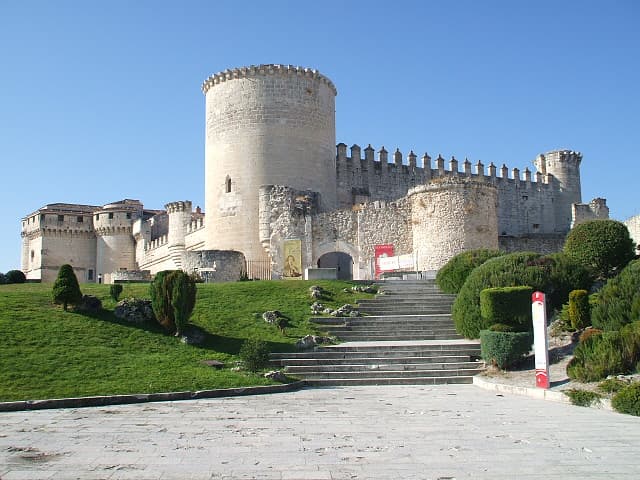
Cuellar Castle, also known as the Castle of the Dukes of Alburquerque, stands as a prominent historic monument in the town of Cuellar, Spain. This hill castle was constructed and modified over several centuries, primarily between the 13th and 18th centuries, resulting in a complex architectural tapestry that reflects the evolution of military and noble residences in Castile.
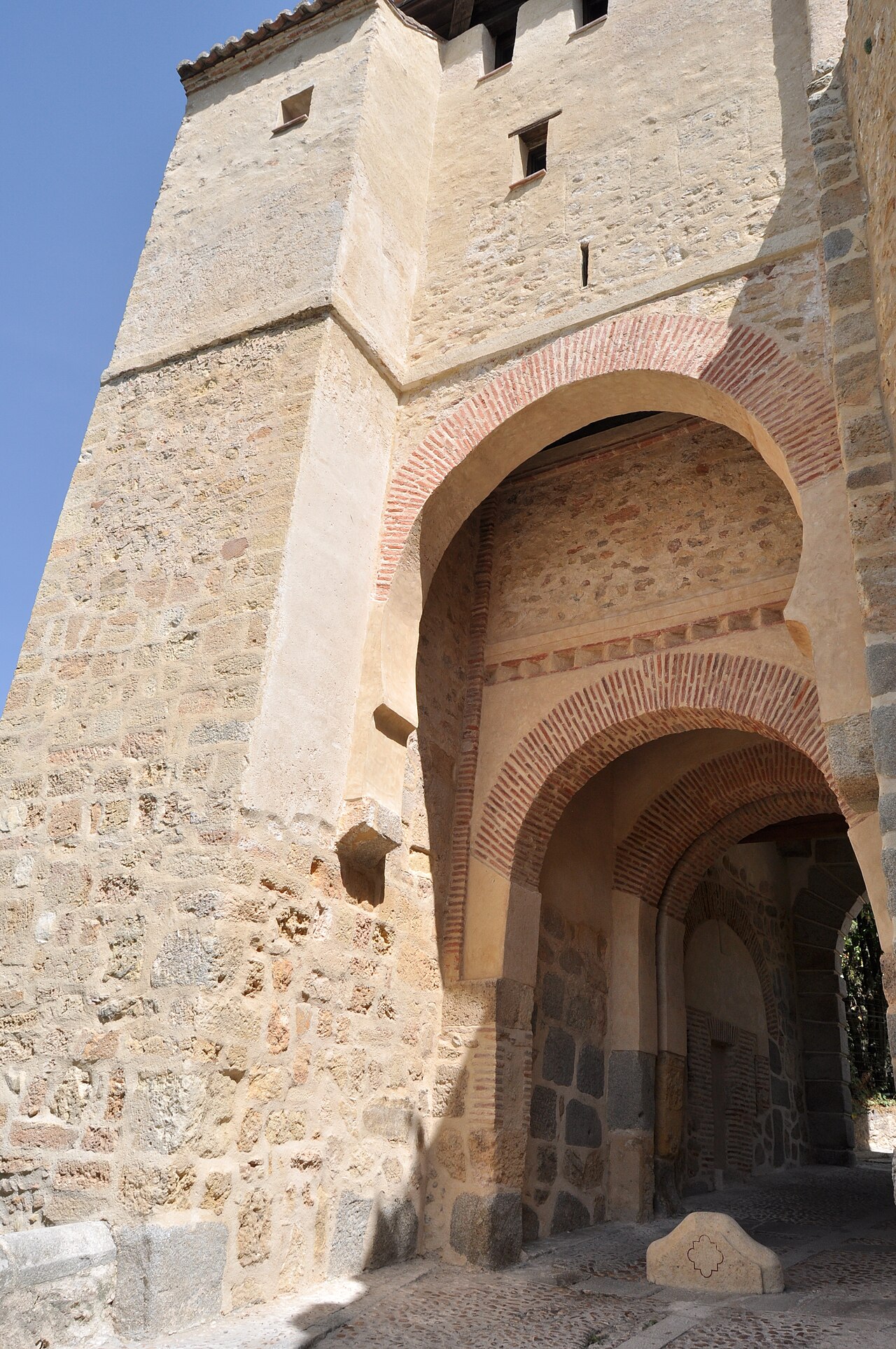
The castle's origins are deeply intertwined with the medieval fortifications of Cuellar, with archaeological evidence pointing to construction activities as early as the 11th century. Early elements include an original defensive wall and a distinctive Mudéjar-style gate dating from the late 12th or early 13th century. These features underscore the castle's initial role as a key defensive stronghold integrated with the town's walls.
Documented explicitly from 1306, when King Fernando IV authorized funds for its repair, the castle underwent significant fortifications throughout the High Medieval period. Notably, in the 15th century, Álvaro de Luna, a powerful Castilian noble, initiated major construction projects including the imposing keep (Torre del Homenaje) and the reinforcement of the northern and eastern walls. Ownership by monarchs such as Isabel the Catholic and Enrique IV of Castile further highlights its strategic and political importance.
Architectural features and defensive structures
The keep and fortifications
The castle's most prominent architectural feature is the cylindrical keep, known as the Torre del Homenaje, which rises approximately 20 meters high with walls nearly 3 meters thick. This robust tower contains vaulted chambers decorated with heraldic shields and a spiral staircase leading to an open terrace, serving both defensive and symbolic functions.
Surrounding the castle is a dry moat and an outer defensive wall called a barbican (falsabraga), constructed in 1465 under the direction of Beltrán de la Cueva. This barbican includes a curtain wall reinforced by five projecting towers, each equipped with multiple firing chambers featuring arrow slits designed for archers and artillery defense.
Innovative defensive corridors and gates
Between the barbican and the eastern walls lies a narrow, bent corridor known as a liza, inspired by Muslim military architecture. This corridor is protected by two gates, creating a trap for attackers. The main entrance to the inner courtyard features an outer gatehouse with a drawbridge and a portcullis, flanked by a tower with arrow slits and elevated firing positions beneath a vaulted ceiling. Above the entrance arch, coats of arms of Beltrán de la Cueva, his wife Mencía de Mendoza y Luna, and King Enrique IV of Castile are prominently displayed.
Historical significance and noble residence
Ownership and noble legacy
Cuellar Castle was home to several notable historical figures, including Álvaro de Luna and Beltrán de la Cueva, before becoming the principal residence of the Dukes of Alburquerque. The dukes maintained the castle as their seat for centuries until relocating to Madrid to be near the royal court. Thereafter, the castle served primarily as a leisure and holiday residence, gradually falling into neglect by the late 19th century.
Military use and decline
During the Peninsular War in the early 19th century, Cuellar Castle was a strategic military stronghold, occupied first by French forces and later by the British under the Duke of Wellington in 1812. This conflict resulted in looting and damage to the structure. Following the extinction of the main Cueva family line in 1811, ownership passed to the Osorio family, descendants of Ambrosio Spinola.
20th-century adaptations and restoration
From 1938 to 1966, the castle was repurposed as a political prison and later as a sanatorium for prisoners with tuberculosis, leading to significant alterations including demolition of ceilings and walls, plastering over murals, and construction of prison facilities. In 1972, the Department of Fine Arts undertook an extensive restoration, removing many of the prison-era modifications and restoring the castle's medieval and Renaissance character. The castle now houses a vocational education school and the Foundation of the Ducal House of Alburquerque, which preserves historical archives.
Palace features and Renaissance enhancements
Renaissance gallery and noble quarters
The 16th century saw the transformation of parts of the castle into a palace, including a two-story Renaissance gallery with eighteen arches, topped by a smaller third level with Greek-inspired lintelled arches. This gallery displays the coats of arms of the Cueva and Girón families, the dukes of the castle. The palace layout includes three wings: the southern wing housed noble living quarters, the western wing served domestic purposes, and the eastern wing contained a large armory.
Interior rooms and decorative elements
A monumental staircase carved from a single stone block, built in 1569, is a central architectural highlight. Vaulted rooms on the ground floor originally served as stables and coach houses and feature stucco decorations including candle-shaped reliefs with Franciscan symbolism. The first floor contains ducal chambers and guest rooms, including a grand dining hall with a balcony overlooking the southern facade, once home to a valuable 17th-century silverware collection. The second floor held smaller salons and a recreation room with original coffered ceilings and decorative sgraffito ring motifs typical of the Segovian region.
Armory, basements, and surrounding grounds
Armory and curiosities
The eastern wing's armory, rebuilt in the 17th century, was renowned for its extensive collection of about 300 suits of armor, weapons, and banners. It also housed curiosities such as large bones thought to be early dinosaur remains, adding a unique historical dimension to the castle's collection.
Basement facilities and storage
Below ground, vaulted basement chambers served practical functions including kitchens, pantries, and storage. These areas feature double-vent chimneys and stone sinks. Some vaulted rooms on the ground floor were likely used as dungeons or additional armory storage.
Huerta del Duque park and historical landscape
Surrounding the castle is the Huerta del Duque park, an eight-hectare area historically used for gardens, orchards, hunting, and livestock, enclosed by a masonry wall. The park includes a windmill tower acquired in 1496, recognized as the oldest documented windmill in Castile and León. Redesigned in the Renaissance style during the 16th century, the grounds now serve as a botanical and recreational space.
Frequently asked questions (FAQ)
- How do I visit Cuellar Castle?
- Cuellar Castle is open to visitors, with guided tours available that explore its medieval and Renaissance architecture. Check local tourism websites for current opening hours and tour schedules to plan your visit.
- What is the historical significance of Cuellar Castle?
- Cuellar Castle served as a strategic military fortress and noble residence from the 13th century, associated with notable figures like Álvaro de Luna and the Dukes of Alburquerque. It played roles in medieval defense and the Peninsular War.
- Can I see the Renaissance gallery and ducal chambers?
- Yes, the Renaissance gallery with its distinctive arches and the ducal chambers featuring period decorations are accessible to visitors, offering insight into the castle's noble lifestyle and architectural evolution.
- Is Cuellar Castle wheelchair accessible?
- Due to its medieval structure with stairs and uneven surfaces, wheelchair access is limited. Visitors with mobility issues should contact the site in advance to inquire about accommodations.
- When was Cuellar Castle restored?
- Major restoration efforts began in 1972 by the Department of Fine Arts, which removed prison-era alterations and restored the castle's medieval and Renaissance features, preserving it for educational and cultural use.
Photo gallery

Photo by Romerin•Public domain
Information
Website
Visit websiteSources & official resources
Verify the information above using these authoritative references.
Loading map...
Visitor reviews
No reviews yet. Been here? Write the first review and help other travelers!
Write the first reviewVisited this castle? Share your experience
Your review helps other travelers and adds first-hand knowledge to our encyclopedia.