Croy Castle
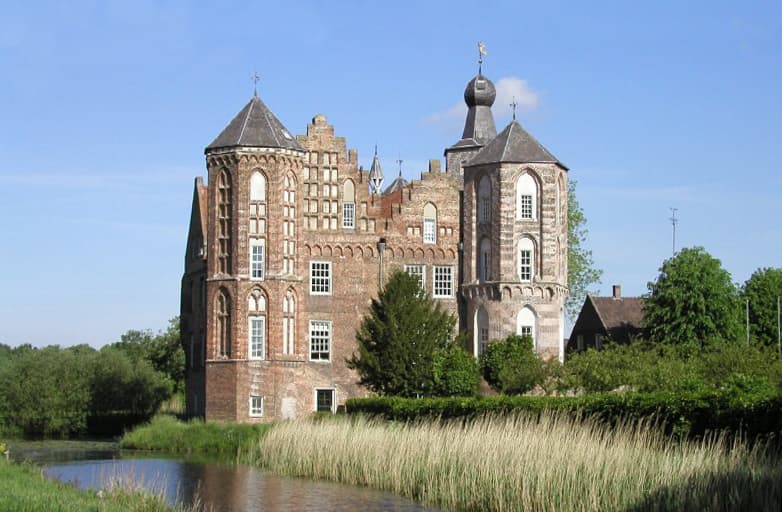
Croy Castle, locally known as Kasteel Croy, is a notable hill castle situated south of the village of Aarle-Rixtel in the province of Noord-Brabant, Netherlands. Its origins date back to the 15th century, making it a significant example of late medieval architecture and noble residence in the region. The castle's enduring presence and well-preserved medieval masonry provide valuable insights into the architectural and social history of the area.
Early history and origins
The earliest recorded mention of Croy Castle dates to 1472, when it was owned by Rutger van Erp. At that time, the structure likely consisted of a simple fortified house with a defensive tower, typical of smaller noble residences in the late medieval period. In 1477, the estate was sold to Jacob van Croÿ, a nobleman connected to the Burgundian court and serving as Bishop of Cambrai. Jacob van Croÿ's ownership lasted until 1494, during which the property was probably enhanced but specific architectural changes are not well documented.
Architectural development under cornelis i van bergen
In 1494, the castle was acquired by Cornelis I van Bergen, who is credited with giving Croy Castle much of its present form. He undertook significant construction, including the building of a gatehouse near what is now known as the French farm, which served as a fortified entrance to the estate. This gatehouse, along with the castle's medieval masonry walls, round tower, and the right wing, represent key elements of the original late medieval structure that survive today. The castle's layout and dimensions have remained largely consistent since this period, despite later modifications and restorations.
Ownership and agricultural innovation in the 18th and 19th centuries
From 1772, the Van der Brugghen family became the castle's owners, beginning with Jan Anthonie van der Brugghen and later his half-brother Johan Karel Gideon van der Brugghen. Johan Karel Gideon was notable for his agricultural innovations on the estate, including the introduction of Spanish rams to crossbreed with local Kempian heath sheep. He also enhanced the land by irrigating the meadows with kalk-rich water from the nearby Zuid-Willemsvaart canal, demonstrating an early example of estate improvement and land management.
During this period, the castle also played a role in regional history. In 1809, during a plague outbreak, King Louis Bonaparte (the French Louis Napoleon and King of Holland) visited the castle and aided the local village of Aarle-Rixtel. This event highlights the castle's social and political significance beyond its architectural presence.
Transition to charitable use and modern restoration
The castle's last private resident was Lady Constance van der Brugghen, who died in 1873. In her will, she stipulated that the castle should be used to house elderly locals in need, a charitable function that was carried out by a Catholic congregation known as the Sisters of Geloof, Hoop en Liefde. This use continued until 1977, when the residence was closed due to updated fire safety regulations.
In 1990, Croy Castle underwent a thorough interior restoration and was repurposed as an office building. The castle's exterior and key medieval features, including the crow-stepped gables added in the 18th century and the sturdy medieval masonry, have been well preserved. Further maintenance was completed in 2024, ensuring the castle remains structurally sound and retains its historical character.
Architectural features and layout
Croy Castle retains much of its original medieval layout and construction style. The cellar, right wing, and round tower are believed to be original parts dating back to the mid-15th century. The castle's walls are built from traditional medieval masonry, reflecting the defensive and residential needs of the period.
The gatehouse constructed by Cornelis I van Bergen remains a prominent feature near the moat and the French farm, marking the historic fortified entrance. The castle's crow-stepped gables and entrance portal, dating from the 18th century, add distinctive architectural character and reflect the evolution of the castle from a fortified medieval residence to a more refined noble estate.
Economic activities and brewing heritage
The estate surrounding Croy Castle has historically supported agricultural pursuits, including sheep grazing and crop cultivation. From around 1795, the castle became associated with beer brewing. Although brewing operations moved to Belgium in 2004, the estate has continued to cultivate ingredients locally. Following a fire in 2006, a microbrewery was reestablished near the castle, maintaining the site's brewing tradition.
The agricultural legacy also includes the maintenance of a herd of Rambouillet-Merino sheep, introduced by the Van der Brugghen family, reflecting the estate's ongoing connection to livestock breeding and land management.
Current use and public access
Today, Croy Castle serves primarily as an office building housing several companies. The barn in front of the castle functions as a shop, and the gatehouse is divided between a private residence and a bed & breakfast accommodation. Unfortunately, the castle interior is not open to the public, but its exterior remains a cherished landmark admired for its historical and architectural significance.
Despite its limited public access, Croy Castle stands as a well-preserved example of a late medieval hill castle in the Netherlands, embodying centuries of noble heritage, architectural evolution, and local history.
Frequently asked questions (FAQ)
- What is the historical significance of Croy Castle?
- Croy Castle is a well-preserved late medieval hill castle dating back to the 15th century, associated with noble families and agricultural innovation in North Brabant, Netherlands.
- Can I visit the interior of Croy Castle?
- The interior of Croy Castle is currently not open to the public as it is used as office space, but visitors can admire its exterior and surrounding grounds.
- When was Croy Castle built?
- Croy Castle was originally constructed in the 15th century, with significant additions made in the late 15th and 18th centuries.
- What architectural features does Croy Castle have?
- Croy Castle features medieval masonry, a round tower, a gatehouse from the late 15th century, and 18th-century crow-stepped gables and entrance portal.
- What was the castle's use after the noble families?
- After the last private owner died in 1873, Croy Castle was used as a residence for elderly locals until 1977, after which it was converted to office use.
Photo gallery

Information
Sources & official resources
Verify the information above using these authoritative references.
Loading map...
Visitor reviews
No reviews yet. Been here? Write the first review and help other travelers!
Write the first reviewVisited this castle? Share your experience
Your review helps other travelers and adds first-hand knowledge to our encyclopedia.