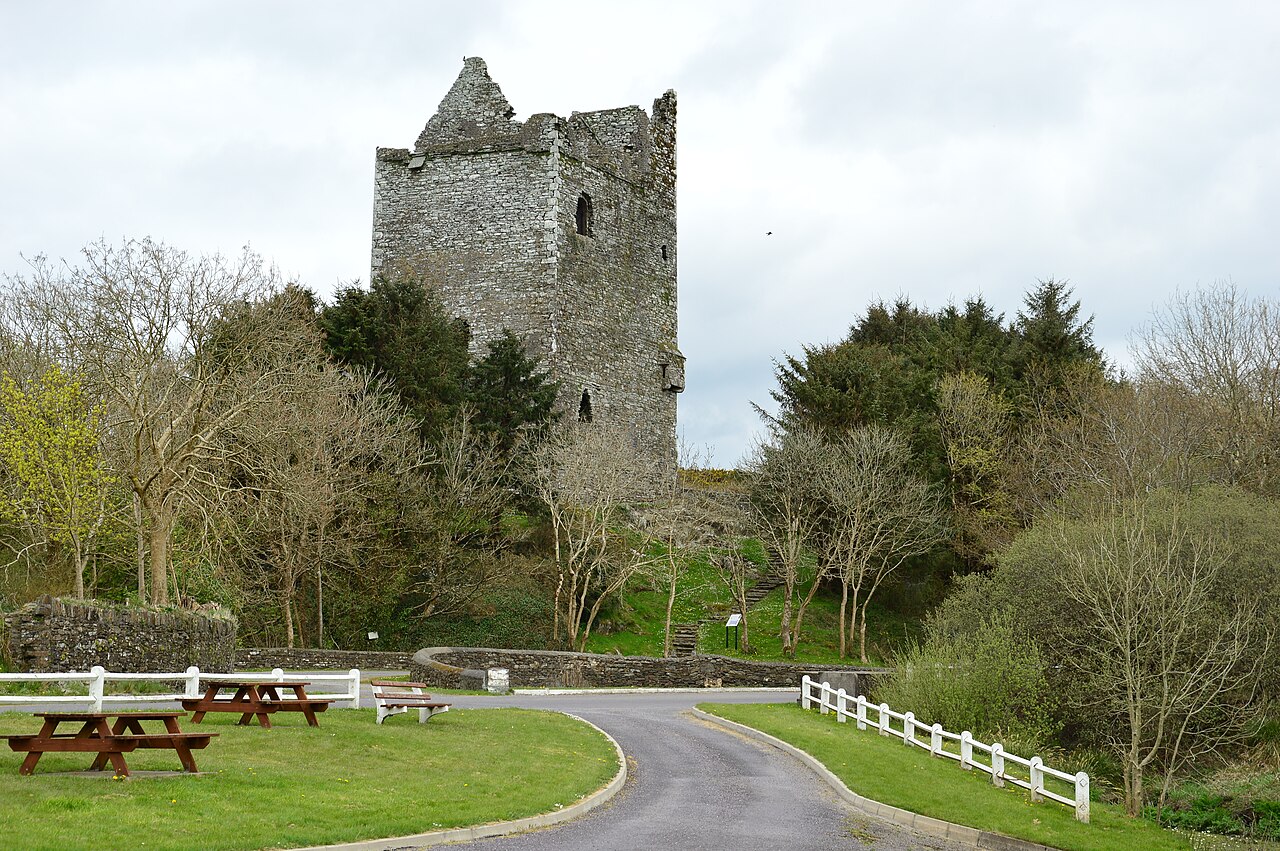
Crowley Castle
Crowley Castle is a late medieval ruin located in the rural townland of Ahakeera in County Cork, Ireland. This small castle was most likely constructed between 1450 and 1500 by the O'Crowley clan, a Gaelic family prominent in the region during the late medieval period. The castle occupies a field on private farmland and is not accessible to the public, partly due to its modest size and the surrounding agricultural land.
The history of Crowley Castle and its owners
The earliest recorded association of the castle is with Auliff O’Crowley, who in 1488 was recognized as the lord of Kilshallow by both the MacCarthy Reagh dynasty and King Henry VII of England. It is believed that by this time, Auliff was already residing at Crowley Castle, which served as the clan's stronghold in the area. The castle's strategic importance was tied to its role as a fortified residence for the O'Crowley family during a time of regional clan rivalries and English expansion into Ireland.
During the turbulent years of the late 16th and early 17th centuries, Crowley Castle suffered significant damage. Around 1602, English troops implemented a scorched earth policy in Munster during the Nine Years' War, targeting Gaelic strongholds to suppress resistance. Crowley Castle was likely destroyed during these military campaigns, leaving it in ruins.
By the late 19th century, the castle remained as a ruin rising to a greater height than today. For safety reasons, the ruin was partially dismantled in the 1880s, reducing its height by approximately half. This intervention has left the castle in its current ruined condition, with limited architectural features visible above ground.
Architectural features and layout
Although Crowley Castle is now a ruin, archaeological investigations have provided insight into its original structure. A geophysical archaeological survey revealed that the castle consisted of a main building block with an attached tower on one side. This tower likely contained a protective lobby and staircase, a common defensive and functional feature in late medieval Irish tower houses.
The castle was surrounded by a partial stone bawn, a defensive enclosure typical of Irish castles of the period. This bawn was complemented by a wooden palisade which included a gate tower, enhancing the castle's defensive capabilities. The combination of stone and timber fortifications was characteristic of smaller Gaelic lordship castles, balancing defense with the available resources.
The castle's modest size and simple design reflect its role as a local stronghold rather than a grand fortress. Its construction materials and layout are typical of late medieval Irish castles built by Gaelic families adapting to the changing military and political landscape of the time.
Current state and access
Today, Crowley Castle remains a ruined structure with limited visible architectural details. The site is situated on private farmland and is not open to public access. Visitors are advised to respect the private property and the agricultural use of the land.
Due to its small size and the extent of its ruinous condition, Crowley Castle does not feature prominently in tourist guides or heritage trails. Additionally, the surrounding farmland can present hazards, as the site is known for the presence of livestock, which can be intrusive and pose safety concerns for visitors.
Significance in Irish medieval heritage
While Crowley Castle is modest compared to larger Irish castles, it represents an important example of a Gaelic lordship castle from the late medieval period. It illustrates the architectural and defensive strategies employed by native Irish clans during a time of increasing English influence and military pressure.
The castle's history is intertwined with the local dynamics of power in County Cork and the broader context of Irish resistance to English rule in the late 15th and early 17th centuries. Despite its ruinous state, Crowley Castle contributes to the understanding of regional castle-building traditions and Gaelic lordship in Munster.
Frequently asked questions (FAQ)
- Is Crowley Castle open to the public?
- Crowley Castle is located on private farmland and is not accessible to the public. Visitors should respect the private property and avoid attempting to enter the site.
- When was Crowley Castle built and by whom?
- Crowley Castle was most likely built between 1450 and 1500 by the O'Crowley clan, a Gaelic family prominent in County Cork during the late medieval period.
- What led to the destruction of Crowley Castle?
- The castle was probably destroyed around 1602 by English troops during the Nine Years' War, as part of a scorched earth policy to suppress Gaelic resistance in Munster.
- What architectural features did Crowley Castle have?
- Archaeological surveys indicate Crowley Castle had a main building block with an attached tower containing a lobby and staircase, surrounded by a partial stone bawn and a wooden palisade with a gate tower.
- Can visitors safely approach Crowley Castle?
- Visitors should exercise caution as the castle is on private farmland and the area may have livestock. The ruin is small and lacks extensive architectural details, so safety and respect for the land are important.
Information
Current owner
Private owner
Loading map...
Visitor reviews
No reviews yet. Been here? Write the first review and help other travelers!
Write the first reviewVisited this castle? Share your experience
Your review helps other travelers and adds first-hand knowledge to our encyclopedia.