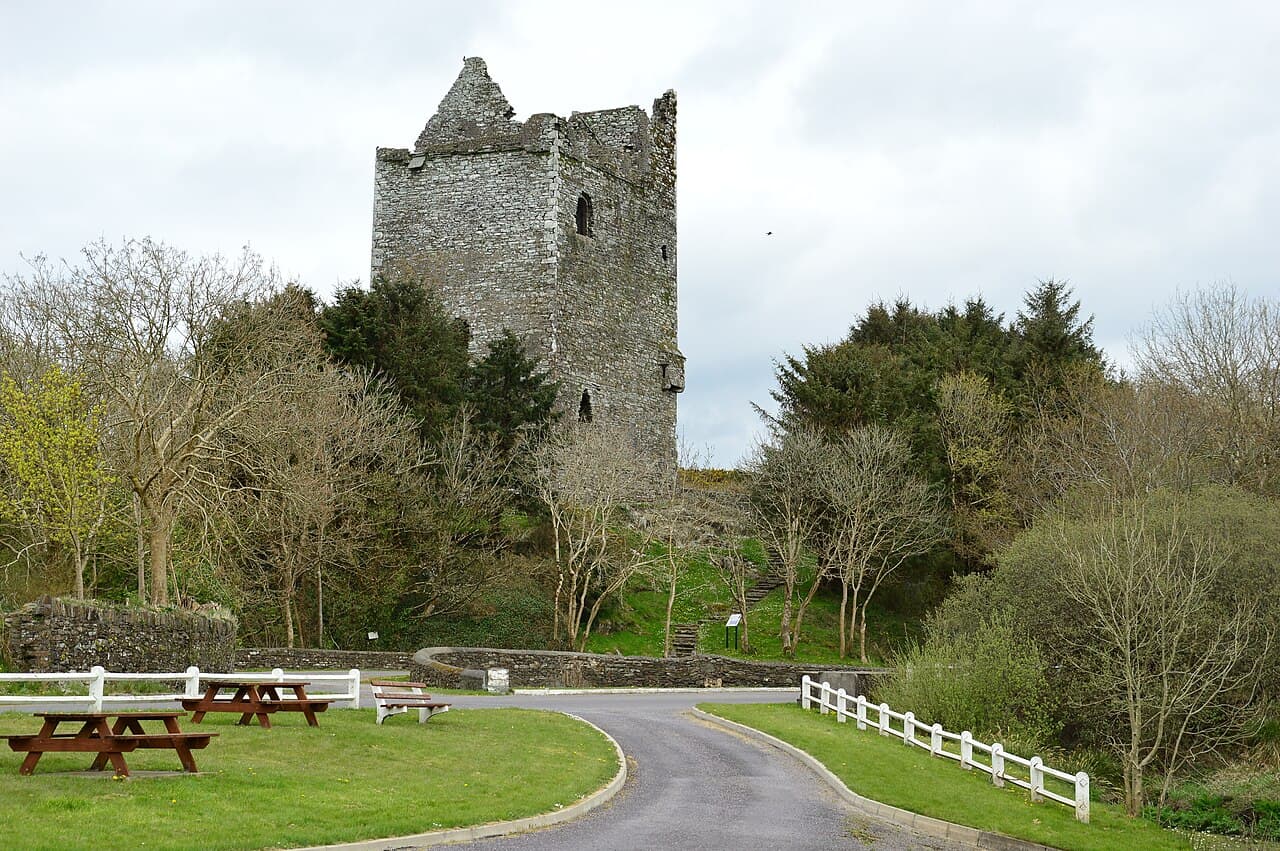
Ballinacarriga Castle
Ballinacarriga Castle (Irish: Béal na Carraige, meaning "Mouth of the Rock") is a prominent 16th-century tower house situated in the village of Ballinacarriga in County Cork, Ireland. Located approximately 9 kilometres from the town of Dunmanway and 7.5 kilometres from the village of Ballineen, this castle stands as a significant example of Renaissance-period Irish fortified residences. Although now in ruined condition, the structure remains remarkably well-preserved in terms of its overall architectural integrity, offering valuable insight into the defensive and domestic design of the era.
Historical context and significance
Constructed in the 16th century, Ballinacarriga Castle was built during a period of considerable social and political change in Ireland. This era saw the rise of tower houses as fortified homes for the Anglo-Irish gentry and Gaelic lords, blending residential comfort with defensive capabilities. The castle's name, "Mouth of the Rock," likely refers to its strategic placement near rocky terrain, enhancing its natural defenses.
The castle was originally associated with the McSweeney family, a Gaelic Irish clan prominent in the region during the late medieval and early Renaissance periods. The structure served as both a residence and a stronghold, reflecting the turbulent times marked by clan rivalries and English expansion.
Architectural features and layout
Tower house design
Ballinacarriga Castle exemplifies the typical tower house design prevalent in Ireland during the Renaissance. It is a rectangular, multi-storey stone building characterized by thick walls, narrow slit windows, and battlements. The structure was designed to provide both defense and habitation, with living quarters, storage, and defensive positions integrated within its compact footprint.
Defensive elements
The castle features corner turrets and battlemented parapets, allowing defenders to monitor and repel attackers from elevated positions. The entrance was likely protected by a heavy wooden door reinforced with iron, possibly accompanied by a murder hole or machicolations to defend against forced entry. The thick stone walls, some reaching over a meter in thickness, provided substantial protection against siege weapons of the period.
Interior spaces
Inside, the castle would have contained a great hall serving as the main living and reception area, along with private chambers and storage rooms. Fireplaces and latrines were incorporated for domestic comfort. The upper floors were accessed via narrow spiral staircases built within the wall thickness, a common defensive feature to hinder attackers.
Current condition and preservation
Today, Ballinacarriga Castle is classified as ruins, yet it remains in good structural condition. The main tower and some of the defensive features are still clearly visible, allowing visitors to appreciate the castle's original form and function. The site is accessible to the public, though it lacks extensive visitor facilities.
Nearby, a modern school serves the local community, highlighting the castle's continued role as a landmark within the village of Ballinacarriga.
Visiting Ballinacarriga Castle
Visitors interested in Irish history and Renaissance architecture will find Ballinacarriga Castle a compelling destination. Its relatively intact ruins offer a tangible connection to Ireland's turbulent 16th century. The surrounding countryside provides a scenic backdrop, enhancing the experience of exploring this historic site.
As the castle is not extensively developed as a tourist attraction, visitors should prepare accordingly, wearing suitable footwear and checking local access conditions.
Legacy and cultural importance
Ballinacarriga Castle stands as a testament to the architectural and historical heritage of County Cork. It reflects the adaptation of medieval defensive architecture to the needs of Renaissance Ireland, blending practicality with the social status of its inhabitants. The castle contributes to the understanding of Gaelic lordship and Anglo-Irish relations during a formative period in Irish history.
Its preservation as a ruin allows ongoing study and appreciation of Ireland's tower houses, an iconic element of the country's medieval and early modern landscape.
Frequently asked questions (FAQ)
- When was Ballinacarriga Castle built?
- Ballinacarriga Castle was constructed in the 16th century during the Renaissance period in Ireland.
- What architectural style does Ballinacarriga Castle represent?
- The castle is an example of a Renaissance-period Irish tower house, featuring defensive elements typical of the era such as battlements and corner turrets.
- Is Ballinacarriga Castle open to visitors?
- Yes, the castle ruins are accessible to the public, though visitor facilities are minimal. Visitors should prepare for uneven terrain and limited amenities.
- Where is Ballinacarriga Castle located?
- It is located in the village of Ballinacarriga, County Cork, Ireland, near the town of Dunmanway and the village of Ballineen.
- What is the current condition of Ballinacarriga Castle?
- The castle is in ruins but remains in good structural condition, with many original architectural features still visible.
Photo gallery

Information
Loading map...
Visitor reviews
No reviews yet. Been here? Write the first review and help other travelers!
Write the first reviewVisited this castle? Share your experience
Your review helps other travelers and adds first-hand knowledge to our encyclopedia.



