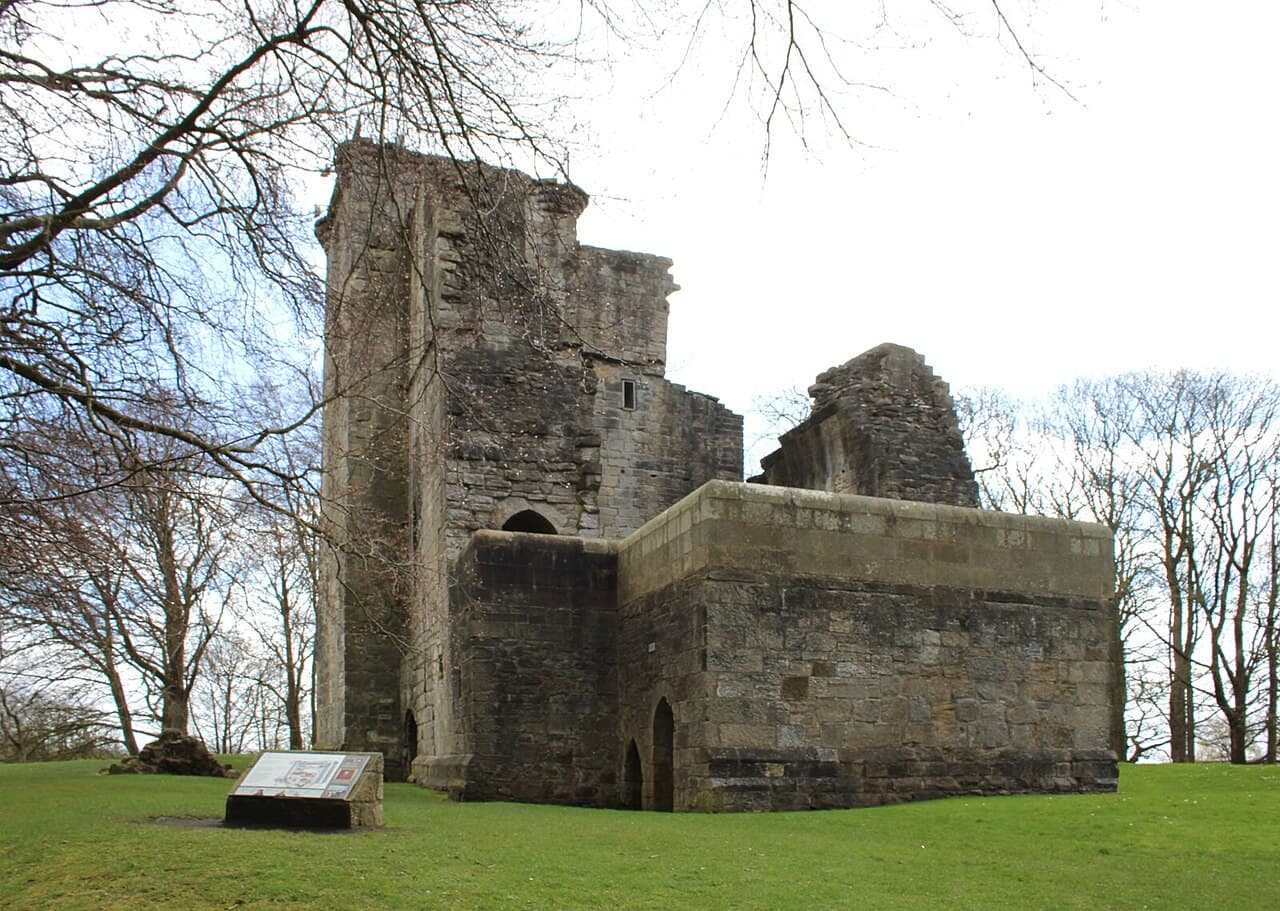
Crookston Castle
Crookston Castle stands as a remarkable example of a late medieval hill castle located in the Pollok area of south-west Glasgow, Scotland. Its origins trace back to the 12th century with a timber and earthwork fortification established by Sir Robert de Croc, whose name also influenced the local village. Archaeological findings reveal that the site hosted an even earlier fortification, underscoring its long-standing strategic importance overlooking the nearby Levern Water and its confluence with the White Cart Water.
The castle's evolution from a timber stronghold to a formidable stone fortress reflects the shifting political and military landscape of medieval Scotland. Around 1400, the Darnley Stewarts replaced the original timber structure with the present stone castle, marking a significant architectural and defensive advancement. This stone castle, characterized by its distinctive irregular X-plan layout, is among the few surviving examples of this uncommon design, also seen at places like Hermitage Castle.
Historical significance and ownership lineage
The lands of Crookston were acquired by Sir Alan Stewart in 1330 and passed to Sir John Stewart of Darnley in 1361. The Stewarts were prominent Scottish nobility, and Crookston became a principal residence for the Earls of Lennox. The castle played a pivotal role during the turbulent times of the late 15th and 16th centuries. In 1489, during a rebellion led by the Stewart Earl of Lennox against King James IV, the castle was bombarded with the famous cannon Mons Meg, brought from Edinburgh. This artillery assault severely damaged the western end of the castle, leading to a swift surrender.
Further military action occurred in 1544 when the castle was besieged and captured by forces led by the Earl of Arran and Cardinal Beaton while the Earl of Lennox was defending Glasgow Castle. At this time, Crookston was recognized as the principal house of the Earls of Lennox, highlighting its political and military importance.
Crookston also holds notable connections to Scottish royal history. The castle is traditionally associated with Henry Stuart, Lord Darnley, the second husband of Mary, Queen of Scots. It is believed they may have been betrothed beneath a yew tree on the castle grounds, a tree that survived until 1816. A model of Crookston Castle, carved from the wood of this yew, is displayed at Pollok House, symbolizing the site's royal associations.
In 1572, the castle was granted to Charles Stewart, Earl of Lennox. Ownership later passed to the Duke of Montrose in 1703, remaining with that family until 1757 when it was sold to the Maxwells of Pollok. After a period of abandonment, the Maxwells partially restored the castle in 1847, coinciding with Queen Victoria's visit to Glasgow. In 1931, Crookston became the first property acquired by the National Trust for Scotland, donated by Sir John Maxwell Stirling-Maxwell, a founder and first Vice President of the Trust.
Architectural features and layout
Site and defensive structures
Perched atop a natural hill, Crookston Castle is encircled by a visible defensive ring-ditch dating back to the 12th century. This earthwork enhanced the castle's natural defenses, with a steep northern slope descending to the Levern Water adding a natural barrier. The castle's prominent position afforded commanding views over the surrounding landscape.
Castle design and structure
The castle's main block is a rectangular stone structure approximately 19 meters by 12 meters, with formidable walls up to 3.7 meters thick. Each corner of the main block was fortified by a tower, creating the castle's distinctive irregular X-plan. This layout provided overlapping fields of fire and strong defensive coverage.
Of the four corner towers, only the north-east tower survives to its full original height, measuring about 6 meters square. The south-east tower's basement also remains, while the two western towers were destroyed during the 15th-century bombardment by James IV's forces and were never rebuilt. Later 19th-century repairs have obscured much of the western remains.
Entrance and internal features
The main entrance is located on the north side adjacent to the north-east tower. It was heavily fortified with a portcullis and two sets of doors to control access. Inside, a mural stair ascends to the upper floors, while ahead lies a barrel-vaulted basement featuring narrow slit windows and a well, essential for water supply during sieges.
The first floor housed the great hall, a vaulted chamber rising to 8.3 meters in height, serving as the main residential and ceremonial space. Above the hall, a turnpike stair in the south-east corner provided access to an additional floor and the upper rooms in the eastern towers. Each tower contained a single room per floor, likely used for private chambers or storage.
Notably, the basement of the north-east tower contained a prison accessible only from above, designed to securely detain prisoners. Modern iron ladders installed during restoration allow visitors to ascend the tower's four storeys, culminating in a roof offering expansive views of the surrounding area. The upper parts of this tower, including the corbels, were rebuilt in the 19th century to preserve structural integrity.
Preservation and public access
Crookston Castle is classified as a ruined structure but remains an important historic monument. Its status as a scheduled monument ensures legal protection and conservation oversight by Historic Environment Scotland. The castle is open to the public, offering visitors a glimpse into Scotland's medieval past and the architectural ingenuity of its builders.
During the Second World War, the castle's north-east tower was repurposed as an aircraft watch tower, illustrating the site's continued strategic relevance. Today, the castle's ruins, combined with the surrounding earthworks and natural landscape, provide a compelling destination for history enthusiasts and tourists alike.
Cultural and historical legacy
As the second-oldest building in Glasgow after Glasgow Cathedral, Crookston Castle holds a special place in the city's heritage. Its connections to the Stewart family, particularly Henry Stuart, Lord Darnley, and Mary, Queen of Scots, enrich its historical narrative. The castle's unique architectural features and its survival through centuries of conflict and change make it a valuable subject for study and preservation.
The castle's partial restoration in the 19th century and subsequent stewardship by the National Trust for Scotland reflect broader efforts to preserve Scotland's medieval heritage. Today, Crookston Castle stands not only as a monument to medieval military architecture but also as a symbol of Scotland's rich and complex history.
Frequently asked questions (FAQ)
- How do I visit Crookston Castle?
- Crookston Castle is open to the public year-round with no admission fee. Visitors can explore the ruins and surrounding earthworks at their own pace. It is advisable to check the Historic Environment Scotland website for any temporary closures or special events.
- What is the historical significance of Crookston Castle?
- Crookston Castle is historically significant as a late medieval stronghold of the Stewart family, notably connected to Henry Stuart, Lord Darnley, husband of Mary, Queen of Scots. It witnessed key military actions, including bombardment by King James IV and sieges in the 16th century.
- Can I access the towers at Crookston Castle?
- The north-east tower is accessible to visitors via modern iron ladders installed during restoration. It offers panoramic views from the roof. Other towers are in ruins and not safe for climbing.
- When was Crookston Castle built?
- The current stone castle was constructed around 1400 by the Darnley Stewarts, replacing an earlier timber and earthwork fortification from the 12th century.
- Is Crookston Castle wheelchair accessible?
- Due to the castle's ruined condition and uneven terrain, wheelchair access is limited. Visitors with mobility issues should contact Historic Environment Scotland in advance for advice on accessibility and alternative viewing options.
Photo gallery

Information
Sources & official resources
Verify the information above using these authoritative references.
Loading map...
Visitor reviews
No reviews yet. Been here? Write the first review and help other travelers!
Write the first reviewVisited this castle? Share your experience
Your review helps other travelers and adds first-hand knowledge to our encyclopedia.



