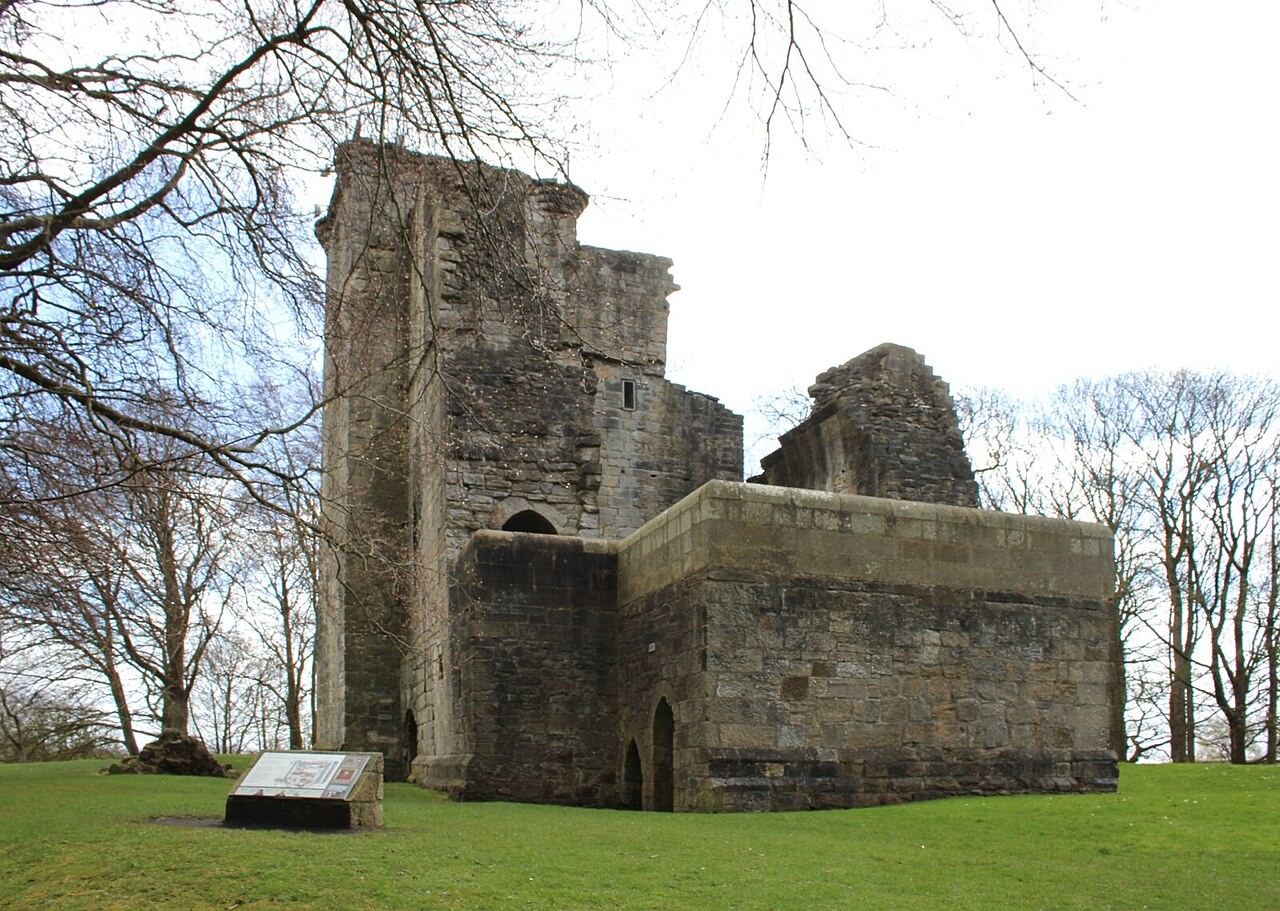
Stanely Castle
Stanely Castle is a late medieval fortress located in Paisley, Scotland, now partially submerged within the waters of the Stanely Reservoir. Constructed in the early 15th century, it originally stood on an island surrounded by marshland, a strategic choice that provided natural defense and isolation. The castle's position on a narrow promontory connected to the reservoir bank on the southwest becomes visible only when the reservoir is drained, revealing its original landform and defensive setting.
Historical background and ownership
The castle was initially the ancient seat of the Danzielston family, a notable local lineage during the medieval period. Ownership transferred in the early 15th century to the Maxwells of Calderwood, a prominent Scottish noble family. In 1629, the estate was sold to Lady Ross of Hawhead, marking another significant change in stewardship. By the 18th century, the castle and estate passed into the hands of the Boyle Earls of Glasgow, a distinguished aristocratic family with extensive landholdings in the region.
Architectural features and condition
Stanely Castle was built as a late medieval stone structure, typical of Scottish island castles of the era, designed to exploit natural water defenses. The castle's architecture likely included defensive walls, towers, and a gatehouse, although much of its detailed layout is now obscured due to its ruined state and partial submersion. Since 1837, the castle has been partially submerged by the reservoir created by the Paisley Water Company, which acquired the property from the 4th Earl of Glasgow to develop the water supply infrastructure for the town.
Today, the castle stands as a ruin and is completely inaccessible to the public. When water levels are low, remnants of the castle's foundations and walls can be observed, indicating its original footprint and defensive design. The partial submersion has preserved some aspects of the structure underwater, limiting archaeological exploration and conservation efforts.
Later uses and significance
Following its period as a noble residence, Stanely Castle was repurposed as a school during the 18th century, reflecting a shift in its functional role within the community. However, it was abandoned by the early 19th century, prior to the reservoir's construction. The transformation of the site into a reservoir in the 19th century dramatically altered the landscape and the castle's accessibility, submerging much of the surrounding marsh and the castle's lower structures.
Geographical and cultural context
Located in Paisley, within the historic county of Renfrewshire, Stanely Castle's setting on an island within a marshland reflects typical defensive strategies of Scottish late medieval castles. The castle's proximity to water was both a defensive advantage and a resource for its inhabitants. Its partial submersion in the Stanely Reservoir is a unique aspect among Scottish castles, highlighting the intersection of historical heritage and industrial development in the region.
Preservation challenges
The castle's status as a ruin submerged in a reservoir poses significant challenges for preservation and study. The waterlogged environment limits archaeological excavation and exposes the structure to erosion and decay. Despite these challenges, Stanely Castle remains an important historical site, offering insights into medieval Scottish architecture and the evolution of land use in Paisley.
Visiting information
Due to its location within the reservoir and its submerged condition, Stanely Castle is inaccessible to visitors. There are no public access routes or facilities at the site, and viewing opportunities are limited to times when the reservoir is drained for maintenance or inspection. Visitors interested in the castle's history can explore local museums and archives in Paisley that document the region's medieval heritage and the castle's role in local history.
Information
Loading map...
Visitor reviews
No reviews yet. Been here? Write the first review and help other travelers!
Write the first reviewVisited this castle? Share your experience
Your review helps other travelers and adds first-hand knowledge to our encyclopedia.