Crichton Castle
Crichton Castle stands as a remarkable example of Scottish medieval architecture, located near the village of Crichton in Midlothian, Scotland. Perched strategically at the head of the River Tyne, it lies approximately two miles from both Pathhead and Gorebridge. This hill castle was originally constructed in the late 14th century as a fortified tower house, reflecting the defensive needs and domestic aspirations of the Scottish nobility during the late medieval period.
The castle's initial builder, John de Crichton, established the tower house as the family seat. His son, William Crichton, 1st Lord Crichton, significantly expanded the structure in the 15th century as the family's influence grew, coinciding with his prominent role as Lord Chancellor of Scotland. William's involvement in the infamous Black Dinner of 1440 led to the Crichtons acquiring the powerful Douglas family's estates, including Bothwell Castle. This event triggered violent reprisals, including an attack and slighting of Crichton Castle in 1445 by John of Corstorphine, a Douglas loyalist. Nevertheless, the castle was rebuilt and extended, and a nearby collegiate church was founded, enhancing the family's regional prominence.
Architectural evolution and features
Medieval tower house origins
The castle's earliest section, the east tower, dates from its original 14th-century construction. This tower featured a vaulted basement, a timber entresol intermediate floor, and a vaulted hall above, typical of Scottish tower houses designed for both defense and residence. The south tower was added in the early 15th century, creating an L-shaped layout. This addition included vaulted cellars flanking a central entrance and two upper halls, reflecting its dual function as a stronghold and noble residence. The gatehouse was positioned between these towers, controlling access to the central courtyard.
15th-century expansions and the west block
Later in the 15th century, a substantial west block was constructed, featuring a six-storey tower at its southwest corner. This tower contained multiple bedrooms with garderobes (medieval toilets) and was accessed via a staircase in the south block, indicating a sophisticated internal layout designed for comfort and defense. Surrounding the core buildings was a barmkin or enclosed courtyard wall, supplemented by earthworks to enhance the castle's defensive capabilities.
Italianate north range and Renaissance influence
In the 1580s, under the ownership of Francis Stewart, 5th Earl of Bothwell, the castle underwent a dramatic transformation with the addition of the Italianate north range. Stewart, having traveled extensively in Europe, was inspired by Renaissance architecture, particularly the Palazzo dei Diamanti in Ferrara, Italy. This influence is evident in the north façade's distinctive diamond-patterned rustication, a rare and innovative feature in Scottish architecture. The façade also bears the initials of Francis Stewart and his wife, Margaret Douglas, alongside an anchor symbol representing Stewart's role as Lord High Admiral of Scotland.
Inside, the north range introduced Scotland's first known example of a scale-and-platt staircase, a modern stair design with landings and straight flights, replacing traditional spiral staircases. Adjacent to the original tower, a drawing room was added, reflecting Renaissance domestic comfort and style. South of the main castle complex lies a large stable block dating from the same period, notable for its horseshoe-shaped entrance wide enough for mounted riders and living quarters above for stable staff or guests.
Historical significance and ownership
The Crichton family and political intrigue
The Crichton family's prominence peaked under William Crichton, whose political maneuvering included orchestrating the Black Dinner, a pivotal event that reshaped Scottish noble power dynamics. The family's fortunes waned after the 3rd Lord Crichton supported the rebellious Alexander Stewart, Duke of Albany, leading to forfeiture of their lands and titles in 1483. The castle briefly passed to Sir John Ramsey before being granted by James IV to Patrick Hepburn, Lord Hailes, later Earl of Bothwell.
The Hepburns and the tumultuous 16th century
The Hepburn family held Crichton Castle through a turbulent period marked by religious and political conflict. The castle was besieged and captured in 1560 during the Scottish Reformation by the forces of Regent Arran. It was also the site of the 1562 wedding of Jean Hepburn and John Stewart, Prior of Coldingham, half-brother to Mary, Queen of Scots, who stayed at the castle during the festivities.
James Hepburn, 4th Earl of Bothwell, infamous for his involvement in the murder of Lord Darnley and subsequent marriage to Mary, Queen of Scots, forfeited the castle in 1567. Ownership then passed to his illegitimate grandson, Francis Stewart, who infused the castle with Renaissance style but later fell from royal favor and fled Scotland following accusations of witchcraft.
Later history and cultural legacy
By the late 16th century, Crichton Castle had begun to decline in importance and fell into disuse. It was recorded as a source of building stone by 1659, indicating partial dismantling. In the 20th century, the castle was placed under state care by Major Henry Callander in 1956 and is now managed by Historic Environment Scotland as a scheduled monument.
The castle has inspired artists and writers, notably J. M. W. Turner, who painted its evocative ruins. It also appears in Sir Walter Scott's poem Marmion and has served as a filming location for movies such as Rob Roy (1995) and The Wicker Tree (2011), cementing its place in Scotland's cultural heritage.
Architectural remains and visitor experience
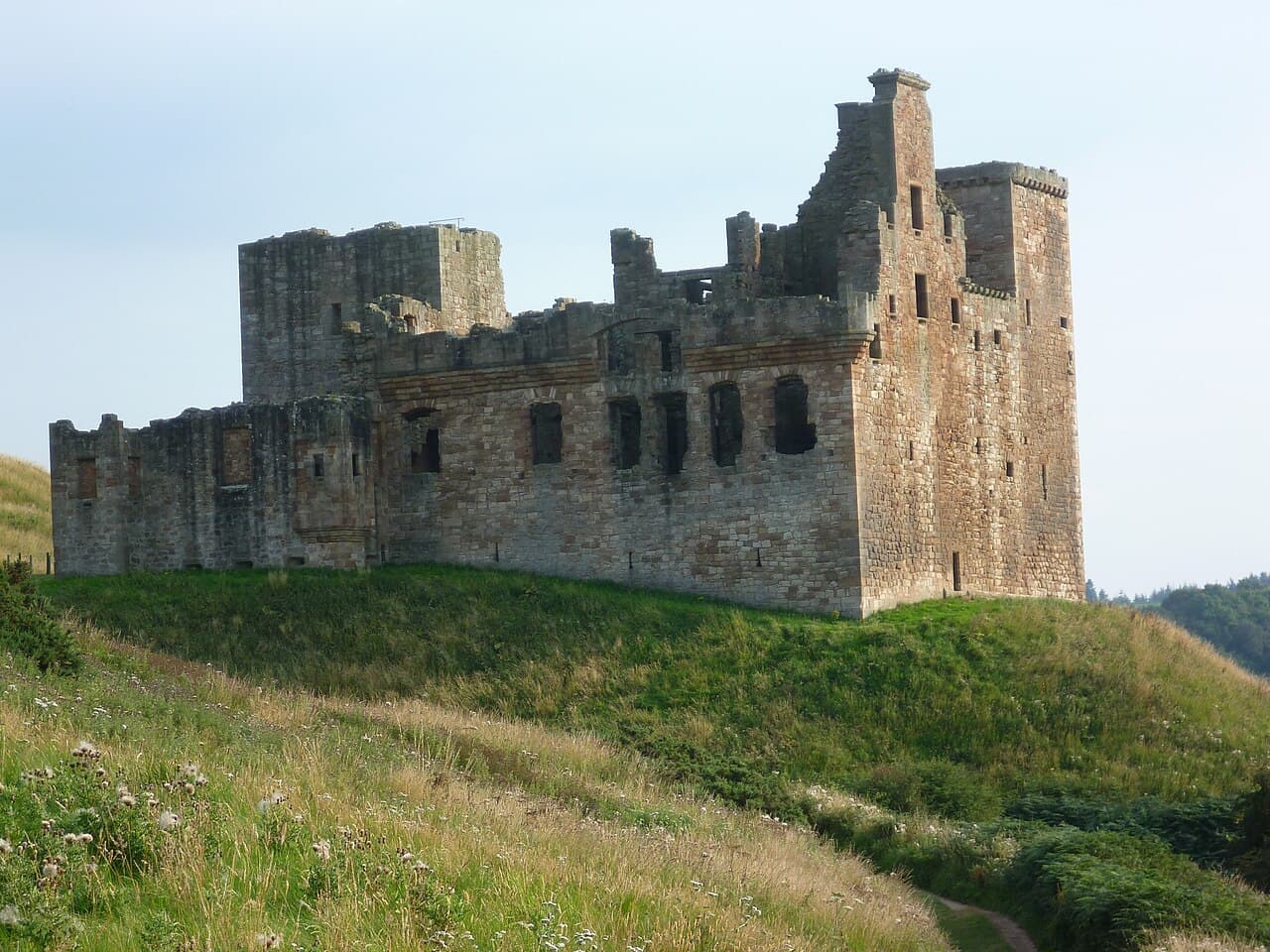
Today, visitors to Crichton Castle can explore the ruins that reveal the castle's layered history through its four interconnected buildings arranged around a central courtyard. The surviving tower houses, gatehouse, and the distinctive diamond-faceted north range offer insight into the evolution of Scottish noble residences from fortified medieval strongholds to Renaissance-inspired homes.
The castle's local sandstone construction ties it visually and materially to the surrounding landscape. The stable block and the remnants of defensive earthworks and courtyard walls further illustrate the castle's original function as a self-contained fortified estate.
Accessible to the public under the stewardship of Historic Environment Scotland, Crichton Castle provides a compelling destination for those interested in Scottish history, architecture, and the dramatic stories of the noble families who shaped its past.
Frequently asked questions (FAQ)
- How do I get to Crichton Castle?
- Crichton Castle is located near the village of Crichton in Midlothian, Scotland. It is accessible by car and local roads from nearby towns such as Gorebridge and Pathhead. Public transport options are limited, so driving or cycling is recommended.
- What are the opening hours for visiting Crichton Castle?
- Crichton Castle is managed by Historic Environment Scotland and is generally open to the public year-round during daylight hours. It is advisable to check the official Historic Environment Scotland website for any seasonal variations or special closures before planning your visit.
- Is there an entrance fee to visit Crichton Castle?
- There is no entrance fee to visit Crichton Castle as it is maintained by Historic Environment Scotland and open to the public free of charge.
- What is the historical significance of Crichton Castle?
- Crichton Castle played a key role in Scottish history, particularly during the late medieval and Renaissance periods. It was associated with influential families such as the Crichtons and Hepburns, and notable events including the Black Dinner and the marriage of Jean Hepburn attended by Mary, Queen of Scots.
- Can I explore the interior of Crichton Castle?
- As Crichton Castle is now a ruin, visitors can explore the exterior walls, towers, and courtyard. Some interior sections are accessible, but caution is advised due to uneven surfaces and partial collapse. There are no modern facilities inside the ruins.
- Why is the north range of Crichton Castle architecturally important?
- The north range, built in the 1580s by Francis Stewart, features an Italianate façade with diamond-patterned rustication inspired by the Palazzo dei Diamanti in Italy. It also includes Scotland's first known scale-and-platt staircase, marking a significant Renaissance influence in Scottish castle architecture.
Photo gallery

Information
Sources & official resources
Verify the information above using these authoritative references.
Loading map...
Visitor reviews
No reviews yet. Been here? Write the first review and help other travelers!
Write the first reviewVisited this castle? Share your experience
Your review helps other travelers and adds first-hand knowledge to our encyclopedia.