Borthwick Castle
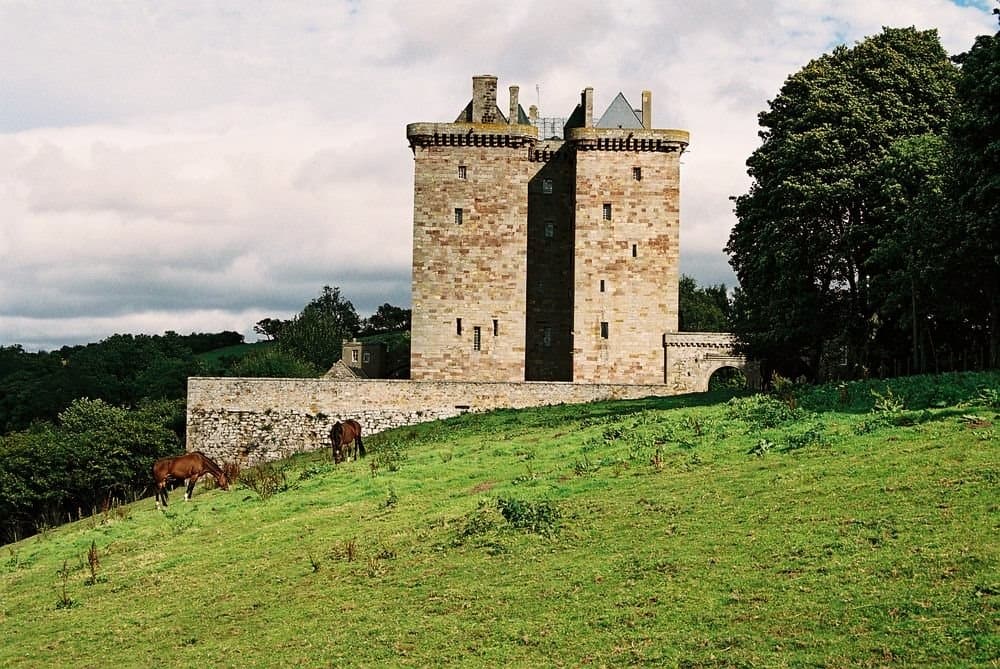
Borthwick Castle stands as one of the most imposing and best-preserved medieval Scottish fortifications, located near Gorebridge in Scotland. Constructed in the 15th century, it represents a quintessential example of a late medieval hill castle with a distinctive U-shaped tower house design. The castle's origins trace back to an earlier fortification on the site known as the Mote of Locherwart, before Sir William Borthwick obtained a royal licence from King James I in 1430 to erect the current stone fortalice. This licence was notable, as Scottish nobles typically did not require formal permission to build defensive structures.
The castle is perched on a small hill, naturally defended by steep slopes on three sides and originally surrounded by a stream, enhancing its strategic defensive position. Its massive sandstone ashlar walls rise to approximately 110 feet (34 meters), with thicknesses reaching up to 14 feet (4.3 meters), showcasing the formidable construction techniques of the period. The U-shaped keep consists of two slightly asymmetrical towers separated by a narrow gap, a design that was unusual for Scottish castles of the time. Surrounding the tower house is a defensive courtyard fortified with round corner towers pierced with shot-holes, evidencing the castle's military purpose.
Architectural features and construction details
Tower house and defensive structures
The castle's central feature is its tall tower house, which remains exceptionally well preserved. The tower house has two original round-headed doorways: one at ground level leading to the subterranean kitchen and storage vaults, and another at first-floor level providing direct access to the great hall via a reconstructed stone bridge. The walls are built from finely cut sandstone blocks assembled in ashlar masonry, giving the castle a smooth and durable exterior. The battlements, though no longer retaining their original stepped crenellations, are supported by massive projecting corbels with corner roundels, highlighting the castle's defensive capabilities.
The great hall
The great hall measures approximately 40 feet (12 meters) in length and is notable for its impressive height and architectural detailing. It features a barrel-vaulted Gothic ceiling painted with images of the castle itself and bears the inscription "De Temple of Honor" in Gothic script. The hall's large chimney is adorned with decorative designs, reflecting the blend of functional and artistic elements within the castle's interior. This hall would have served as the main communal and ceremonial space within the castle.
Historical significance and notable events
The borthwick family and early history
Sir William Borthwick, the castle's founder, established the fortress as the family's ancestral seat after acquiring lands from William Hay, whose resentment towards the rising Borthwicks is documented in historical accounts. The castle played a pivotal role in Scottish noble affairs during the 15th and 16th centuries, including the turbulent period of the Rough Wooing wars between Scotland and England. Notably, in 1544, John, the 5th Lord Borthwick, was captured, leading to a reciprocal hostage situation involving his wife, Isobel Lindsay, who detained the 3rd Earl of Bothwell at Borthwick until her husband's release.
Mary, queen of scots and the 1567 siege
Mary, Queen of Scots visited Borthwick Castle in 1563 and again in 1566. The castle is famously linked to her marriage to James Hepburn, 4th Earl of Bothwell, which took place in May 1567. Shortly after, Mary and Bothwell were besieged at Borthwick by forces led by Lord Home and the laird of Cessford. The queen is said to have escaped the siege disguised as a male page. However, she was later captured and imprisoned at Lochleven Castle. Bothwell fled Scotland, eventually dying in exile in Norway in 1578. This episode marks one of the castle's most dramatic historical moments, intertwining its story with Scotland's royal and political turmoil.
Cromwell's siege and later history
In 1650, during Oliver Cromwell's military campaign in Scotland, Borthwick Castle was attacked and surrendered after only a few cannon shots. The damage inflicted during this siege remains visible today as a large cannon scar on one of the castle's walls. Following a period of abandonment, the castle underwent restoration by 1914. During World War II, it served a crucial role as a secure hiding place for national treasures. In 1973, the castle was leased from the Borthwick family and converted into an exclusive hire venue, undergoing further restoration starting in 2013 and reopening in 2015.
Preservation and current status
Borthwick Castle is remarkably intact for a structure of its age, with the main tower house and much of the surrounding curtain wall preserved or restored. The castle's fine sandstone ashlar masonry and architectural features such as the original doorways and vaulted great hall have been carefully maintained. The battlements, while no longer at their original height, retain their medieval character through the surviving corbels and turrets. The castle remains under the ownership of the Borthwick family and operates as a venue for exclusive events, allowing visitors to experience a living piece of Scottish history.
Cultural and architectural legacy
Borthwick Castle exemplifies the evolution of Scottish castle architecture in the late medieval period, combining defensive features with residential comfort and status symbolism. Its U-shaped tower house design with a defensive courtyard and corner towers reflects the military needs of the time while also serving as a noble residence. The castle's association with significant historical figures, especially Mary, Queen of Scots, enhances its cultural importance. Nearby, the parish church of St Kentigern houses medieval funerary effigies of Sir William Borthwick and his wife, as well as a 15th-century aisle linked to the family, further cementing the castle's historical footprint in the region.
Frequently asked questions (FAQ)
- What is the historical significance of Borthwick Castle?
- Borthwick Castle is one of the best-preserved medieval castles in Scotland, dating back to the 15th century. It played a crucial role in the Wars of Scottish Independence and served as a stronghold for important historical figures, such as Mary, Queen of Scots, who visited the castle in 1567.
- When was Borthwick Castle built?
- Borthwick Castle was constructed between 1430 and 1450 by Sir William Borthwick. Its impressive architecture and robust defenses reflect the turbulent times during which it was built, making it a significant example of medieval Scottish military architecture.
- Can I visit Borthwick Castle?
- Yes, Borthwick Castle is open to visitors for guided tours and private events. It is advisable to check the castle's official website for the latest information on visiting hours and any special events.
- What are the opening hours for Borthwick Castle?
- Borthwick Castle typically opens to visitors from April to October, with tours available on specific days. Opening hours can vary, so it's best to confirm times on the castle's official website before planning your visit.
- Is it possible to host events at Borthwick Castle?
- Yes, Borthwick Castle is available for private events, including weddings and corporate functions. The castle offers a unique and historic setting, and interested parties should contact the venue for more information on packages and availability.
- What are the ticket prices for visiting Borthwick Castle?
- Ticket prices for Borthwick Castle can vary depending on the type of tour or event. It is recommended to check the official website for detailed pricing information and any discounts that may be available for groups or special occasions.
- When is the best time to visit Borthwick Castle?
- The best time to visit Borthwick Castle is during the spring and summer months, from April to September, when the weather is more favorable and the grounds are particularly beautiful. Additionally, the castle often hosts special events during this time, enhancing the visitor experience.
- Is Borthwick Castle accessible for visitors with mobility issues?
- Borthwick Castle has made efforts to improve accessibility for visitors with mobility challenges. However, due to its historical structure, some areas may be difficult to navigate, so it's advisable to contact the castle in advance to discuss specific needs and available accommodations.
- What nearby attractions can I visit while at Borthwick Castle?
- While visiting Borthwick Castle, you can explore nearby attractions such as the historic town of Gorebridge and the beautiful Midlothian countryside. Other local highlights include Rosslyn Chapel and the Pentland Hills Regional Park, both offering stunning scenery and rich history.
Photo gallery

Information
Website
Visit websiteSources & official resources
Verify the information above using these authoritative references.
Loading map...
Visitor reviews
No reviews yet. Been here? Write the first review and help other travelers!
Write the first reviewVisited this castle? Share your experience
Your review helps other travelers and adds first-hand knowledge to our encyclopedia.