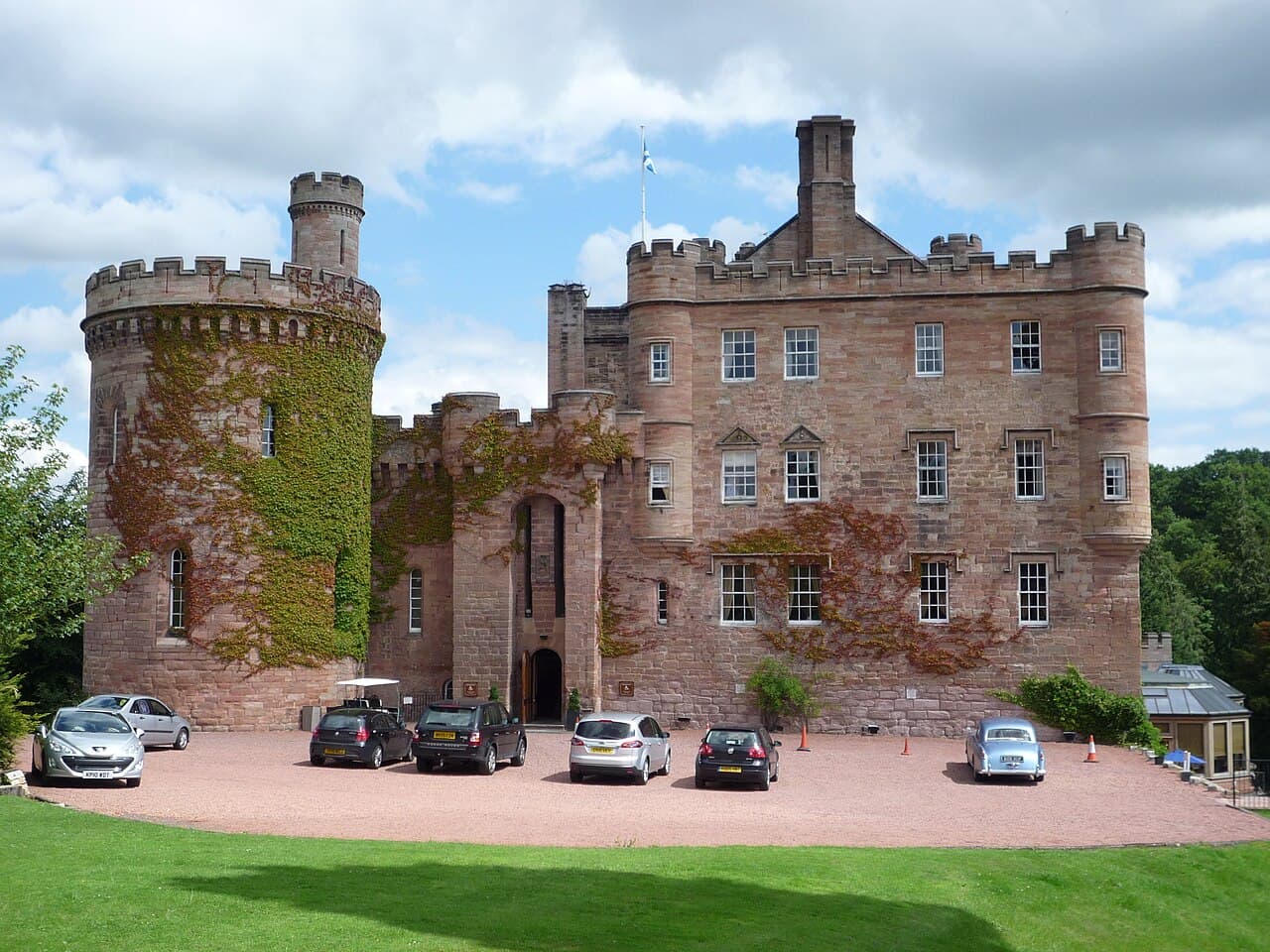
Dalhousie Castle
Dalhousie Castle stands as a remarkable example of Scottish medieval and early modern fortification and noble residence. Located near Bonnyrigg in Midlothian, Scotland, about 13 kilometers south of Edinburgh, the castle occupies a commanding position overlooking the River Esk. Its origins trace back to the mid-12th century, around 1140, when Simundus de Ramesie, an English knight of Norman descent and vassal to David, Earl of Huntingdon (later King of Scotland), established the first fortification on the site then known as Dalwolsey. This foundation marked the beginning of the Clan Ramsay legacy and the castle's role as their ancestral seat for more than eight centuries, the longest continuous family ownership of any Scottish castle.
Early history and foundation
The initial castle constructed by Simundus de Ramesie was a strategic stronghold designed to secure the area and assert control over the surrounding lands. The location was chosen for its natural defensive advantages—situated on elevated ground with views over the river valley, it controlled key routes south of Edinburgh. The early structure likely consisted of timber and earthworks, typical of Norman fortifications of the period, though no physical remains of this earliest phase survive today.
By the 15th century, the castle had evolved into a substantial stone fortress. The oldest surviving part of the current structure is the mid-15th-century drum tower, a round defensive tower integrated into the castle's L-plan layout. This architectural form was common in Scottish castles, combining a main rectangular block with a projecting wing, allowing for better defense and more comfortable living quarters.
Medieval military significance
Dalhousie Castle played a notable role in Scotland's turbulent medieval history. In 1298, King Edward I of England, known as Longshanks, stayed at the castle as he prepared for the Battle of Falkirk, a key conflict during the Wars of Scottish Independence. This highlights the castle's strategic importance on the borderlands between Scotland and England.
In 1400, the castle endured a significant military episode when Sir Alexander Ramsay successfully withstood a six-month siege by English forces led by King Henry IV. This prolonged defense underscored the fortress's strength and the Ramsay family's determination to maintain their hold on the territory.
Later, in the 17th century, Oliver Cromwell used Dalhousie Castle as a military base during his invasion of Scotland, further cementing its role as a strategic military asset across centuries.
Architectural development and estate features
The castle as it stands today largely reflects the extensive rebuilding and expansion carried out during the 17th century. The red sandstone construction features robust defensive walls, battlements, and the characteristic L-plan with the drum tower anchoring one corner. Originally, the castle was surrounded by a dry moat, a defensive ditch that was later filled in but partially re-excavated in the late 20th century, revealing insights into the castle's original defenses.
Around 1800, the castle's grounds were enhanced with a walled garden redesigned by the renowned landscape gardener Walter Nicol. This garden added a formal aesthetic to the estate, reflecting the transition of the castle from purely defensive fortress to a stately country residence with cultivated green spaces.
Later history and modern transformation
Dalhousie Castle remained the seat of the Earls of Dalhousie and the Ramsay clan for centuries. Around the turn of the 20th century, the clan seat was relocated to Brechin Castle, though Dalhousie remained under Ramsay ownership until 1977, marking an extraordinary eight-century tenure.
Throughout the 20th century, the castle was leased to various tenants, including a boarding school, before its conversion into a hotel in 1972. This adaptive reuse preserved the castle's historic fabric while allowing it to serve a new function in hospitality. In 2003, the property was acquired by Von Essen Hotels for approximately £10 million.
In June 2004, a significant fire damaged the castle's roof area. Thanks to prompt evacuation and firefighting efforts by the Lothian and Borders Fire Brigade, the damage was contained without major structural loss. Restoration work was undertaken to repair the roof and preserve the castle's integrity, enabling the hotel to resume operations.
Following financial difficulties faced by Von Essen Hotels, Dalhousie Castle was sold in 2012 to Robert Parker, a private owner with interests in historic properties.
Architectural highlights and preservation
Dalhousie Castle's architecture is a blend of medieval and early modern Scottish styles. The drum tower remains a key defensive feature, while the 17th-century expansions added more comfortable living quarters and refined stonework. The castle's L-plan design maximizes defensibility while providing residential space.
The partially excavated dry moat offers valuable archaeological evidence of the castle's defensive arrangements. The red sandstone used throughout the construction gives the castle its distinctive appearance, harmonizing with the natural landscape.
The walled garden designed by Walter Nicol is an important landscape element, illustrating the evolution of the estate from fortress to country house. The garden's layout and planting reflect early 19th-century tastes and gardening practices.
Cultural significance and visitor experience
Dalhousie Castle is not only a historic monument but also a living heritage site. Its conversion to a hotel allows visitors to experience the atmosphere of a Scottish castle with modern comforts. The castle's long association with the Ramsay family and its involvement in key historical events make it a place of considerable cultural importance.
Visitors can explore the castle's historic interiors, enjoy the scenic views over the River Esk, and appreciate the carefully maintained gardens. The castle's preservation efforts ensure that its architectural and historical character remains intact for future generations.
Dalhousie Castle exemplifies the layered history of Scottish castles, combining military, residential, and landscape elements that tell the story of Scotland's noble families and their enduring legacy.
Frequently asked questions (FAQ)
- What is the historical significance of Dalhousie Castle?
- Dalhousie Castle, dating back to the 13th century, is one of the oldest fortified buildings in Scotland. It has served as a stronghold for the Ramsay family for centuries and reflects the rich heritage of Scottish feudal history.
- When was Dalhousie Castle built?
- Dalhousie Castle was originally constructed in the 13th century, with significant renovations taking place in the 19th century. The castle has evolved over the years, showcasing various architectural styles and historical features.
- Can I visit Dalhousie Castle?
- Yes, Dalhousie Castle is open to visitors who wish to explore its rich history and stunning architecture. Guided tours are available, allowing guests to learn more about the castle's past and its significance in Scottish history.
- What are the opening hours of Dalhousie Castle?
- Dalhousie Castle typically opens to visitors from 10 AM to 5 PM daily, but it's advisable to check their official website for any seasonal changes or special events. Pre-booking may be required for guided tours.
- Is Dalhousie Castle accessible for those with mobility challenges?
- Yes, Dalhousie Castle strives to be accessible for all visitors. However, some areas may have limited access due to the historical nature of the site, so it is recommended to contact the castle in advance for specific accessibility inquiries.
- What is the best time to visit Dalhousie Castle?
- The best time to visit Dalhousie Castle is during the spring and summer months when the weather is mild, and the gardens are in full bloom. Visiting during these seasons also allows you to enjoy outdoor events and activities hosted at the castle.
- Are there any nearby attractions to Dalhousie Castle?
- Yes, nearby attractions include the picturesque village of Bonnyrigg and the scenic Pentland Hills Regional Park, perfect for hiking and outdoor activities. Additionally, Edinburgh is just a short drive away, offering a wealth of historical sites and cultural experiences.
- What are the ticket prices for visiting Dalhousie Castle?
- Ticket prices for Dalhousie Castle vary depending on the type of tour and age of the visitor, typically ranging from £10 to £15 for adults. Discounts may be available for children, seniors, and groups, so it's best to check the official website for the most current pricing details.
Photo gallery

Information
Website
Visit websiteSources & official resources
Verify the information above using these authoritative references.
Loading map...
Visitor reviews
No reviews yet. Been here? Write the first review and help other travelers!
Write the first reviewVisited this castle? Share your experience
Your review helps other travelers and adds first-hand knowledge to our encyclopedia.



