Criccieth Castle
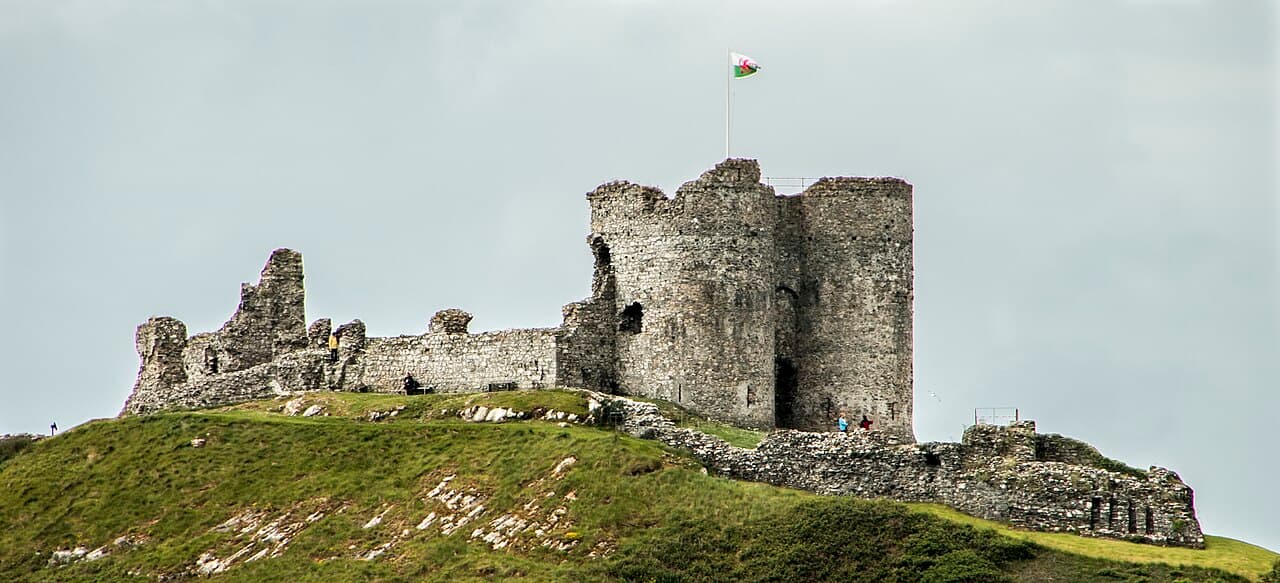
Criccieth Castle stands prominently on a rocky headland overlooking Tremadog Bay in the town of Criccieth, Gwynedd, Wales. This hill castle is a remarkable example of medieval military architecture, reflecting the turbulent history of Welsh-English relations during the High Medieval period. Constructed initially in the early 13th century by the Welsh prince Llywelyn the Great (Llywelyn ap Iorwerth), the castle's strategic coastal location provided commanding views of the sea and surrounding lands, crucial for defense and control.
The castle's construction began with the establishment of the inner ward and a distinctive twin D-shaped tower gatehouse, which was unusual among native Welsh fortifications for its advanced defensive features, including a portcullis, murder holes, and arrow slits. The gatehouse was likely inspired by contemporary English designs such as Beeston Castle in Cheshire and Montgomery Castle in Powys, demonstrating a blend of Welsh and English architectural influences.
Phases of construction and architectural evolution
Early building phase under llywelyn the great
The initial phase in the 1230s focused on creating a defensible core with the inner ward and the impressive gatehouse. This phase established the castle's fundamental layout, including the vaulted gate passage with a spring-fed cistern, ensuring a reliable water source within the fortification. The gatehouse towers provided both defense and accommodation, featuring guard chambers and living quarters.
Expansion under llywelyn ap gruffudd
In the 1260s or 1270s, Llywelyn ap Gruffudd, grandson of Llywelyn the Great, expanded the castle by adding an outer ward with its own curtain wall and a new gateway featuring a large two-storey rectangular tower. This addition created a dual-circuit defense system, enhancing the castle's military capabilities during a period of increasing conflict with English forces.
Edwardian modifications and enhancements
Following the castle's capture by Edward I in 1283 during his conquest of Wales, significant modifications were undertaken by the renowned architect James of Saint George. These included raising the height of the gatehouse towers, strengthening existing mural towers, and constructing an outer barbican to protect the entrance. The addition of the Engine Tower, possibly designed to house siege engines, reflects the castle's adaptation to evolving military technology.
Military history and sieges
Criccieth Castle endured several military actions throughout its history. It withstood a siege during the Welsh revolt of 1294–1295 led by Madog ap Llywelyn, demonstrating its robust defenses. Later, in 1404, the castle fell to Welsh forces under Owain Glyndŵr during his widespread rebellion against English rule. Following its capture, the castle was deliberately damaged and set ablaze, leaving scorch marks visible on some surviving stonework.
Architectural features and surviving remains
Inner ward and gatehouse
The heart of the castle is the inner ward, a roughly six-sided polygon surrounded by a curtain wall, largely intact except for a section between the gatehouse and a south-east tower. The twin D-shaped gatehouse towers remain a dominant feature, with their vaulted passage, portcullis, and multiple defensive layers. The presence of a spring-fed cistern beneath the gatehouse highlights the castle's self-sufficiency in water supply.
Each gatehouse tower contained guardrooms equipped with triple arrow slits aimed outward, and upper floors likely served as living quarters. The west tower includes external latrine projections and evidence of a chapel, indicated by the discovery of a gilt bronze and enamel crucifix from Limoges, underscoring the spiritual life within the fortress.
Outer ward and defensive structures
The outer ward features several towers, including a north tower with latrine chutes and wide staircases designed for moving ammunition or equipment. The larger south-west tower, originally two storeys, was enhanced under Edward I with new stairways, decorative stonework such as chamfered doorways, corbels carved with foliage and human heads, and foliate capitals.
The outer gatehouse evolved into a fortified entrance with a second gate and thickened walls, complemented by the Edwardian addition of a barbican to strengthen the castle's defenses.
Cultural significance and preservation
Criccieth Castle holds a prominent place in Welsh heritage as a symbol of native Welsh resistance and later English conquest. It inspired the Romantic artist Joseph Mallord William Turner, who depicted the castle in his evocative series of paintings of shipwrecked mariners, capturing its dramatic coastal silhouette.
After centuries of decline and ruin, the castle underwent restoration efforts in the late 19th century under Lord Harlech and was placed under state guardianship in 1933. Archaeological investigations led by Bryan O’Neil contributed to understanding its complex history and architecture. Today, the castle is maintained by Cadw, the Welsh government's historic environment service, and serves as a popular tourist destination with exhibits on Welsh castles and the Anglo-Norman writer Gerald of Wales.
The castle's layered history, architectural complexity, and coastal setting make it a significant monument for understanding medieval Welsh fortifications and the broader history of Wales during the High Medieval period.
Frequently asked questions (FAQ)
- What are the opening hours of Criccieth Castle?
- Criccieth Castle is typically open to visitors from 10 AM to 5 PM, with variations during the winter months. It's advisable to check the official website for any changes to opening hours, especially around public holidays.
- When was Criccieth Castle built?
- Criccieth Castle was constructed in the late 13th century, specifically around 1283, under the orders of Edward I. This historical landmark played a significant role in the Welsh struggles against English rule.
- Is it possible to access Criccieth Castle with a wheelchair?
- While efforts have been made to improve accessibility, some areas of Criccieth Castle may pose challenges for wheelchair users due to uneven terrain and steep pathways. It is recommended to contact the site in advance for detailed accessibility information.
- What is the historical significance of Criccieth Castle?
- Criccieth Castle is notable for its strategic location overlooking the sea and its role in the defense against Welsh uprisings. It was the site of several battles and has witnessed key events in Welsh history.
- Can I purchase tickets online for Criccieth Castle?
- Yes, tickets for Criccieth Castle can be purchased online through their official website. Buying tickets in advance is recommended to avoid long queues, especially during peak tourist season.
- What is the best time to visit Criccieth Castle?
- The best time to visit Criccieth Castle is during the spring and early autumn months when the weather is generally mild, and the gardens are in bloom. Summer can be busy with tourists, so visiting in the shoulder seasons may offer a more pleasant experience.
- Are there any nearby attractions to visit alongside Criccieth Castle?
- Yes, nearby attractions include the picturesque beach at Criccieth, the charming town center, and the stunning landscape of Snowdonia National Park. Exploring these sites can enrich your visit to the castle.
- How do I get to Criccieth Castle?
- Criccieth Castle is easily accessible by car, with ample parking options available nearby. If you are using public transport, local bus services connect Criccieth to larger towns and cities in the area.
- What are the ticket prices for Criccieth Castle?
- Ticket prices for Criccieth Castle are generally affordable, with discounts available for children, students, and seniors. It's best to check the official website for the most current pricing and any available promotions.
Photo gallery

Information
Website
Visit websiteSources & official resources
Verify the information above using these authoritative references.
Loading map...
Visitor reviews
No reviews yet. Been here? Write the first review and help other travelers!
Write the first reviewVisited this castle? Share your experience
Your review helps other travelers and adds first-hand knowledge to our encyclopedia.