Craigmillar Castle
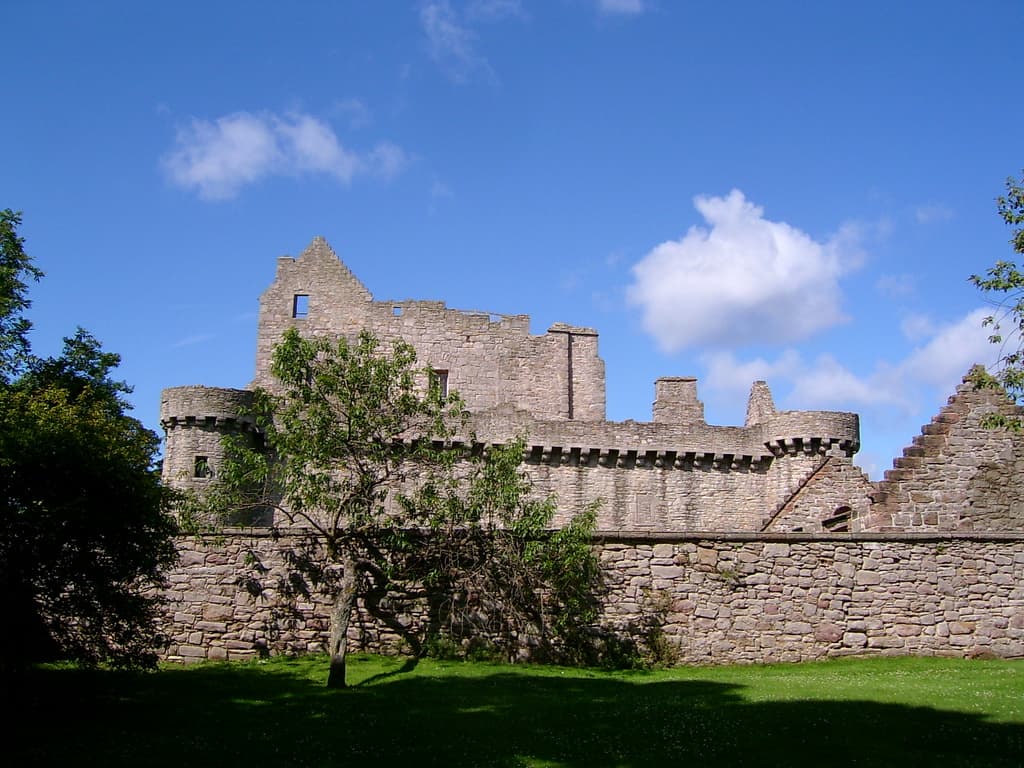
Craigmillar Castle stands prominently on the southern outskirts of Edinburgh, Scotland, offering a remarkable glimpse into the country's late medieval fortifications and noble residences. This castle is celebrated as one of Scotland's best preserved castles, retaining much of its original character as a medieval stronghold despite centuries of change. Its location near the capital city places it within an urban setting, yet it evokes the atmosphere of a rural retreat from its historical past.
The castle's origins trace back to the early 15th century, beginning with the construction of an L-plan tower house that formed the core of the complex. This tower house, rising approximately 17 meters to its battlements with walls nearly 3 meters thick, was among the earliest examples of this architectural form in Scotland. The tower included a great hall on the first floor and a series of interconnected private chambers. Notably, the so-called "Queen Mary's Room" on the first floor is traditionally associated with Mary Queen of Scots, although historical evidence suggests she likely stayed in a more private apartment within the courtyard's east range.
Historical development and ownership
The castle was granted in 1374 by King Robert II to Sir Simon Preston, whose family held the estate for nearly three centuries. Over time, the Prestons expanded and fortified the castle, reflecting both the defensive needs and residential aspirations of its owners. In the 15th century, a robust enclosure wall with round towers at each corner was constructed around the original tower house. These walls were equipped with machicolations, architectural features designed to allow defenders to drop projectiles or pour boiling substances on attackers at the base of the walls, a testament to the castle's military function.
During the 16th century, the castle underwent further expansion with the addition of an outer curtain wall that created a large outer courtyard. This development transformed Craigmillar from a purely defensive structure into a more comfortable and complex residence, incorporating ancillary buildings such as a private family chapel within the courtyard walls. The castle's layout, with multiple ranges and defensive features, exemplifies the evolution of Scottish castles from fortified tower houses to more elaborate noble residences.
Craigmillar Castle and Mary Queen of Scots
Mary Queen of Scots is closely linked to Craigmillar Castle's history. She visited the castle several times and stayed there during pivotal moments in her reign. In 1566, the castle was the site of a secret meeting involving conspirators such as the Earls of Argyll, Huntly, and Bothwell, as well as Sir James Balfour and William Maitland of Lethington. These nobles plotted the removal of Mary's husband, Henry, Earl of Darnley. The following year, Darnley was found murdered after the explosion of the house where he was staying, an event that remains one of Scotland's most infamous royal intrigues.
Mary's association with Craigmillar extends beyond political conspiracies; the castle served as a refuge after the murder of her secretary, David Rizzio. The castle's role in these dramatic episodes underscores its importance not only as a military and residential site but also as a stage for Scotland's turbulent political history during the Renaissance period.
Later history and architectural changes
After nearly 300 years of Preston family ownership, David Preston sold Craigmillar Castle in 1660 to Sir John Gilmour. The Gilmour family initiated significant renovations, including the construction of a new residential range on the west side of the inner courtyard. This addition reflected changing tastes and the desire for modern comforts while maintaining the castle's historic fabric.
During the 18th century, the Gilmours relocated to nearby Inch House, and Craigmillar gradually fell into disrepair. Despite this decline, the castle's substantial stonework and defensive walls remained largely intact. In 1813, a walled-up skeleton was discovered in one of the vaults, adding to the castle's aura of mystery and historical intrigue.
Architectural features and castle layout
The tower house and great hall
The original L-plan tower house is the centerpiece of Craigmillar Castle. Its massive walls and battlements are characteristic of Scottish tower houses of the period. The great hall on the first floor was the social and administrative heart of the castle, hosting feasts, meetings, and courtly events. The tower's design includes defensive features such as narrow windows and thick walls, balancing comfort with security.
Enclosure walls and defensive structures
The 15th-century curtain wall enclosing the tower house is fortified with round corner towers and topped with machicolations. These defensive features allowed defenders to protect the castle effectively against siege tactics common in the medieval period. The walls also contain gunholes shaped like inverted keyholes, designed for early firearms, illustrating the adaptation of the castle's defenses to evolving military technology.
Outer courtyard and ancillary buildings
The outer courtyard created in the 16th century provided space for additional domestic buildings, stables, and service areas. Within the courtyard lies a private family chapel, reflecting the religious practices of the castle's inhabitants. The courtyard's layout facilitated both defense and daily life, with multiple access points and secure boundaries.
Gardens, parkland, and heritage trees
Surrounding Craigmillar Castle is an expansive parkland that once served as the castle's gardens and agricultural land. Today, Craigmillar Castle Park preserves these green spaces, offering visitors a sense of the castle's historical setting as a rural retreat. Notably, at the castle's entrance stand ancient yew trees (Taxus baccata) of considerable age and historical significance. These trees, planted to frame the castle's entrance, are believed to have provided wood for bows and arrows, linking the natural landscape to the castle's martial heritage.
The local council actively promotes these "heritage trees" as part of Edinburgh's cultural and natural heritage, encouraging public appreciation of the castle's environment alongside its architectural and historical importance.
Modern use and visitor experience
Today, Craigmillar Castle is a popular destination for visitors interested in Scotland's medieval history and architecture. The castle's well-preserved ruins offer numerous stairs, passageways, and rooms to explore, making it a fascinating site for history enthusiasts and families alike. Its proximity to Edinburgh makes it an accessible alternative or complement to the more famous Edinburgh Castle.
The castle also serves as a venue for special events, including wedding ceremonies held in the Sala Grande, a historic hall that can accommodate up to 60 guests. This use highlights the castle's continuing role as a place of significance and celebration.
Visitors can appreciate the castle's layered history, from its origins as a fortified tower house through its expansions and residential adaptations, to its present status as a cherished heritage site. The combination of architectural grandeur, historical intrigue, and scenic surroundings makes Craigmillar Castle a unique and enriching experience.
Frequently asked questions (FAQ)
- How do I get to Craigmillar Castle from Edinburgh city center?
- Craigmillar Castle is located south of Edinburgh city center and can be reached by a short bus ride or a 30-minute walk. Public transport options include local buses that stop near Craigmillar Castle Road.
- What is the historical significance of Craigmillar Castle?
- Craigmillar Castle is historically significant as a well-preserved late medieval Scottish fortress linked to Mary Queen of Scots and key political events, including the plot against her husband, Lord Darnley.
- Can I explore the interior of Craigmillar Castle?
- Yes, visitors can explore the castle's extensive ruins, including the tower house, great hall, courtyards, and various passageways. The site offers a rich experience of medieval architecture and history.
- Is Craigmillar Castle suitable for family visits?
- Craigmillar Castle is family-friendly with many stairs and passageways to explore. However, some areas may be challenging for very young children or those with mobility issues.
- When is the best time to visit Craigmillar Castle?
- The castle is best visited during the warmer months from spring to early autumn when the surrounding parkland is at its most attractive and outdoor exploration is comfortable.
Photo gallery

Information
Address
Craigmillar Castle Road, United Kingdom of Great Britain and Northern Ireland
Loading map...
Visitor reviews
No reviews yet. Been here? Write the first review and help other travelers!
Write the first reviewVisited this castle? Share your experience
Your review helps other travelers and adds first-hand knowledge to our encyclopedia.