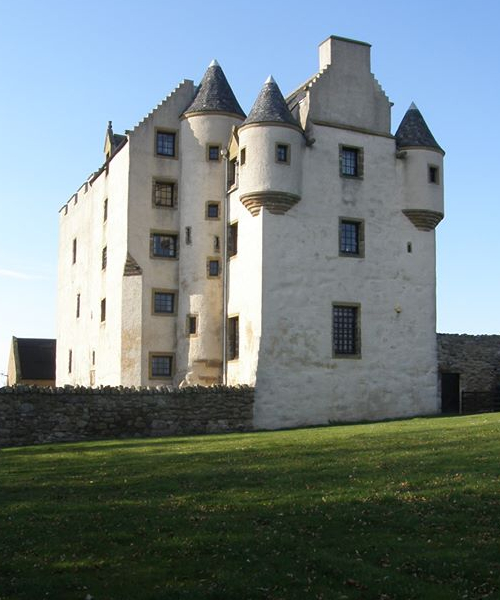
Cousland Castle
Cousland Castle stands as a significant historical site nestled in the village of Cousland, Scotland. This hill castle was originally constructed in the 15th century by Scottish nobility as a fortified tower house, a prevalent architectural form among the landed gentry of the period. The castle's strategic location and robust construction reflect the defensive and residential needs of its owners during a turbulent era in Scotland's history.
Early ownership and royal connections
The castle initially served as a hunting lodge for the influential St Clair family, specifically the branch known as the St Clair of Roslin. This early function underscores the castle's role not only as a defensive stronghold but also as a symbol of status and leisure for Scottish aristocracy. In 1493, ownership passed from Henry Sinclair, Lord Sinclair, to William Ruthven, Lord Ruthven, marking the beginning of the Ruthven family's long association with the estate.
Before this transfer, the estate had notable royal ties through Thomas Cochrane, a favored courtier of King James III of Scotland. Cochrane was granted the lands as a royal gift in the late 15th century, highlighting the estate's importance within the royal domain. His tenure ended abruptly with his assassination in 1482, but the royal connection continued to elevate the castle's prestige.
Conflict and damage in the 16th century
The 16th century brought significant turmoil to Cousland Castle, reflecting the broader political and military instability in Scotland during this period. In 1529, the castle was set ablaze amid a violent dispute between Patrick Charteris and William Ruthven, 2nd Lord Ruthven. This event illustrates the intense local rivalries that could escalate to armed conflict.
Further damage occurred after the Battle of Pinkie in 1547, a major confrontation between Scotland and England. Following the battle, Edward Seymour, Duke of Somerset, led English forces in a campaign to suppress Scottish fortifications, during which Cousland Castle was deliberately slighted—intentionally damaged to reduce its military value. This act was part of a broader English strategy to weaken Scottish resistance.
Historical military records from 1548 refer to the castle as "Cowsland" on maps created by William Patten, reflecting variations in place-names over time. The castle's involvement in these conflicts underscores its strategic significance in the border struggles of the era.
Associations with mary, queen of scots and later ownership
A notable episode in the castle's later history is its connection to Mary, Queen of Scots. In 1567, following the Battle of Carberry Hill, Mary is reputed to have formally surrendered to the Confederate Lords at or near Cousland Castle. While some historical accounts suggest the surrender took place in the vicinity rather than within the castle itself, this association remains a part of local tradition and highlights the castle's role in Scotland's royal and political drama.
Subsequent ownership passed through several prominent Scottish families. The castle was held by John Ruthven, 3rd Earl of Gowrie before being forfeited. It was then granted to Hugh Herries, a physician to James VI and I, notable for his involvement in the monarch's rescue in 1605. Later proprietors included the Hays of Kinnoull and the Makgill family during the 17th century. By the late 1600s, John Dalrymple, 1st Earl of Stair, acquired the estate, reflecting its continued importance among Scotland's noble elite.
Architectural features and surviving remains
The visible remains of Cousland Castle primarily consist of the ruins of a tower house dating from the 16th century and the surrounding enclosure walls. Originally built in the 15th century, the tower was expanded during the following century to accommodate the evolving needs and status of its inhabitants, transforming it into a more substantial residence.
The castle complex is arranged around a square walled garden, measuring approximately 68 metres (223 feet) across. This courtyard space is typical of fortified homes of the period, providing both security and a controlled outdoor environment. At the north-east corner of the enclosure lies the basement of the tower, notable for its vaulted ceiling. This architectural feature, involving curved stone construction, was designed to strengthen the underground chamber and support the structure above.
Encircling the garden are stone walls approximately 85 centimetres (33 inches) thick. These walls are believed to date from after 1690, indicating later modifications to the estate's defenses or garden layout. The northern portion of these enclosure walls remains largely intact, surviving even after the demolition of the main residential buildings, which demonstrates the durability of the castle's defensive architecture.
Archaeological investigations have confirmed the foundations of the house portion of the castle, providing valuable insights into the original footprint and scale of the residence before its decline. These foundational remains, together with the tower and garden walls, constitute the key physical evidence of Cousland Castle's historic presence.
Decline and preservation
After centuries of occupation, conflict, and changing ownership, Cousland Castle fell into decline and was eventually demolished sometime after 1760. Despite this, the ruins remain a protected Scheduled Monument, recognized for their cultural and archaeological significance within Scotland's heritage.
The site is legally safeguarded to ensure the preservation of its historical footprint for future study and reflection. While detailed descriptions of decorative features or inscriptions have not been documented, the castle's architectural remains offer valuable insights into Scottish fortified residences of the late medieval and early modern periods.
Today, visitors and scholars can explore the ruins to appreciate the castle's historical importance, architectural evolution, and its role in Scotland's turbulent history. The enduring stone walls, vaulted basement, and garden enclosure continue to tell the story of Cousland Castle's noble past and its place within the landscape of Scottish castles.
Frequently asked questions (FAQ)
- How do I get to Cousland Castle?
- Cousland Castle is located in the village of Cousland, Scotland, accessible by local roads. It is advisable to check local transport options or use a car for the most convenient access.
- What is the historical significance of Cousland Castle?
- Cousland Castle played a notable role in Scottish noble history, serving as a fortified tower house and hunting lodge for prominent families such as the St Clairs and Ruthvens. It was involved in significant 16th-century conflicts and has associations with Mary, Queen of Scots.
- Can I visit the ruins of Cousland Castle?
- Yes, the ruins of Cousland Castle are accessible to the public as a protected Scheduled Monument. Visitors can explore the remains of the tower house, enclosure walls, and garden foundations, although facilities may be limited.
- When was Cousland Castle built and expanded?
- The castle was originally constructed in the 15th century as a tower house and was expanded in the 16th century to form a larger residence, reflecting the needs of its noble occupants.
- Why was Cousland Castle damaged in the 16th century?
- Cousland Castle suffered damage during local disputes, such as the 1529 fire, and was deliberately slighted after the Battle of Pinkie in 1547 by English forces aiming to weaken Scottish defenses.
Information
Loading map...
Visitor reviews
No reviews yet. Been here? Write the first review and help other travelers!
Write the first reviewVisited this castle? Share your experience
Your review helps other travelers and adds first-hand knowledge to our encyclopedia.