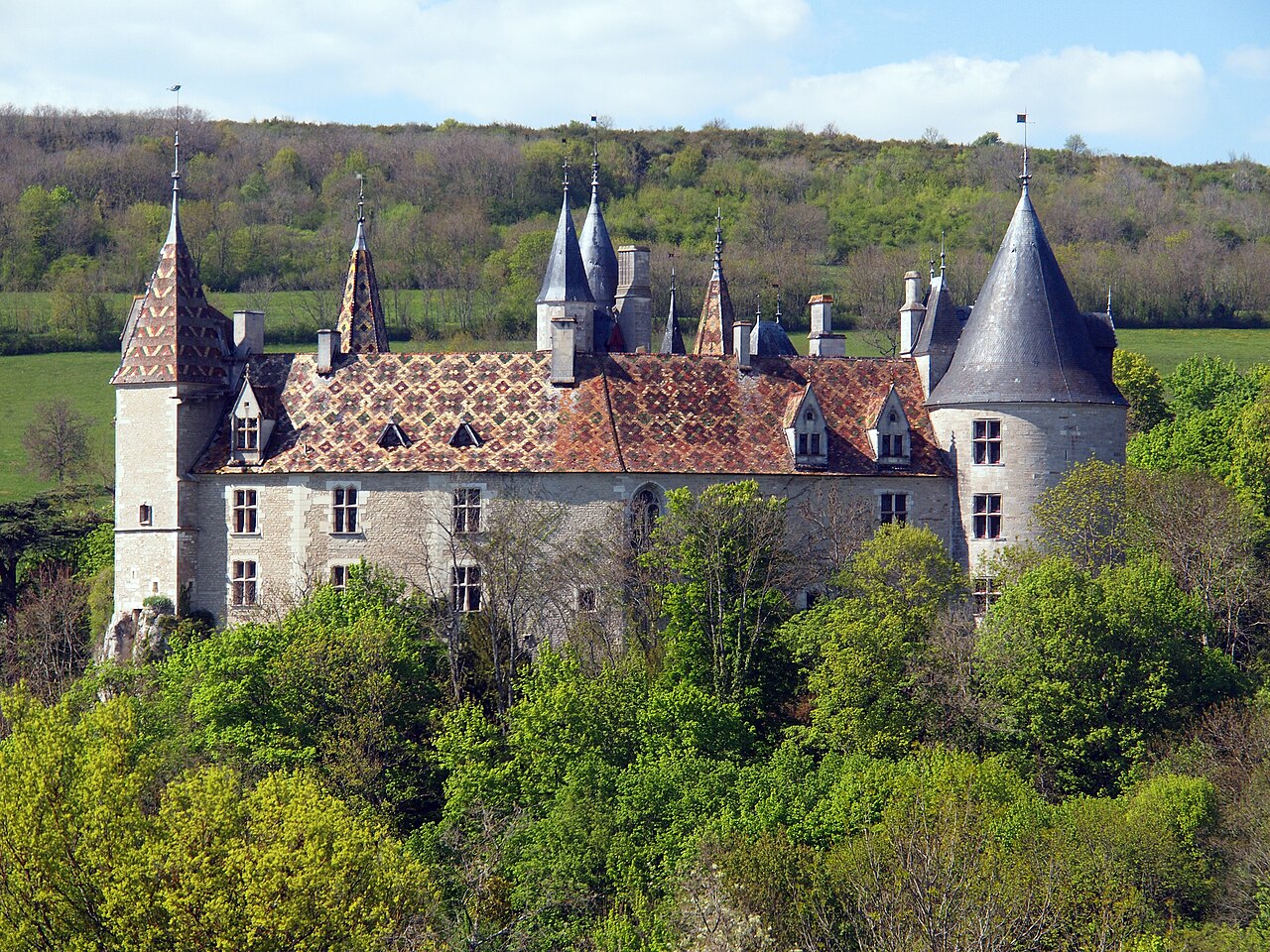
Corabœuf Castle is a historic hill castle located near Ivry-en-Montagne in the Hauts-de-France region of France. This medieval fortress was originally built by the noble Coraboeuf family during the 11th to 14th centuries and served as their fortified residence amid the fragmented feudal territories of medieval Burgundy. The castle's strategic position on a gentle slope allowed it to control the surrounding landscape and roads, contributing to its military and administrative significance.
Throughout its history, Corabœuf Castle witnessed numerous changes in ownership and architectural transformation, reflecting the turbulent political and social shifts of the region. The castle's most significant structural elements date from the 15th century, particularly the imposing donjon built around 1450 after damage sustained during the Hundred Years’ War. This fortified tower stands approximately 17 to 18 meters tall and features a square base with defensive turrets at each corner, exemplifying the military architectural style of the late medieval period.
The castle later came under the control of the influential Salins family in the early 15th century, who reinforced its defenses and left heraldic marks such as the coat of arms of Catherine de Mypont on the "Tour du chasseur", a distinctive round tower once used as a kennel. Despite royal orders to dismantle fortifications in the late 15th century, Corabœuf remained a fortified stronghold, underscoring its ongoing strategic importance.
Medieval origins and early history
The origins of Corabœuf Castle trace back to the medieval period when the Coraboeuf family established it as a feudal seat in Burgundy. The castle's initial construction spanned several centuries from the 11th to the 14th century, during which it evolved from a basic fortified residence into a more complex defensive structure. Its location near Ivry-en-Montagne was significant for controlling local routes and asserting noble authority in the region.
During the Hundred Years’ War, the castle experienced direct conflict, notably suffering damage inflicted by the Écorcheurs, mercenary bands notorious for their pillaging. This event prompted the Salins family, who acquired the castle in the early 15th century, to undertake major reconstruction efforts around 1450. The rebuilding focused on strengthening the donjon and the main entrance, incorporating advanced defensive features such as arrow slits and machicolations.
Architectural evolution and defensive features
The donjon and fortifications
The centerpiece of Corabœuf Castle is its donjon, a robust square tower rising 17 to 18 meters with a 10-meter side length at its base. Each corner is fortified with turrets topped by conical roofs and pierced with arrow slits, allowing defenders to repel attackers while remaining protected. Inside, the donjon's vaulted ground floor is supported by a central hexagonal pillar, demonstrating medieval engineering designed to bear significant weight and withstand assaults.
Attached to the north wing is a porch tower that houses the main entrance, featuring remnants of machicolations—openings in the parapet through which defenders could drop stones or boiling liquids on enemies below. The entrance complex includes both pedestrian and carriage doors, framed by traces of a former drawbridge mechanism, highlighting the castle's layered defensive measures.
The north wing and neo-gothic renovations
The north wing of the castle was reconstructed in 1860 under the direction of architect Roidot-Errard for Paul-Désiré Richard d’Ivry. This renovation embraced the neo-Gothic style, popular in 19th-century France, and introduced architectural elements such as mullioned and transomed windows and decorative interiors. Artists Charles Suisse and Xavier Schanosky contributed wood paneling and painted ceilings, enhancing the wing's historic character while adapting it for modern residential use.
The wing is capped with a slate double-pitched roof and features a square tower facing the parking area, adding to the asymmetrical silhouette that blends medieval and 19th-century design influences.
The east wing and later modifications
The east wing, adjoining the donjon’s south face, reflects renovations made after 1763 by Jean-Baptiste Richard d’Ivry. This section includes a raised ground floor and a small terrace overlooking the courtyard. The facade was restored in the 1980s and is distinguished by nine windows beneath a roof decorated with yellow diamond patterns. The "Tour du chasseur", a round tower with a conical roof formerly used as a kennel, bears the coat of arms of Catherine de Mypont, symbolizing the 16th-century alliance of the Salins family.
The estate and landscape features
The castle estate covers approximately 8 to 10 hectares, featuring a central courtyard with grassy areas and gravel paths. Adjacent to the donjon lies a formal French-style garden divided into six plots of wild grass bordered by trimmed alleys, contrasting manicured and natural landscaping traditions.
A terrace beside an old fishpond runs the length of the east wing and hosts a neoclassical hunting pavilion. This pavilion, with its ground floor and half-story, includes windows framed by decorative crossettes and a garland medallion over the door, likely serving as a leisure retreat aligned with the castle's eastern entrance.
Between 1996 and 2006, an arboretum was established in the northeast part of the grounds, replacing older gardens and an orangery originally created by Jean-Baptiste Richard d’Ivry. The arboretum includes 64 species of trees such as oaks, cedars, beeches, walnuts, plane trees, and acacias, reflecting a commitment to botanical diversity and historic landscape preservation.
Historical significance and ownership lineage
Over the centuries, Corabœuf Castle changed hands among several noble families, including the Salins, Collonge, Esdouard, Saint-Martin d’Agencourt, and Spada families. In 1763, it was acquired by Jean-Baptiste Richard de Curtil, later Marquis d’Ivry, whose descendants witnessed the upheavals of the French Revolution.
The castle suffered during the French Wars of Religion when it was attacked and set on fire by Protestant forces in 1575. Despite royal orders in 1478 to dismantle its fortifications, the castle remained a fortified residence, emphasizing its military importance in the region.
During the 19th century, the Richard d’Ivry family undertook neo-Gothic renovations, preserving the castle’s medieval character while adapting it to contemporary tastes. The 20th century saw the castle largely unoccupied, though it played a role during World War II as a site occupied by military and resistance forces.
Since 1957, ownership by Baron Gérard Law de Lauriston-Boubers has led to restoration efforts and cultural revitalization. Officially protected as a historic monument since 1989, Corabœuf Castle now hosts cultural events and stands as a preserved heritage site reflecting centuries of French history and architecture.
Interior decorations and artistic heritage
The castle's interiors include portraits of Jean-Baptiste Richard d’Ivry and his family displayed in the dining room, alongside a full-length painting of Pierre Richard de Curtil, a military governor of Douai, in the salon. These artworks connect the castle’s architectural heritage with the personal histories of its owners, enriching its cultural significance.
Decorative elements such as wood paneling and painted ceilings from the 19th-century renovations contribute to the castle’s unique blend of medieval and neo-Gothic aesthetics, offering visitors a glimpse into the evolving tastes and lifestyles of French nobility.
Frequently asked questions (FAQ)
- How do I get to Corabœuf Castle?
- Corabœuf Castle is located in the picturesque region of France, easily accessible by car or public transport. If you're traveling by train, the nearest station is a short taxi ride away, making it convenient for visitors from major cities.
- What is the historical significance of Corabœuf Castle?
- Corabœuf Castle dates back to the 12th century and has played a crucial role in the region's history, serving as a stronghold during various conflicts. Its rich heritage reflects the architectural styles of different eras and the strategic importance it held over the years.
- When was Corabœuf Castle built?
- Construction of Corabœuf Castle began in the early 12th century and was completed in the late 13th century. Its design and fortifications have evolved over centuries, showcasing the architectural advancements of the time.
- Can I take guided tours of Corabœuf Castle?
- Yes, guided tours are available and offer an in-depth look at the castle's history and architecture. These tours are conducted by knowledgeable guides who can provide fascinating insights into the castle's past and its significance in French history.
- Why is Corabœuf Castle considered an architectural gem?
- Corabœuf Castle is renowned for its stunning blend of medieval and Renaissance architectural styles. Its impressive towers, fortified walls, and intricate stonework make it a captivating example of historical architecture that attracts visitors from all over.
- Is it possible to host events at Corabœuf Castle?
- Yes, Corabœuf Castle offers event hosting services, allowing you to celebrate weddings, corporate events, and private gatherings in a unique historical setting. The majestic surroundings provide an unforgettable backdrop for any occasion.
- What are the opening hours for Corabœuf Castle?
- Corabœuf Castle is open to visitors from 10 AM to 6 PM, with extended hours during the summer months. It's advisable to check the official website for any seasonal changes or special events that may affect opening times.
- What are the ticket prices for visiting Corabœuf Castle?
- Ticket prices for Corabœuf Castle are reasonably priced, with discounts available for students, seniors, and children. Group rates are also offered, making it an affordable option for families and school trips.
- When is the best time to visit Corabœuf Castle?
- The best time to visit Corabœuf Castle is during the spring and early fall when the weather is pleasant and the gardens are in full bloom. This is also when the castle hosts various events and activities, enhancing your visitor experience.
- Are there any nearby attractions to explore after visiting Corabœuf Castle?
- Yes, there are several nearby attractions, including charming villages, local vineyards, and scenic walking trails. Visitors can enjoy a full day of exploring the beautiful countryside and rich cultural offerings of the region.
Information
Website
Visit websiteSources & official resources
Verify the information above using these authoritative references.
Loading map...
Visitor reviews
No reviews yet. Been here? Write the first review and help other travelers!
Write the first reviewVisited this castle? Share your experience
Your review helps other travelers and adds first-hand knowledge to our encyclopedia.