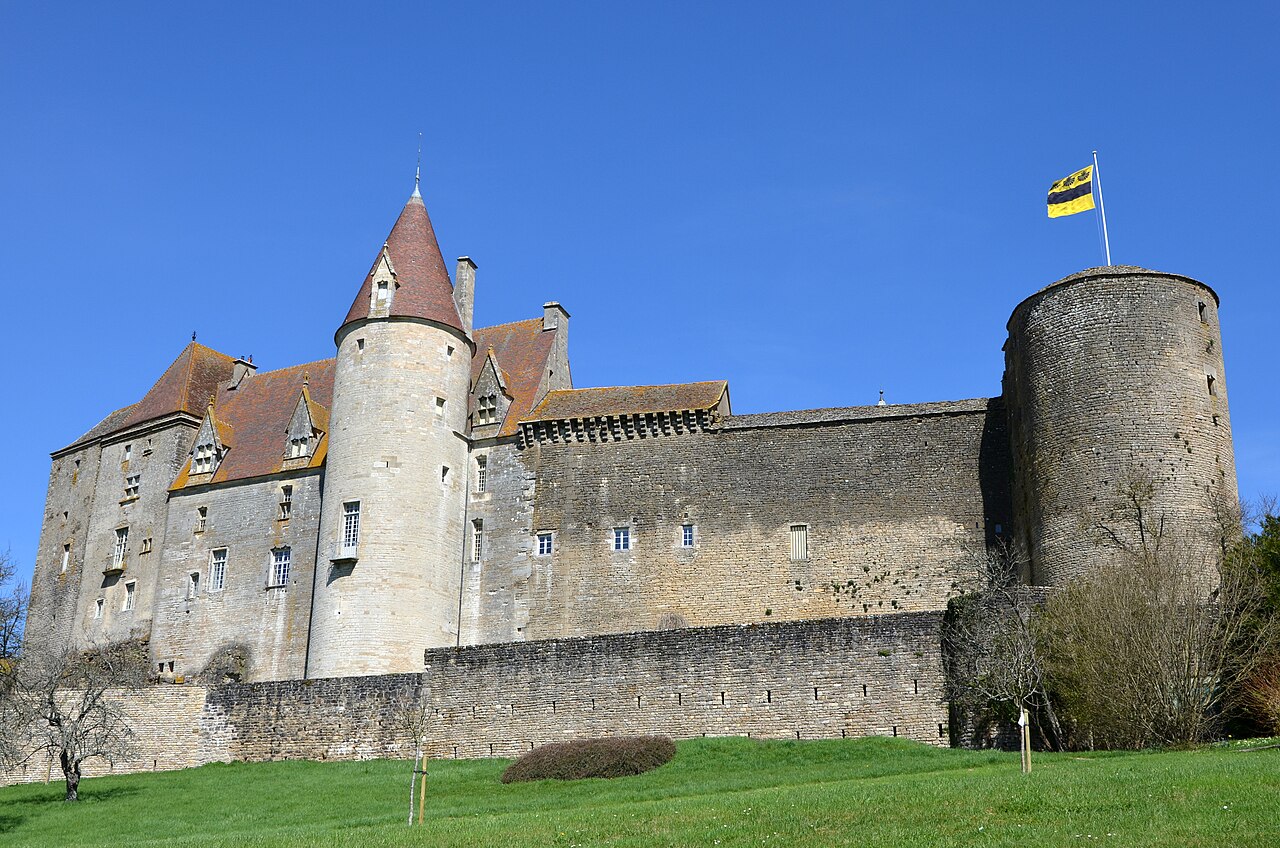
Antigny Castle
Antigny Castle, also known as Château d'Antigny, is located in the village of Antigny-le-Château within the Côte-d'Or department of France. This historic castle stands on a hillock, offering a commanding view of the surrounding landscape. Its origins trace back to the early 12th century, with the first recorded mention of a Lord of Antigny appearing in 1116. The initial fortress likely consisted of a polygonal enclosure with a rectangular keep, a typical defensive configuration of the period designed to provide strong protection and surveillance.
Medieval origins and architectural evolution
The castle remained under the control of the original Antigny family until around 1200, when it passed by marriage to the Neublans family. Over the subsequent centuries, ownership transferred through several noble houses, including the Counts of Montbéliard, the Counts of Tancarville, and the House of Vienne, who were also Counts of Commarin. This succession of noble proprietors reflects the castle's strategic and social importance in the region.
During the 15th century, significant architectural changes were made to Antigny Castle. It was during this period that the distinctive round corner tower was constructed, marking a transition in fortification styles from the earlier polygonal and rectangular forms to more rounded towers, which better deflected projectiles and improved defensive capabilities. This enlargement is characteristic of the late medieval period when castles were frequently updated to meet evolving military needs.
Renaissance additions and later modifications
The large rectangular building visible from the village dates from 1624, indicating a Renaissance-era expansion that introduced more residential and perhaps administrative functions to the castle complex. This period often saw castles transformed from purely military fortresses into more comfortable noble residences, reflecting changes in warfare and lifestyle.
In 1654, ownership passed to the House of Damas, who held the title of Barons of Antigny and were later elevated to Marquesses. The Damas family contributed further to the castle's development, including the construction of a wing connected to the round tower during the 18th century. This wing complements the castle's evolving architectural narrative and adds to its residential character.
Notably, at the other end of this wing lies a 14th-century chapel, a significant religious structure that predates the Renaissance additions. The chapel's survival highlights the castle's continuous occupation and the importance of religious practice within the noble household.
Ownership changes and decline
The castle remained in the hands of the House of Damas and their descendants until the French Revolution at the end of the 18th century. It is probable that the castle was confiscated and sold during the revolutionary period, as was common for aristocratic properties. By 1803, it belonged to a certain Perrier, who allowed the castle to fall into disrepair, marking the beginning of a period of neglect.
Between 1818 and 1876, the castle was owned by the mayor of the nearby town of Foissy. By 1910, it had passed to a local farmer who used the premises primarily for grain storage, reflecting a significant decline from its noble origins.
20th-century restoration and cultural connections
In 1923, the castle was auctioned by the local council and purchased for under $3,000 by Royall Tyler, an American art historian, economist, and diplomat, and his wife Elisina Palamidessi de Castelvecchio, a descendant of Napoleon's brother Louis. The Tylers had first encountered the castle in 1913 and fell in love with its historic charm. They undertook extensive restoration efforts to revive the castle's former grandeur.
During their ownership, Antigny Castle became a cultural hub, hosting notable guests such as Edith Wharton, the acclaimed American novelist and the first woman to win the Pulitzer Prize in Literature. The Tyler family maintained ownership of the castle until 2013, preserving its architectural and historical legacy through much of the 20th century.
Current status and architectural highlights
Today, Antigny Castle remains private property and is not open to the public. However, its exterior can be admired from the village, where the contrast between the ruins of the original medieval castle and the later Renaissance and 18th-century additions is clearly visible. The castle's combination of defensive medieval structures, such as the polygonal enclosure and the round tower, alongside residential wings and the chapel, offers a layered architectural narrative spanning several centuries.
The castle's location on a hillock and its various architectural elements provide insight into the evolution of French noble residences from fortified medieval strongholds to Renaissance and post-Renaissance manor houses. The survival of the 14th-century chapel and the 15th-century tower underscore the site's long-standing historical significance.
Frequently asked questions (FAQ)
- Can I visit Antigny Castle?
- Antigny Castle is currently private property and is not open to public visits. However, it can be viewed from the nearby village of Antigny-le-Château.
- When was Antigny Castle originally built?
- The original castle likely dates back to the early 12th century, with the first mention of a Lord of Antigny in 1116. The current main structures date mainly from the 15th century onward.
- What architectural styles are visible at Antigny Castle?
- Antigny Castle exhibits a mix of late medieval defensive architecture, including a polygonal enclosure and a 15th-century round tower, alongside Renaissance and 18th-century residential additions.
- Who were some notable owners of Antigny Castle?
- Notable owners include the original Antigny family, the Neublans family, the Counts of Montbéliard, the House of Vienne, the House of Damas, and the American art historian Royall Tyler and his wife Elisina Palamidessi de Castelvecchio.
- What is the condition of Antigny Castle today?
- The castle is partially preserved with some original medieval structures in ruins, while Renaissance and later additions remain intact, reflecting its complex history.
Information
Current owner
Private owner
Address
Hameau d'Antigny-le-Château, Côte-d'Or, France
Loading map...
Visitor reviews
No reviews yet. Been here? Write the first review and help other travelers!
Write the first reviewVisited this castle? Share your experience
Your review helps other travelers and adds first-hand knowledge to our encyclopedia.