Copertino Castle
Copertino Castle stands as a magnificent example of Renaissance military architecture in the Apulia region of southern Italy. Located in the town of Copertino, north of Gallipoli on the Salento peninsula, this fortress uniquely blends its Norman origins with significant 16th-century enhancements designed to counter the evolving threats posed by gunpowder weaponry. Its imposing structure, sprawling over a large area, reflects centuries of architectural evolution, noble lineage, and strategic military importance.
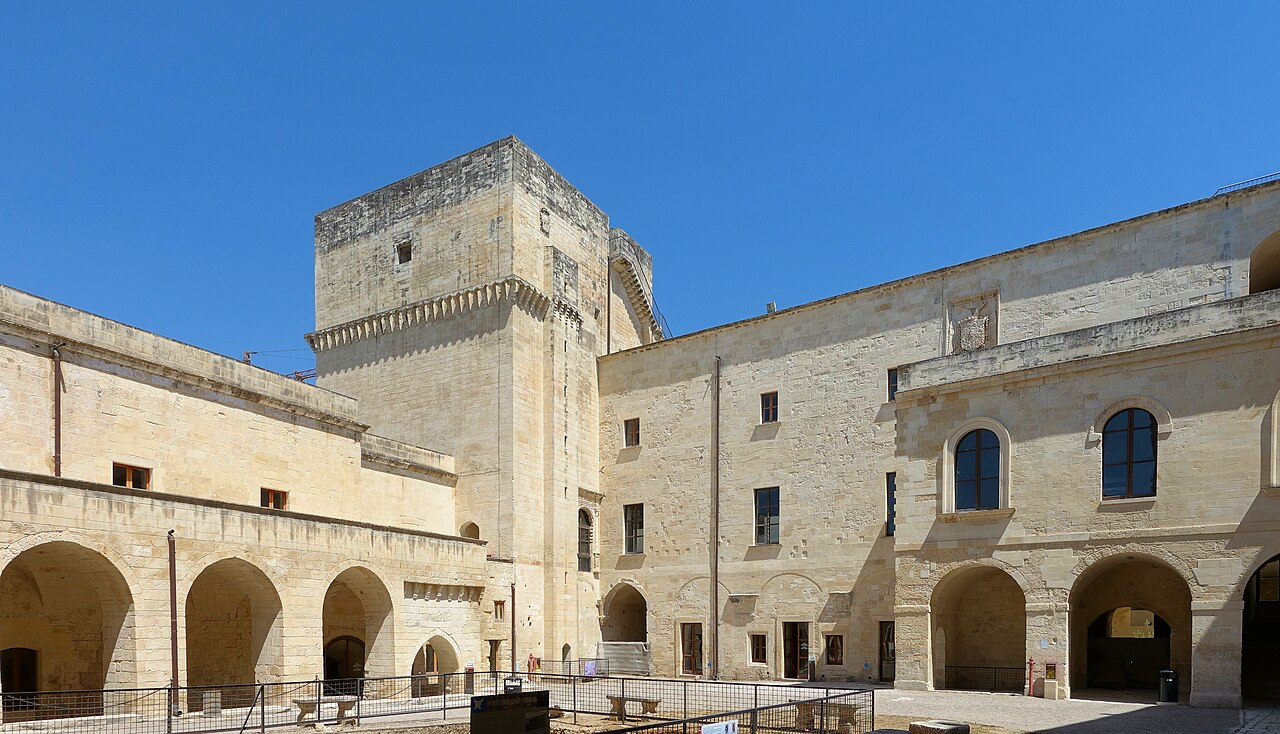
The castle’s history dates back to the Norman period between the 13th and 14th centuries, when it was originally constructed as a defensive stronghold featuring a tall, slender quadrangular keep. This keep, characteristic of Norman military architecture, resembles towers found in nearby Lecce and Leverano, symbolizing the castle’s medieval roots. Over time, the fortress was expanded and transformed to meet the demands of changing warfare and noble residence requirements.
Historical development and noble ownership
Throughout its history, Copertino Castle passed through the hands of several prominent noble families, often through marriage alliances that linked it to powerful regional rulers. Early owners included the Angevin rulers Ladislas of Anjou-Durazzo and Maria d’Enghien. Later, the castle was associated with influential figures such as Caterina di Taranto and Isabella del Balzo, the latter bringing the castle as part of her dowry upon marrying Frederick I of Aragon. This marriage connected the fortress to the royal Aragonese lineage, and Frederick I eventually granted ownership of the castle and its surrounding lands to the local community of Copertino.
The castle’s noble connections are further enriched by local tradition, which holds that Isabella of Taranto, daughter of Tristan de Clermont and Catherine of Taranto and later Queen of Naples, was born within its walls. This legend adds a personal and royal dimension to the fortress’s historical narrative, intertwining it with the dynastic politics of southern Italy.
Renaissance transformation and military architecture
By the 16th century, the advent of gunpowder and artillery revolutionized military tactics and fortress design. Recognizing the need to modernize defenses, Alfonso Castriota of the Branai Castriota family commissioned the renowned military architect Evangelista Menga between 1538 and 1540 to undertake a comprehensive renovation of Copertino Castle.
Menga’s work transformed the medieval fortress into a formidable Renaissance bastioned fortress with a square plan featuring four lance-shaped bastions at each corner. These bastions were designed to optimize defensive coverage and withstand cannon fire, reflecting the latest advances in military engineering. The castle’s walls were thickened and angled to deflect artillery shots, and a deep moat was constructed to further protect the structure.
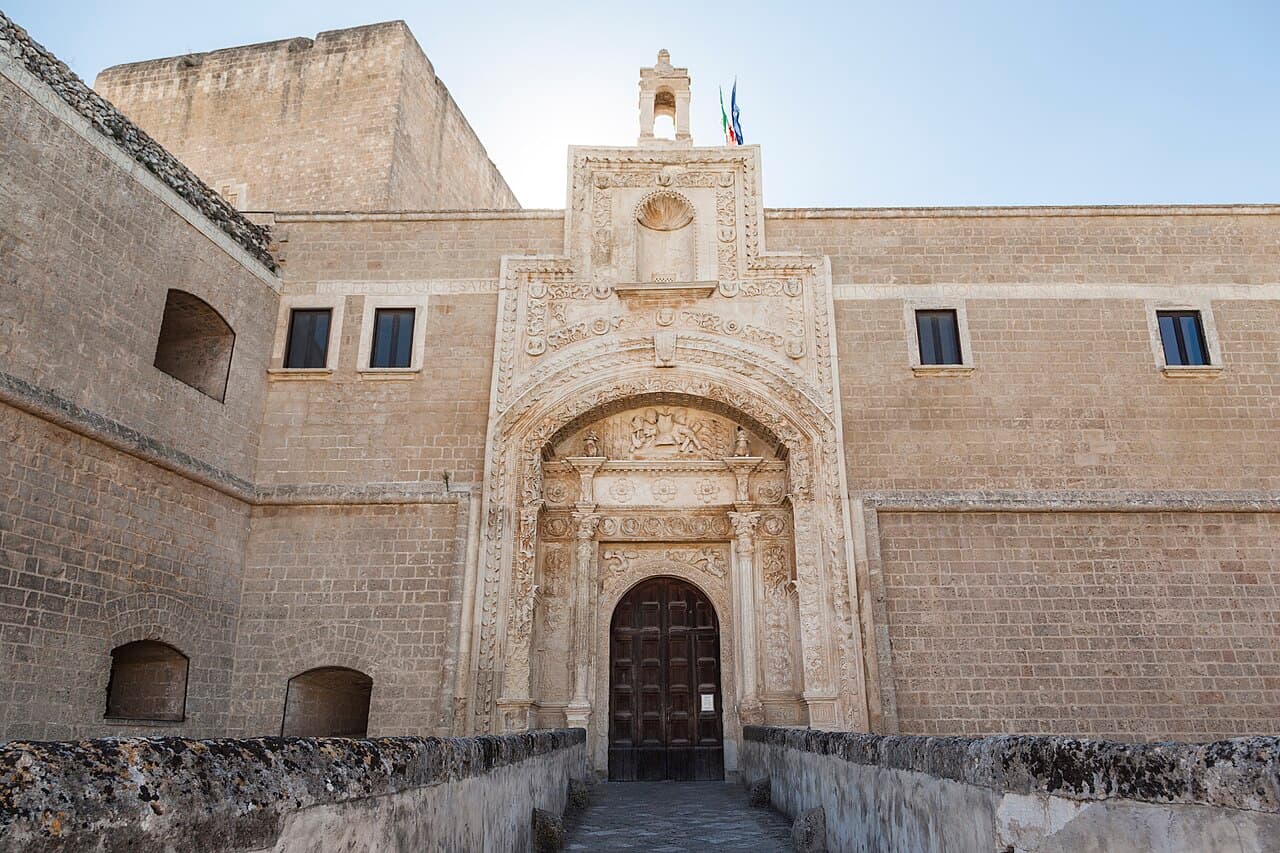
The entrance gate was redesigned in the distinctive Catalan-Durazzesque style, conceived as a monumental triumphal arch. This portal is richly decorated with sculpted grotesque and vegetal motifs, as well as martial imagery such as weapons and armor, emphasizing the castle’s dual role as a noble residence and military stronghold.
Architectural features and interior spaces
Within the castle’s walls, the oldest surviving element remains the Norman quadrangular keep, standing as a testament to its medieval origins. Surrounding this core is the expansive courtyard, enclosed by the bastioned ramparts and connected by vaulted tunnels that allowed defenders to move safely during sieges.
To the left of the main entrance lies the Pinelli-Pignatelli palace, built as a noble residence for the Counts of Copertino and Marquises of Galatone, ancestors of the Princes of Belmonte. This section of the castle blends residential comfort with the fortress’s defensive purpose.
Opposite the palace, on the right side of the entrance, is the family chapel of Saint Mark. This chapel is adorned with 15th-century frescoes by the mannerist painter Gianserio Strafella, commissioned by the Genoese Squarciafico family who acquired the castle in 1557. The chapel’s artwork enriches the cultural and religious significance of the fortress.
Another notable interior space is the Mary Magdalene chapel located within the 16th-century residential areas. During recent restorations, original 15th-century frescoes were uncovered here, providing insight into the castle’s artistic patronage and spiritual life.
Defensive structures and preservation
Copertino Castle is surrounded by a fully intact moat, a rare feature that highlights its original defensive design. Access to the castle today is via a stone bridge, a later addition that facilitates visitor entry but was not part of the initial fortifications.
The castle’s star-shaped layout with bastioned corners is a hallmark of 16th-century military architecture, designed to counter the destructive power of artillery. The thick, angled walls and numerous arrow slits (approximately 90) allowed defenders to operate cannons and firearms effectively.
The vaulted tunnels connecting the bastions provided secure passageways during attacks, enhancing the fortress’s resilience. The combination of medieval and Renaissance elements makes Copertino Castle one of the largest and best-preserved fortresses in Apulia.
Cultural significance and modern management
Declared a national monument in 1886, Copertino Castle has long been recognized for its historical and architectural importance. Protection measures were established in 1955, and since December 2014, the castle has been managed by the Italian Ministry of Cultural Heritage.
Recent restoration efforts completed between 2017 and 2018 have helped preserve the fortress’s structural integrity and artistic treasures, ensuring that it remains accessible and informative for visitors and scholars alike.
Today, Copertino Castle serves not only as a tourist attraction but also as a cultural symbol of the region’s rich history, showcasing the evolution of military architecture from the medieval period through the Renaissance. Its blend of defensive innovation, noble residence, and artistic patronage offers a comprehensive glimpse into the past of Apulia and southern Italy.
Frequently asked questions (FAQ)
- How do I visit Copertino Castle and what are the opening hours?
- Copertino Castle is open to visitors typically during daytime hours, but it is best to check the official website or local tourist information for the most current opening times and any special events or closures.
- What is the historical significance of Copertino Castle?
- Copertino Castle is significant for its blend of Norman origins and Renaissance military architecture, reflecting the evolution of fortress design in response to gunpowder warfare and its connection to noble families and regional rulers.
- Can I see the frescoes by Gianserio Strafella inside the castle?
- Yes, visitors can view the 15th-century frescoes by Gianserio Strafella in the family chapel of Saint Mark, which are an important artistic highlight of the castle.
- Is the castle accessible for people with limited mobility?
- Due to the historic nature of the castle and its defensive structures, accessibility may be limited in some areas. Visitors with mobility concerns should inquire in advance about available accommodations.
- What architectural styles are represented in Copertino Castle?
- Copertino Castle features a mixed architectural style, combining <strong>Norman medieval elements</strong> with <strong>Renaissance bastioned fortifications</strong> and Catalan-Durazzesque decorative influences.
Photo gallery

Information
Sources & official resources
Verify the information above using these authoritative references.
Loading map...
Visitor reviews
No reviews yet. Been here? Write the first review and help other travelers!
Write the first reviewVisited this castle? Share your experience
Your review helps other travelers and adds first-hand knowledge to our encyclopedia.