Castle of Charles V
The Castle of Charles V in Lecce, Italy stands as a remarkable example of Renaissance military architecture, embodying centuries of historical evolution from medieval fortifications to a modern bastioned fortress. Originally established in the Middle Ages, the castle was extensively redesigned and strengthened in 1539 under the commission of Emperor Charles V of the Habsburg dynasty. The renowned architect and military engineer Gian Giacomo dell’Acaya played a pivotal role in its design, creating a structure that reflects the advanced defensive needs of the 16th century, particularly against frequent Turkish incursions along the Adriatic coast.
The castle’s location is unique, as it is not perched atop a hill but rather embraces a hill within its polygonal walls, distinguishing it from typical hill castles. This strategic siting allowed it to control and protect the city of Lecce effectively. The construction required the demolition of significant religious buildings, including the Chapel of the Trinity and the Benedictine Monastery of the Saint Cross, which were relocated to accommodate the fortress’s footprint.
Historical development and architectural evolution
Medieval origins and early fortifications
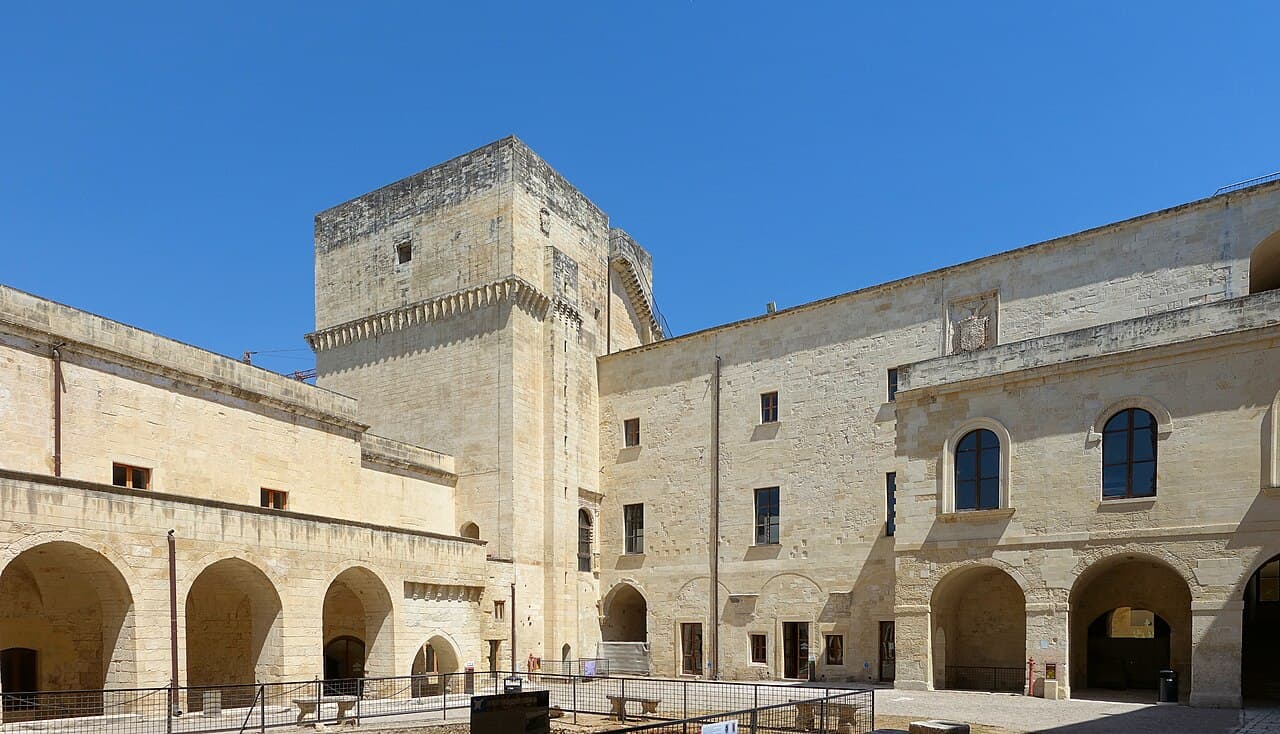
The site originally hosted a medieval princely bastion dating back to the 13th and early 14th centuries, during the Swabian and Angevin periods. A tall, square tower known as the mastio or central keep formed the core of the early fortifications. Remnants of a noble palace and the Torre Mozza were incorporated into the later Renaissance fortress, preserving layers of architectural history.
Renaissance redesign under charles v
In 1539, Charles V ordered the demolition of the medieval structures to construct a modern fortress reflecting the latest advances in military architecture. The design by Gian Giacomo dell’Acaya introduced a polygonal plan with four bastions named S. Croce, S. Martino, S. Giacomo, and S. Trinità, arranged clockwise around the fortress. These bastions were connected by straight curtain walls and surrounded by a moat, creating a formidable defense system.
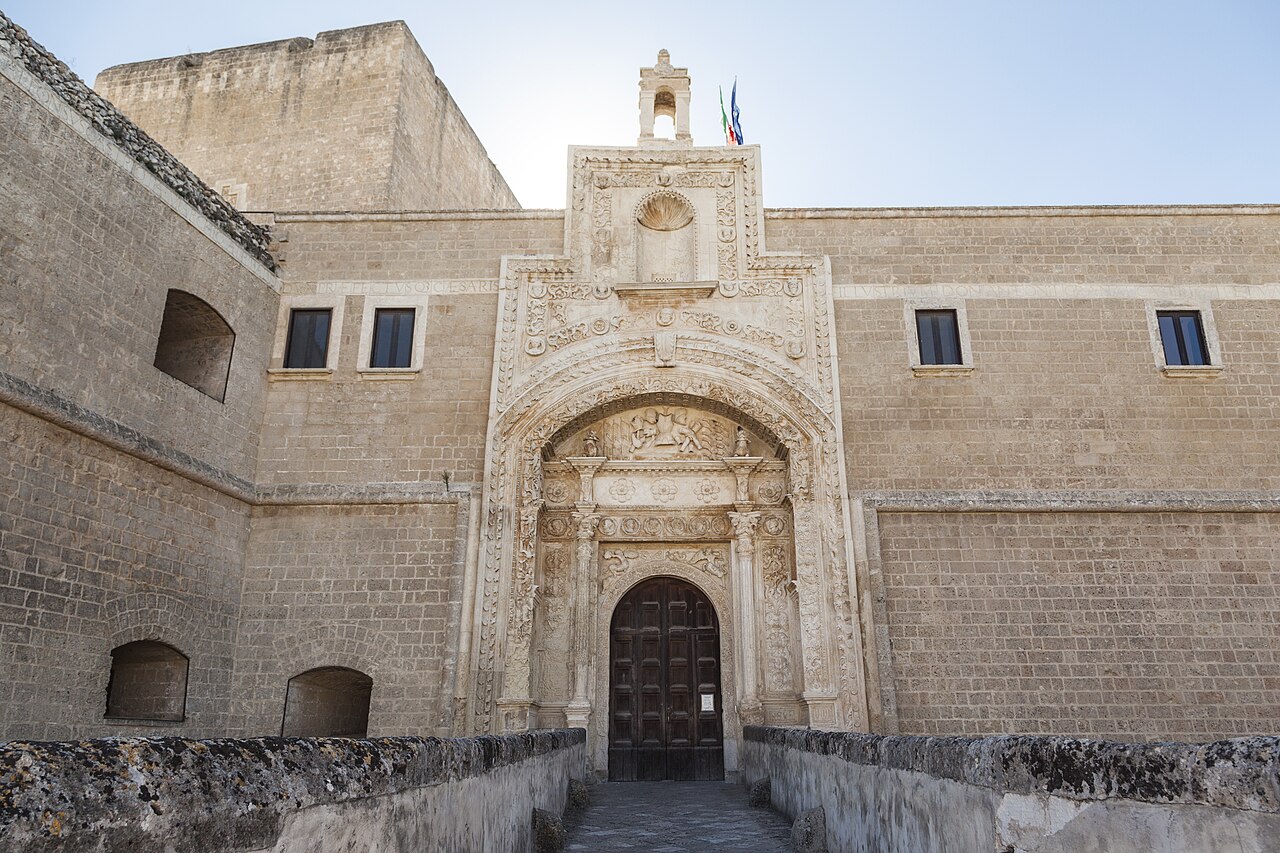
The castle’s gates, notably Porta Reale and Porta Falsa, were heavily fortified and adorned with the imperial Habsburg coat of arms, symbolizing its political and military significance. The fortress was equipped with multiple artillery placements, including cannon embrasures visible along the walls and bastions, designed to repel attacks from the sea and land.
Functional transformations and cultural significance
Military and civil uses through the centuries
Beyond its military role, the castle adapted to various functions over time. In the 18th century, one of its rooms was converted into a theater, reflecting its integration into the cultural life of Lecce. From 1870 to 1979, it served as a military district and barracks, demonstrating its continued strategic importance well into the modern era.
Significant changes occurred in the 19th century, including the filling of the moat in 1872 and the removal of drawbridges, marking a shift from military to urban use. Since 1983, the castle has been managed by the Municipality of Lecce and functions as the seat of Cultural Affairs, hosting numerous cultural events and exhibitions.
Legends and local heritage
The castle is steeped in local legend, notably the tale of the Orsini Del Balzo family who, in the 14th century, reputedly kept a white bear in the moat. This bear served as both a status symbol and a deterrent to intruders, enriching the castle’s historical mystique.
Architectural features and remaining structures
Layout and defensive elements
The castle’s quadrangular plan with four angular bastions is a hallmark of Renaissance fortification. The bastions—S. Croce, S. Martino, S. Giacomo, and S. Trinità—are robust structures designed to provide overlapping fields of fire. The curtain walls connecting these bastions are prominently preserved, especially on the side facing Lecce’s city center.
Originally surrounded by a water-filled moat, the defensive perimeter included drawbridges and fortified gates. Although the moat has been filled in, traces remain near the eastern gate, where remnants of the drawbridge mechanisms can still be seen. The castle’s two main gates, Porta Reale and another on the opposite side, are distinguished by their imperial Habsburg shields, emphasizing their historical importance.
Interior spaces and decorative elements
The interior of the castle features imposing stone columns supporting the upper floors, with richly decorated capitals and large stained glass windows that illuminate the grand halls. The delicate ornamental work inside contrasts with the fortress’s robust exterior, highlighting its dual role as a military stronghold and a noble residence.
Archaeological and historical layers
Archaeological studies have uncovered elements from earlier periods embedded within the castle’s structure, including parts of the medieval palace and the Torre Mozza. These findings illustrate the castle’s continuous occupation and adaptation through various historical phases, from medieval times through the Renaissance and into the modern era.
Modern use and visitor experience
Today, the Castle of Charles V serves as a vibrant cultural center under the management of the Municipality of Lecce. It hosts exhibitions, cultural initiatives, and public events that celebrate the region’s rich heritage. Visitors can explore the castle’s architectural features, learn about its layered history, and enjoy its unique atmosphere enhanced by the interplay of medieval and Renaissance elements.
The castle’s location near Lecce’s historic center makes it easily accessible, and its well-preserved bastions and interiors offer a compelling glimpse into the military and cultural history of southern Italy. The blend of defensive architecture and artistic decoration makes the Castle of Charles V a significant landmark in the Apulia region.
Photo gallery

Information
Website
Visit websiteSources & official resources
Verify the information above using these authoritative references.
Loading map...
Visitor reviews
No reviews yet. Been here? Write the first review and help other travelers!
Write the first reviewVisited this castle? Share your experience
Your review helps other travelers and adds first-hand knowledge to our encyclopedia.