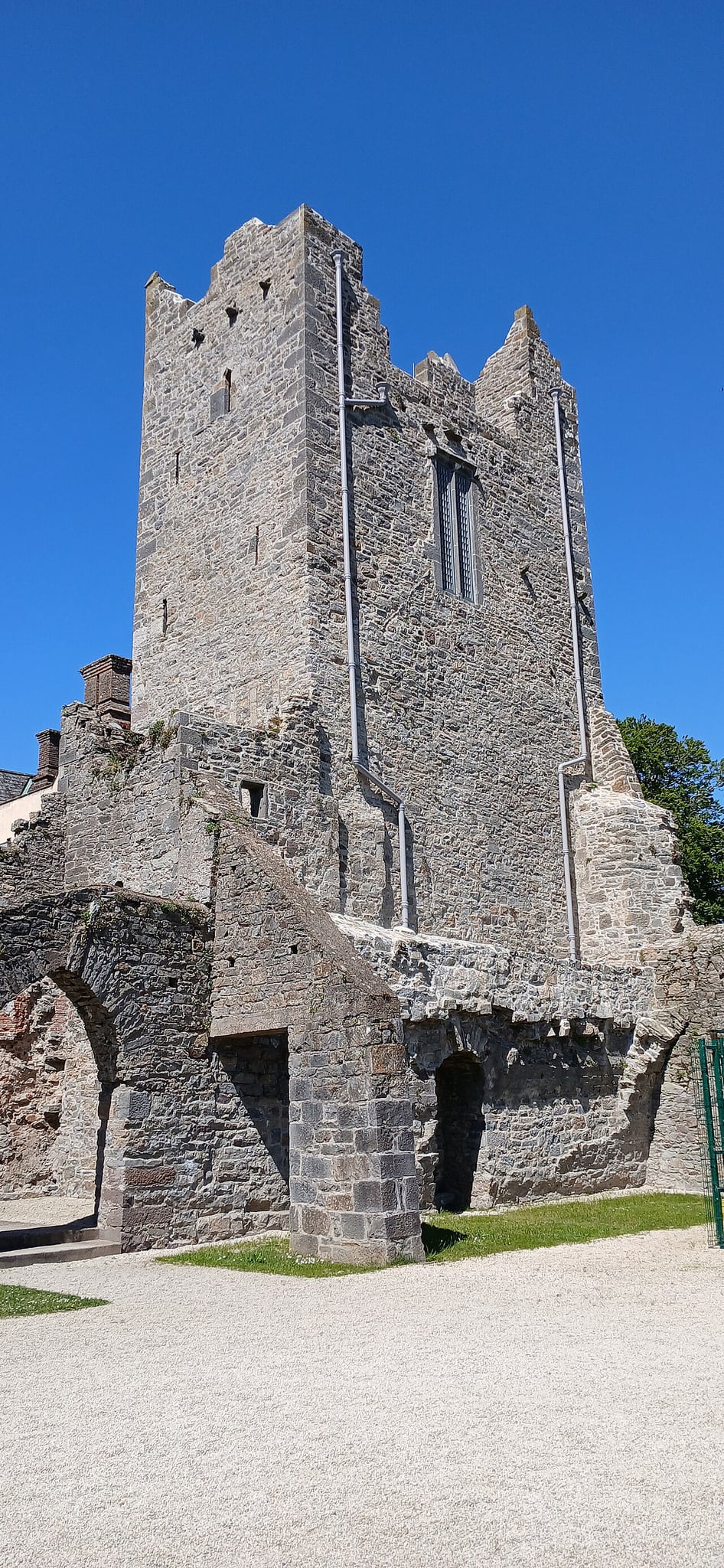
Coolnamuck Castle
Coolnamuck Castle is a historic tower house located in the townland of Coolnamuck Demesne in County Waterford, Ireland. Constructed around 1585-1588, it was built by Gerald Wall, a member of the local gentry during the late 16th century. This castle exemplifies the typical defensive residences erected by landed families in Ireland during the turbulent Elizabethan era.
The castle originally stood as a enclosure, a fortified courtyard surrounded by a defensive wall, with flanking towers at the corners. The main structure was a tower house, a common type of fortified dwelling in Ireland designed for both defense and residence. Today, only the south wall and the beginnings of the east and west walls of the tower remain intact. Despite its ruined state, several architectural details are still visible, including a bartizan—a small overhanging turret used for observation and defense—a chimney, and the remnants of a staircase.
Architectural features and layout
The square bawn surrounding the tower house would have served as a defensive courtyard, protecting the residence and providing space for livestock and daily activities during sieges. While much of the bawn wall and the corner towers have been lost to time and are now overgrown with trees, bushes, and undergrowth, their foundations hint at the castle's original formidable presence.
The surviving bartizan is a notable feature, projecting from the upper walls to allow defenders to observe and fire upon attackers from a protected vantage point. The presence of a chimney indicates the castle was designed for year-round habitation, combining defense with domestic comfort. The stair remnants suggest a typical vertical layout, with multiple floors connected by narrow staircases, characteristic of Irish tower houses.
Historical context and significance
Coolnamuck Castle was built during a period of significant unrest in Ireland, marked by conflicts such as the Desmond Rebellions and increasing English control over Irish lands. Tower houses like Coolnamuck were constructed by local landowners to assert their status and provide security against raids and local conflicts.
Gerald Wall, the castle's builder, belonged to a family that held land in the region, reflecting the social hierarchy of the time where fortified homes symbolized both power and protection. The castle’s location on the western side of a small ravine provided a natural defensive advantage, controlling access through the surrounding farmland.
Current condition and access
Today, Coolnamuck Castle stands in ruins within farmland, with much of its structure obscured by natural overgrowth. The south wall remains the most prominent surviving element, while the east and west walls show only the initial sections. The bawn walls and corner towers are largely lost beneath vegetation, making detailed examination difficult without clearing.
The castle is not open to the public as it is situated on private farmland. Visitors can view the ruins from a distance but cannot access the interior or the bawn area. Despite its ruined state, Coolnamuck Castle remains an important example of a late 16th-century Irish tower house, illustrating the architectural and historical characteristics of the period.
Architectural typology and regional significance
As a tower house with a square bawn, Coolnamuck Castle fits within the common typology of Irish fortified homes from the late medieval to early modern period. Such castles were widespread in County Waterford and throughout Ireland, serving as fortified residences for the gentry.
The castle's features, such as the bartizan and chimney, reflect the blend of military and domestic functions typical of tower houses. The use of a bawn wall with flanking towers provided additional protection against raids and small-scale attacks, a necessity in the often unstable political environment of 16th-century Ireland.
Comparison with other Irish tower houses
Coolnamuck Castle shares characteristics with other 16th-century tower houses in Ireland, such as those at Bunratty and Aughnanure, though it is smaller and less well-preserved. Its location in a rural agricultural setting is typical, as many tower houses were built to oversee and protect farmland holdings.
Preservation challenges and archaeological potential
The overgrowth covering much of the castle and bawn walls poses challenges for preservation and archaeological study. Without active conservation efforts, the ruins risk further deterioration. However, the visible architectural elements provide valuable insights into construction techniques and defensive design of the period.
Potential archaeological investigation could reveal more about the castle’s layout, the daily life of its inhabitants, and the broader historical landscape of late 16th-century County Waterford.
Frequently asked questions (FAQ)
- How do I visit Coolnamuck Castle?
- Coolnamuck Castle is located on private farmland and is not open to the public. Visitors can view the ruins from a distance but cannot access the interior or bawn area.
- What is the historical significance of Coolnamuck Castle?
- Built around 1585-1588 by Gerald Wall, Coolnamuck Castle is a typical late 16th-century Irish tower house representing local defensive architecture during a turbulent period in Ireland's history.
- What architectural features remain at Coolnamuck Castle?
- Remnants include the south wall of the tower, parts of the east and west walls, a bartizan, chimney, and stair remains. The bawn walls and corner towers are mostly lost beneath vegetation.
- Is Coolnamuck Castle accessible for archaeological study?
- While overgrown, the ruins hold archaeological potential to reveal more about construction techniques and daily life in the late 16th century, though access requires permission from landowners.
Information
Loading map...
Visitor reviews
No reviews yet. Been here? Write the first review and help other travelers!
Write the first reviewVisited this castle? Share your experience
Your review helps other travelers and adds first-hand knowledge to our encyclopedia.