Gwrych Castle
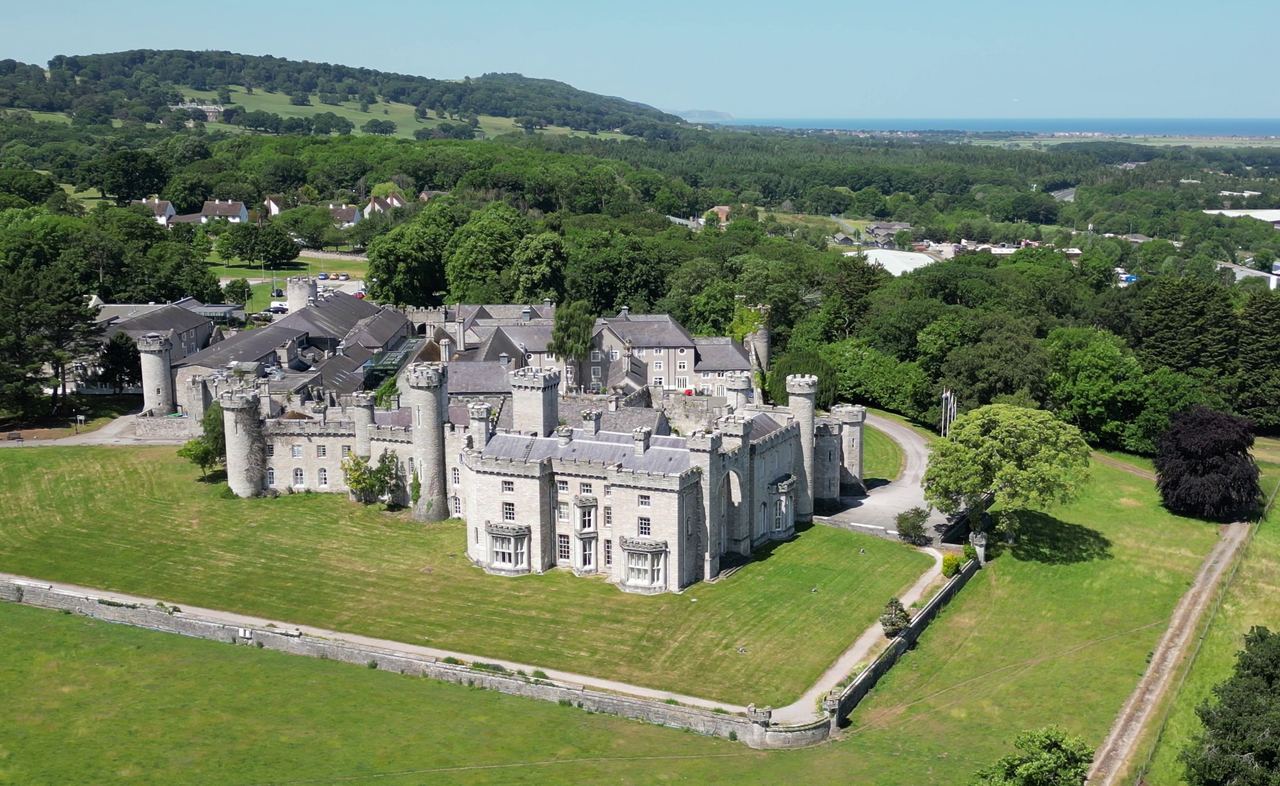
Gwrych Castle is a striking example of 19th-century Gothic Revival architecture prominently situated on Cefn yr Ogof hill near Abergele in Conwy County Borough, Wales. Though it appears as a medieval fortress from a distance, the castle is a relatively modern creation, built between 1819 and 1825 by Lloyd Hesketh Bamford-Hesketh as a grand tribute to his mother and family heritage. The castle's commanding hilltop location offers sweeping views across the Irish Sea and surrounding Welsh landscape, reinforcing its imposing presence along the North Wales coastline.
Historical background and lineage
The site of Gwrych Castle has a rich history extending back to the Iron Age, with archaeological evidence of ancient hillforts and defensive earthworks predating Roman occupation. During the Roman era, a shrine stood on the estate, indicating the area's longstanding cultural significance. In the medieval period, the site was associated with regional conflicts, commemorated by stone tablets at the castle's main entrance marking battle sites.
The Lloyd family held a late-medieval house on this site from at least the 16th century, establishing the ancestral lineage that would inspire the later construction of the castle. In the early 19th century, Lloyd Hesketh Bamford-Hesketh commissioned the construction of the current Gwrych Castle, initially designed by Charles Busby in Regency style but soon replaced by the more elaborate Gothic Revival plans of Thomas Rickman. Over subsequent decades, architects including C. E. Elcock, Detmar Blow, and Henry Kennedy contributed to the castle's expansion and stylistic refinement.
From 1894 until her death in 1924, the castle was the residence of Winifred Bamford-Hesketh, granddaughter of the original builder. She bequeathed the castle to King George V with the hope it would become an official Welsh residence for the Prince of Wales, an offer that was declined. The property then passed through various hands, including the Venerable Order of Saint John and later back to the Dundonald family, although they did not reside there again.
Role during world war ii and subsequent uses
During World War II, Gwrych Castle served a humanitarian role by housing approximately 200 Jewish children refugees evacuated under the Kindertransport program. The children were cared for by the Zionist youth movement Bnei Akiva, highlighting the castle's significance as a sanctuary during a turbulent period.
Following the war, the castle was transformed into a public attraction, known as "The Showpiece of Wales," welcoming millions of visitors over two decades. It hosted medieval reenactments, jousting tournaments, and mock banquets, becoming a cultural hub. The castle also served as a training ground for notable figures such as the world middleweight boxing champion Randolph Turpin in the early 1950s.
However, after its closure in 1987, Gwrych Castle suffered from neglect, vandalism, and structural decline. Attempts at restoration by various owners, including American businessman Nick Tavaglione, were unsuccessful, leading to further deterioration.
Architecture and landscape features
Gwrych Castle is a vast castellated mansion exhibiting hallmark features of the Gothic Revival style, including extensive battlements, multiple towers, turrets, and crenellated walls. The stone construction and elaborate detailing reflect the romanticized medieval aesthetic popular in the 19th century. The castle's layout evolved from an initial Regency design to a grand Gothic complex through the input of several architects.
The castle occupies a strategic hilltop position with natural protection from prevailing winds, offering panoramic views eastward toward Castell Cawr hill and westward to the Little and Great Orme near Llandudno. Its elevated site enhances its defensive appearance and scenic prominence.
Surrounding the castle are numerous ancillary structures, including a belvedere for scenic viewing, Lady Eleanor's Tower, estate walls, agricultural buildings, a home farm, and six lodges. Many of these outbuildings are listed as Grade II* or Grade II heritage structures, underscoring their architectural and historical importance.
The estate historically covered between 236 and 3,424 acres, though today about 200 acres remain under the stewardship of the Gwrych Castle Preservation Trust. The grounds integrate evidence of earlier occupations, including Iron Age fortifications and Roman religious sites, linking the castle to a deep historical continuum.
Preservation efforts and current status
Following decades of decline, the Gwrych Castle Preservation Trust was established by historian Mark Baker to advocate for the castle's conservation. The Trust successfully pressured local authorities to compulsorily purchase the property and later secured ownership in 2018 with funding from the National Heritage Memorial Fund.
Since then, stabilization and restoration efforts have focused on preserving the castle's remaining fabric and celebrating its heritage. Despite these efforts, the castle remains in a fragile state and is listed as a building at high risk on Wales's national heritage register as of 2024.
The castle gained renewed public attention as the filming location for the television series "I'm a Celebrity...Get Me Out of Here!" in 2020 and 2021. This exposure brought valuable funding and raised awareness of the castle's plight, supporting ongoing conservation work.
While much of the interior is ruinous, some rooms and outbuildings remain accessible, and original architectural plans and stained-glass designs are preserved in archives, aiding restoration. The castle's hilltop location has historically provided natural protection, as demonstrated during Storm Arwen in 2021, when nearby structures were damaged but the castle remained intact.
Cultural significance and visitor experience
Gwrych Castle holds a unique place in Welsh cultural heritage, embodying the romantic ideals of the Gothic Revival and reflecting centuries of layered history from Iron Age fortifications to 19th-century aristocratic ambition. Its dramatic silhouette along the North Wales coast makes it a landmark visible for miles.
Visitors can explore the extensive grounds, view the castle's exterior architectural features, and learn about its varied history, including its role as a refuge during World War II and its later use as a public attraction. The preservation trust continues to develop the site to enhance visitor access and interpretation, aiming to restore the castle to a condition where its historic marble halls and battlements can be appreciated once more.
Frequently asked questions (FAQ)
- When was Gwrych Castle built and by whom?
- Gwrych Castle was built between 1819 and 1825 by Lloyd Hesketh Bamford-Hesketh as a tribute to his mother and family heritage.
- What architectural style characterizes Gwrych Castle?
- The castle is primarily designed in the Gothic Revival style, featuring battlements, towers, and turrets typical of 19th-century romantic medievalism.
- What role did Gwrych Castle play during World War II?
- During World War II, Gwrych Castle housed 200 Jewish refugee children evacuated under the Kindertransport program, cared for by the Zionist youth movement Bnei Akiva.
- Is Gwrych Castle open to the public today?
- The castle is currently under preservation and not fully open to the public, but the Gwrych Castle Preservation Trust organizes events and guided visits periodically.
- How can visitors reach Gwrych Castle?
- Gwrych Castle is located near Abergele in Conwy County Borough, Wales, accessible by road with parking available nearby.
Information
Sources & official resources
Verify the information above using these authoritative references.
Loading map...
Visitor reviews
No reviews yet. Been here? Write the first review and help other travelers!
Write the first reviewVisited this castle? Share your experience
Your review helps other travelers and adds first-hand knowledge to our encyclopedia.