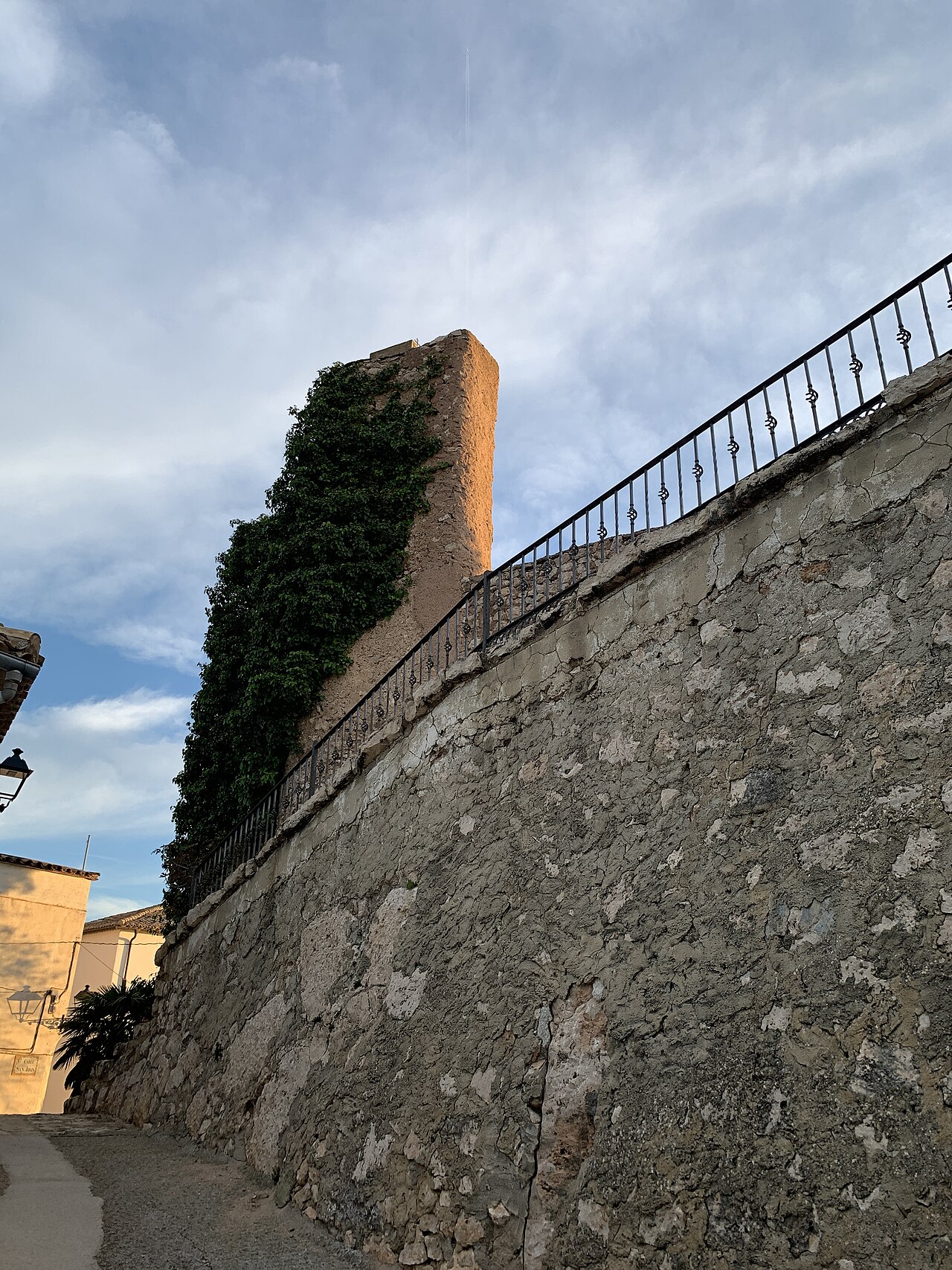
Cofrentes Castle
Cofrentes Castle stands majestically atop Cerro de Agrás, an extinct volcanic hill in the municipality of Cofrentes, Spain. This historic hill castle dates back to the 12th century and was originally constructed by Islamic builders during the High Medieval period. Its strategic location overlooking the confluence of the Júcar and Cabriel rivers made it a crucial defensive stronghold controlling river transport and valley access.
The castle's ruins today reveal a complex architectural evolution shaped by centuries of conflict, adaptation, and restoration. The fortress is divided into three main sections: the lower section, the middle section, and the upper bastion, which housed the noble quarters and was accessed through the courtyard. The imposing Torre del Homenaje (Keep) remains a defining feature, rising four stories with a distinctive Gothic-arched window and a historic clock, considered one of the oldest mechanical clocks in the Region of Valencia.
Historical significance and origins
The site of Cofrentes Castle has a long history of human occupation, with archaeological finds including ceramic fragments from the Bronze Age, Iberian, and Roman periods. The castle itself was established in the 12th century, between 1147 and 1172, during the era of Islamic rule in the Iberian Peninsula. It served as a key military fortress guarding the vital river routes and controlling access through the valley.
Political shifts in the late 13th century saw the castle change hands following the Treaty of Campillo in 1281. This treaty between Alfonso X of Castile and Pedro III of Aragon transferred the castle to the Kingdom of Valencia under Castilian control, marking its role as a frontier fortress between Christian kingdoms.
Architectural features and layout
Fortress structure and defensive elements
The castle covers a roughly rectangular area measuring approximately 800 by 600 meters. It is constructed primarily of hard stone, utilizing masonry techniques typical of medieval military architecture. The fortress includes a lower courtyard known as the albacar, historically used for livestock, and an upper enclosure containing the main buildings and defensive towers.
Access to the fortress is gained via a ramp leading to a prominent gateway fortified by two semicircular towers. These towers are built from roughly hewn small ashlar stones, while the gateway features a semicircular arch made of carefully cut blocks, demonstrating skilled craftsmanship. Four additional towers are positioned within the complex to provide flanking defense, two toward the northeast and two to the southwest.
The keep and clock tower
The heart of the upper enclosure is the Torre del Homenaje, a square-shaped keep rising four levels. This tower features a distinctive window with a slightly pointed Gothic arch and a unique keystone notch forming an upward-pointing vertex. Mounted on the keep is a historic clock, restored in the early 21st century. While some sources date the clock to the 16th century, Valencian Heritage authorities attribute it to the 19th century. This clock is a significant cultural artifact and one of the oldest mechanical clocks in the region.
Historical transformations and conflicts
Over the centuries, Cofrentes Castle underwent numerous adaptations reflecting changing military and residential needs. In the 16th and 17th centuries, the fortress evolved from a purely defensive structure into a palace residence, mirroring broader trends in fortification use during peacetime.
The castle saw renewed military action during the War of Spanish Succession in the early 18th century, when it was seized by Bourbon forces loyal to Philip V. It also played roles in the French War of Independence and the Carlist Wars, during which it sustained significant damage. These conflicts accelerated the fortress's decline.
Preservation and cultural importance
By the early 20th century, Cofrentes Castle had fallen into ruins. Recognizing its historical and cultural value, Spanish authorities declared it a Bien de Interés Cultural in 2001, ensuring its protection as a heritage site.
Today, visitors can explore the castle ruins, including the barbican tower that once guarded the entrance and the remains of the defensive walls. The keep has been converted into a viewing point offering panoramic views of the surrounding landscape. Entrance tickets include access to a newly opened museum that showcases the castle's history and the earlier settlement on the site.
The museum's highlight is the Reloj de la Torre del Castillo, the mechanical clock from the keep, which provides a tangible link to the castle's past and technological heritage.
Visitor experience and accessibility
Visitors to Cofrentes Castle can enjoy a rich historical journey through the museum and the well-preserved architectural remains. The site offers breathtaking views from the keep and opportunities to appreciate medieval military architecture firsthand. The castle's elevated position on a volcanic hill provides a unique setting combining natural beauty with historical intrigue.
The castle is accessible by a ramp leading to the main gate, and the site is suitable for those interested in history, architecture, and cultural heritage. The museum enhances the visitor experience by providing context and detailed information about the fortress's evolution and significance.
Frequently asked questions (FAQ)
- When was Cofrentes Castle originally built?
- Cofrentes Castle was constructed during the 12th century, between 1147 and 1172, by Islamic builders during the High Medieval period.
- What architectural features define Cofrentes Castle?
- The castle features a three-part layout with a lower courtyard (albacar), an upper enclosure, semicircular gate towers, four flanking towers, and a square keep (Torre del Homenaje) with a Gothic-arched window and historic clock.
- Can visitors access the Torre del Homenaje?
- Yes, the Torre del Homenaje has been converted into a viewing point offering panoramic views of the surrounding landscape and the rivers below.
- What is the historical significance of the clock in Cofrentes Castle?
- The castle's clock, mounted on the keep, is one of the oldest mechanical clocks in the Region of Valencia, dating possibly from the 16th or 19th century, and has been restored to preserve its heritage.
- How did the castle's role change over time?
- Initially a military fortress, Cofrentes Castle evolved into a palace residence in the 16th and 17th centuries, reflecting changes in military technology and residential needs.
- Is Cofrentes Castle protected as a cultural heritage site?
- Yes, Cofrentes Castle was declared a Bien de Interés Cultural in 2001, ensuring its protection and recognition as an important historical monument.
Information
Current owner
Municipality
Loading map...
Visitor reviews
No reviews yet. Been here? Write the first review and help other travelers!
Write the first reviewVisited this castle? Share your experience
Your review helps other travelers and adds first-hand knowledge to our encyclopedia.