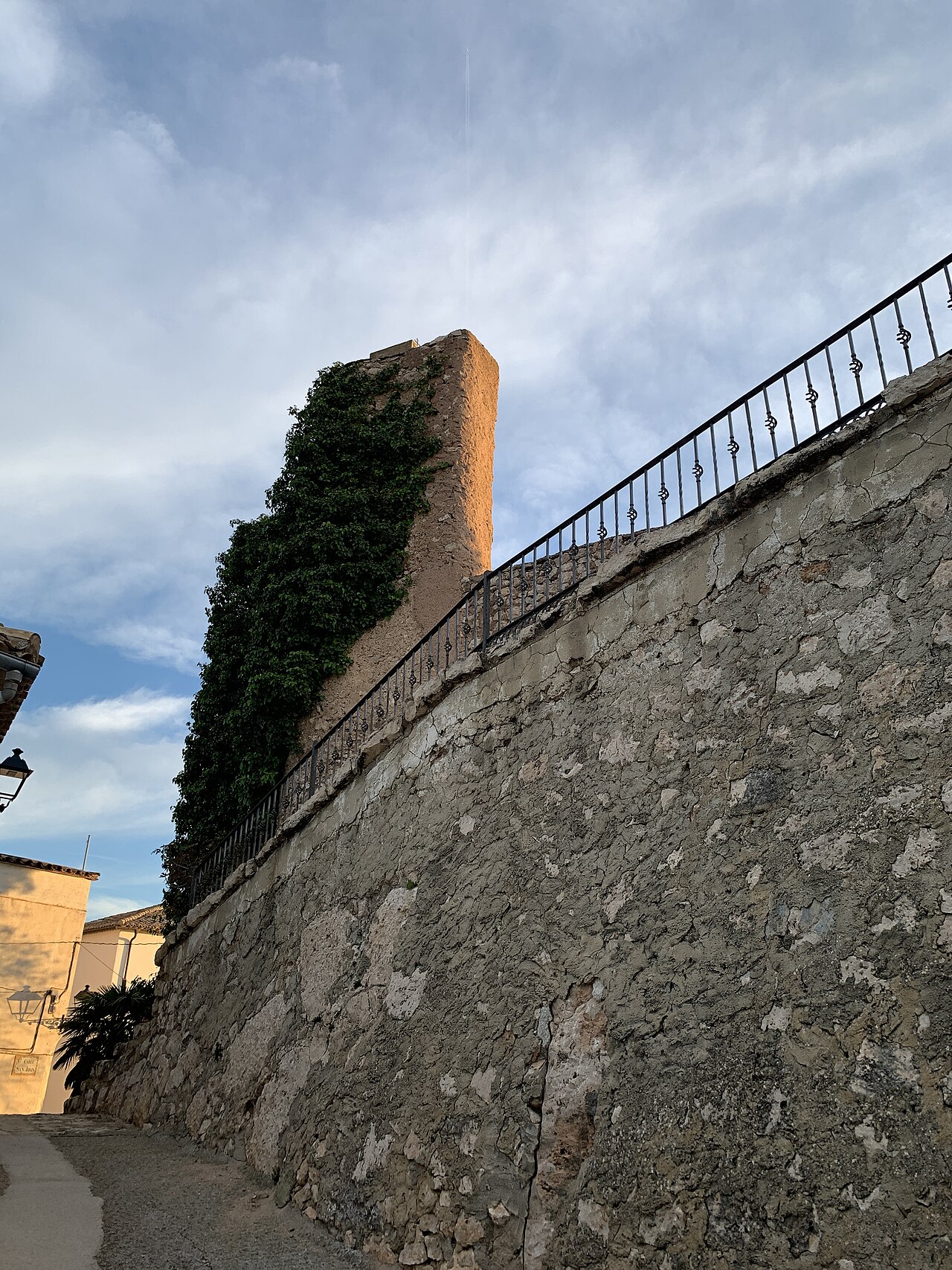
Chirel Castle
Chirel Castle, located in the municipality of Cortes de Pallás in Spain, is a remarkable example of a late medieval hill castle with deep roots tracing back to the period of Muslim rule in the Iberian Peninsula. Originally established as a Muslim fortress, it underwent significant transformations following the Christian conquest in the 13th century, when the Moors were expelled and the castle became a strategic base for Christian forces under the command of James I the Conqueror, the king of Aragon. This transition marked the beginning of the castle's role as a military stronghold during the turbulent Reconquista period.
The castle's position atop the natural rocky elevation known as Muela del Cinto del Castillo provided a commanding view of the surrounding landscape, including the Cintos de Sácaras and the Cortes reservoir. Its triangular ground plan was ingeniously adapted to the rugged terrain and deep gorges, maximizing its defensive capabilities. Despite suffering significant damage from a major earthquake in 1748 that led to the collapse of much of the fortress, key elements such as the main tower, double walls, two large towers, and a substantial cistern (aljibe) remain visible today.
Historical significance and military role
The castle played a pivotal role during the Al-Azraq revolt, a notable uprising against Christian forces led by the Muslim leader al-Azraq. After the Christian conquest, it served as a base of operations for the Aragonese crown. Documents from 1349 confirm the castle's active military presence, highlighting its importance within the network of fortifications in the region.
In the 15th century, reconstruction efforts enhanced the castle's defenses, evident in the carefully cut ashlar stones framing the entrances, decorative shields, and voussoirs above doorways. These architectural details reflect the castle's adaptation to evolving military technologies and the ongoing conflicts of the period.
During the early 17th century, Castillo de Chirel was instrumental in the suppression of the Morisco revolts. The fortress served as a strategic base for government troops combating Morisco guerrilla fighters in the surrounding Muela de Cortes area. This period underscores the castle's continued military relevance even as the geopolitical landscape shifted.
Following the expulsion of the Moriscos in 1609, the fortress gradually lost its strategic importance. The decline of the local population and reduced geopolitical significance led to its abandonment and eventual ruin. Despite this, the castle's historical and cultural value was recognized when it was declared a Bien de Interés Cultural in 2002, granting it legal protection as a heritage site.
Architectural features and defensive design
Layout and fortifications
The castle's triangular layout is a direct response to the natural topography of its rocky hilltop setting. The design maximizes defensive potential by incorporating natural barriers such as steep slopes and gorges. The fortress is enclosed by a double wall system, providing layered protection against attackers.
Entrances and defensive mechanisms
Access to the castle was deliberately challenging. The main entrance features an elevated walkway approximately one meter high, marked by a pointed arch on the exterior and a semicircular arch on the interior, leading into a small lobby. From here, a narrow corridor winds between two closely set walls, creating a complex path designed to slow and expose attackers. A similar defensive arrangement is found at the watchtower entrance, emphasizing the fortress's layered security approach.
Towers and walls
Two prominent towers anchor the eastern and western ends of the castle. The eastern tower has a trapezoidal footprint and rises several stories, though its interior is now in ruins. The western tower is square in plan and retains two floors; the lower floor features a barrel vault roof constructed from brick laid in a spiral pattern, a technique providing exceptional strength. The upper floor’s roof has been lost over time.
The double-walled enclosure remains a defining feature of the fortress, outlining the perimeter and reinforcing its defensive capabilities. The walls are punctuated by arrow slits (saeteras), allowing defenders to fire upon enemies while remaining protected. Parapets and embrasures further enhance the castle's fortifications.
Water management and self-sufficiency
Within the castle grounds lies a large cistern (aljibe), an essential feature for storing water during sieges. This cistern highlights the fortress's capacity for prolonged defense and self-sufficiency in harsh conditions.
Current condition and preservation efforts
Today, Chirel Castle stands in a partially preserved state, with significant portions of its structure in ruins due to centuries of neglect and the devastating earthquake of 1748. Despite this, the site remains accessible and safe for visitors, thanks to improvements made to the access roads and pathways. The castle's dramatic setting and panoramic views of the surrounding landscape make it a popular destination for tourists and history enthusiasts alike.
Efforts to preserve and potentially restore the castle are ongoing, with the site listed on the waiting list for reconstruction. Its designation as a Bien de Interés Cultural underscores its importance as a cultural heritage site and provides a framework for future conservation initiatives.
Visiting chirel castle
Visitors to Chirel Castle can explore the remains of the main tower, the double walls, and the two large towers, as well as the impressive cistern. The castle offers breathtaking views of the Muela del Cinto del Castillo and the surrounding natural features, including the Cintos de Sácaras and the Cortes reservoir.
The site is accessible via well-maintained roads, ensuring a safe visit despite the ruinous condition of the castle itself. Visitors are advised to wear suitable footwear and take care when exploring the uneven terrain.
Cultural and historical legacy
Chirel Castle embodies the layered history of the Iberian Peninsula, reflecting the complex interactions between Muslim and Christian powers during the Middle Ages. Its architectural features and strategic location illustrate the military and political dynamics of the Reconquista and subsequent conflicts, including the Morisco revolts.
As a protected heritage site, the castle serves as a tangible link to Spain's medieval past and offers valuable insights into the region's cultural evolution. Its preservation and study contribute to a broader understanding of medieval fortifications and their role in shaping historical landscapes.
Frequently asked questions (FAQ)
- When was Chirel Castle originally built and by whom?
- Chirel Castle was originally built during the Muslim period before the 13th century. After the Christian conquest in the 13th century, it was rebuilt and adapted by Christian forces.
- What are the main architectural features of Chirel Castle?
- The castle features a triangular layout adapted to the rocky hilltop, a double-walled enclosure, two large towers with distinct footprints, arrow slits, and a large cistern for water storage.
- Is Chirel Castle open to visitors and is it safe to visit?
- Yes, Chirel Castle is accessible to visitors. Although the castle is partially ruined, the access roads and pathways have been improved to ensure visitor safety.
- What historical events is Chirel Castle known for?
- Chirel Castle is known for its role during the Al-Azraq revolt, the Christian conquest under James I the Conqueror, and the Morisco revolts in the early 17th century.
- Why is Chirel Castle important culturally and historically?
- The castle reflects the complex history of Muslim and Christian interactions in medieval Spain and serves as a protected heritage site illustrating military architecture and regional conflicts.
Information
Loading map...
Visitor reviews
No reviews yet. Been here? Write the first review and help other travelers!
Write the first reviewVisited this castle? Share your experience
Your review helps other travelers and adds first-hand knowledge to our encyclopedia.