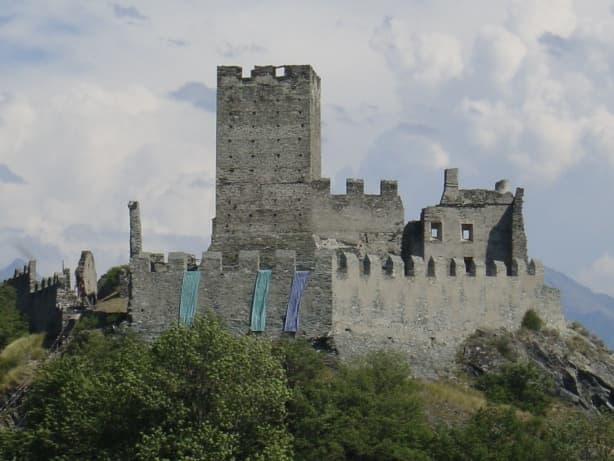
Cly Castle
Cly Castle stands as a remarkable example of early medieval fortification in the region of Campania, Italy. Perched strategically on a hilltop in the municipality of Saint-Denis, it overlooks the Dora Baltea river and commands panoramic views of the surrounding countryside. The castle's origins trace back to the early 11th century, making it a significant relic of high medieval architecture and feudal history in the Italian Alps.
The castle is classified as a hill castle, built in the so-called "primitive" style characterized by a central keep or mastio surrounded by a defensive curtain wall. Its construction is dated to around 1027 based on dendrochronological analysis of timber remains, although the first documentary mention appears in 1207. This early date situates Cly Castle among the oldest fortifications in the region, reflecting the strategic importance of controlling Alpine passes and trade routes during the medieval period.
Historical context and ownership
The site of Cly Castle reveals evidence of human occupation that predates its medieval construction, with archaeological findings indicating prehistoric and protohistoric activity. The castle's earliest wooden structures, particularly within the central keep, have been scientifically dated to the early 11th century, underscoring its role as a fortified manor established by local nobility during the early Middle Ages.
Originally a fief under the suzerainty of the Counts of Savoy, the castle was granted to the Cly branch of the Challant family in the 13th century. Notably, Boson IV, son of Viscount Boson III of Aosta, significantly fortified and expanded the manor, shaping it into a complex that controlled a vast territory including present-day Chambave, Saint-Denis, Diémoz, Verrayes, Torgnon, and the Valtournenche valley. This expansion highlights the castle's strategic role in regional governance and defense.
Following Boson IV, the lordship passed through his descendants, including Boniface I and his son Peter, whose oppressive rule led to conflict with Count Amadeus IV of Savoy. As a result, Peter's titles and properties, including Cly Castle, were confiscated. From 1376, the castle came under direct control of the House of Savoy, serving as an administrative center and justice seat for approximately two centuries.
Notable events and later history
One of the castle's most somber historical episodes occurred in 1428 when Johanneta Cauda was imprisoned in its dungeons. She is historically significant as the first woman in the Western Alps accused of witchcraft. After a 71-day confinement, she was executed by burning near the castle grounds, marking a dark chapter in the castle's history.
Ownership of the castle later passed through several noble families, including the San Martino, de Candia, Visdomini di Ginevra, Birago San Martino de Candia, and finally the Roncas family in 1634. By the late 17th century, the castle was abandoned, and much of its stone was repurposed to construct a more comfortable manor in Chambave. The castle subsequently fell into ruin until the early 20th century when historian Tancredi Tibaldi acquired the property on behalf of the Saint-Denis municipality, preserving its remains.
Architectural features and layout
Cly Castle exemplifies the primitive castle style typical of the Aosta Valley, dominated by a massive central keep rising approximately 18 meters above its rocky foundation. The keep's base measures roughly 9.4 by 9 meters and is internally divided into three floors. Its elevated entrance, originally accessed by a wooden ladder, provided defensive advantages against attackers. This entrance was later modified with a stone staircase supported by a now-collapsed flying buttress. Over time, several doors and windows were bricked up to enhance the keep's defensibility.
Surrounding the keep is a nearly intact crenellated curtain wall enclosing about 2800 square meters. The western section of the wall was intentionally left free of buildings to serve as a refuge area for the local population during attacks. On the southeastern side, archaeological excavations have revealed the foundations of several buildings dating from the 11th to 14th centuries. These included kitchens, stables, a guardhouse, and the lord's residence, alongside the Romanesque chapel of Saint Maurice.
The chapel of saint maurice
The chapel, attached directly to the keep, likely dates back to the 11th century. Its east-facing apse once featured frescoes depicting angels, saints, and evangelists. Although only fragments remain today, these frescoes were documented by early 20th-century scholars through drawings and descriptions, offering valuable insights into the castle's religious and artistic heritage.
Water supply and defensive structures
In the northwest corner of the castle enclosure lie the remains of a tower beneath which is a subterranean cistern lined with cocciopesto, a waterproof mortar used since antiquity. This cistern was part of an advanced water supply system, supplemented by a wooden pipeline that channeled water from a hillside spring. Such infrastructure highlights the castle's self-sufficiency and the importance of water management in medieval fortifications.
The southern portion of the castle, once home to residential buildings and guardhouses, now exists largely in ruins, with only faint traces discernible. Despite this, the preserved curtain wall and central keep continue to convey the castle's original medieval layout and defensive design.
Cultural significance and visitor information
Today, Cly Castle is a cherished cultural landmark within the Aosta Valley, symbolizing the region's medieval heritage and feudal past. Its ruins offer visitors a tangible connection to the early medieval period and the complex history of noble families, regional power struggles, and architectural evolution.
The castle is owned by the municipality of Saint-Denis and is open to the public through guided tours during the summer months of July and August. Visitors can explore the castle's ruins, appreciate its commanding views, and learn about its historical significance through interpretive materials and expert guides.
Its location atop a hill overlooking the town of Chambave makes it accessible to visitors interested in medieval architecture, history, and Alpine culture. The site also attracts scholars and enthusiasts of medieval fortifications due to its well-preserved primitive style and archaeological importance.
Frequently asked questions (FAQ)
- How do I get to Cly Castle?
- Cly Castle is located in Saint-Denis, Italy, and can be accessed via public transportation or by car. If traveling by train, the nearest station is a short bus ride away. Parking facilities are available for those who choose to drive.
- What is the historical significance of Cly Castle?
- Cly Castle dates back to the 12th century and played a crucial role in the region's defense during various conflicts. It is a prime example of medieval architecture and has been well-preserved, offering insights into the historical lifestyle of nobility in Italy. Visitors can explore its rich history through informative displays throughout the castle.
- When was Cly Castle built?
- Cly Castle was constructed in the 12th century, making it one of the oldest castles in the region. Its strategic location was chosen for defensive purposes and to oversee the surrounding lands. The castle has undergone several renovations over the centuries while maintaining its original charm.
- Can I take guided tours of Cly Castle?
- Yes, guided tours are available at Cly Castle, providing an in-depth look at its history and architecture. Tours are conducted by knowledgeable guides who share fascinating stories and facts about the castle. It is recommended to book in advance during peak tourist seasons to ensure availability.
- Why is Cly Castle considered an architectural gem?
- Cly Castle is renowned for its stunning medieval architecture, featuring intricate stonework and impressive towers. The layout of the castle reflects the defensive strategies of the time, with its thick walls and narrow windows. Its preservation allows visitors to appreciate the craftsmanship and design typical of the era.
- Is it possible to hold events at Cly Castle?
- Yes, Cly Castle offers facilities for hosting special events, including weddings and corporate gatherings. The picturesque setting and historical ambiance make it a unique venue. Interested parties should contact the castle administration for availability and further details.
- What are the opening hours for Cly Castle?
- Cly Castle is open to visitors from 9 AM to 6 PM, with extended hours during the summer months. It is advisable to check the official website for any seasonal changes or special events that may affect opening times. Last entry is typically one hour before closing.
- What are the ticket prices for visiting Cly Castle?
- Ticket prices for Cly Castle vary depending on age and group size, with discounts available for children, students, and seniors. General admission is typically around €10, while guided tours may have an additional fee. Visitors can purchase tickets on-site or online through the castle's official website.
- When is the best time to visit Cly Castle?
- The best time to visit Cly Castle is during the spring and fall months when the weather is mild and pleasant. This allows for comfortable exploration of the grounds and surrounding areas. Additionally, visiting during off-peak times can help avoid large crowds and enhance the overall experience.
- Are there any nearby attractions to Cly Castle?
- Yes, several attractions are located near Cly Castle, including beautiful gardens, local museums, and historical landmarks. Visitors can also explore the charming town of Saint-Denis, which offers a variety of shops and dining options. A visit to the nearby vineyards can enhance your experience of the region's rich culture and traditions.
Photo gallery

Photo by Irene La Barbera•Attribution
Information
Website
Visit websiteSources & official resources
Verify the information above using these authoritative references.
Loading map...
Visitor reviews
No reviews yet. Been here? Write the first review and help other travelers!
Write the first reviewVisited this castle? Share your experience
Your review helps other travelers and adds first-hand knowledge to our encyclopedia.



