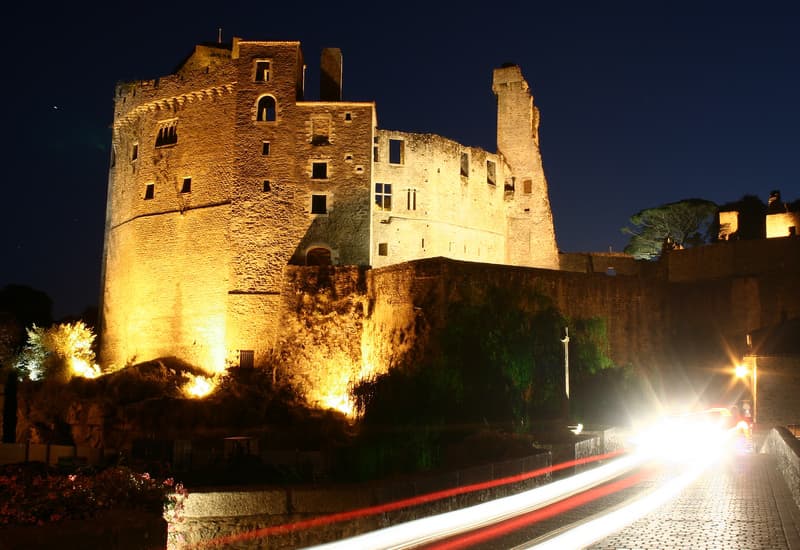
Clisson Castle
Clisson Castle, located in the town of Clisson in western France, is a remarkable example of a medieval hilltop fortress that played a pivotal role in the defense of the Duchy of Brittany. Perched on a granite promontory overlooking the left bank of the Sèvre Nantaise river, the castle's strategic position allowed it to control important routes between Brittany and the neighboring provinces of Anjou and Poitou. Its origins date back to the 11th century, when the powerful Lords of Clisson established a fortified stronghold that would evolve over several centuries into a complex defensive system reflecting advances in military architecture.
The castle was initially constructed as a polygonal enclosure with defensive towers during the High Medieval period. It served as a key stronghold on the Marches de Bretagne, the borderlands of the Duchy of Brittany, protecting the region from external threats and rival feudal powers. Throughout its history, the castle underwent significant expansions and modifications, particularly under the ownership of the Dukes of Brittany after the fall of the Clisson family in the early 15th century. Notably, Duke François II of Brittany transformed Clisson Castle into a formidable fortress by adding a second curtain wall with numerous towers designed to accommodate artillery, reflecting the evolving nature of warfare.
Early history and medieval origins
The first documented references to the Lords of Clisson date from around 1040. The original fortification was likely a wooden structure situated on the granite outcrop, which was gradually replaced by stone constructions during the 12th and 13th centuries. By the 13th century, the castle had taken the form of an irregular polygonal stone enclosure with round towers and a moat separating it from the rocky plateau. This design was typical of high medieval military architecture, emphasizing strong defensive walls and vantage points.
Guillaume de Clisson was responsible for much of the 13th-century construction, including the erection of a massive gatehouse and curtain walls. In the 14th century, Olivier III de Clisson enhanced the fortifications by incorporating the gatehouse into a large square donjon or keep, which became the dominant feature of the castle. The donjon served both as a last refuge during sieges and as the lordly residence, rising approximately 35 meters high with multiple floors.
Notable medieval figures
The castle was home to several prominent members of the Clisson family, including Olivier IV, who was executed in 1343, and Olivier V, who gained distinction as Constable of France in 1380. Their turbulent lives and political roles are intertwined with the history of the castle, which remained a significant feudal seat until the early 15th century.
Transition to ducal ownership and renaissance fortifications
After the dispossession of Marguerite de Clisson around 1420, the castle passed into the hands of the Dukes of Brittany. Under Duke François II, significant upgrades were made between 1464 and 1488 to modernize the fortress in response to the advent of gunpowder artillery. A second rectangular enclosure was constructed to the west, featuring towers with artillery casemates designed to mount cannons and defend the approach routes.
This period saw the addition of a barbican and a fortified northern gate with crenellations and machicolations, architectural elements that allowed defenders to repel attackers effectively. The castle's defenses were further enhanced during the late 16th century amid the French Wars of Religion, when terraced bastions were added to the south to provide layered protection.
Architectural features and defensive innovations
The castle's layout includes two main curtain walls forming irregular polygons, with numerous round towers, a large square donjon, and a variety of defensive structures such as arrow slits, murder holes, and portcullises. The 15th-century artillery towers on the western side have walls approximately six meters thick, designed to withstand cannon fire. The presence of multiple lines of defense, including a moat, barbicans, and bastions, demonstrates the castle's evolution from a medieval fortress to an artillery-capable stronghold.
Destruction and romantic revival
Clisson Castle was abandoned by its lords in the mid-18th century and suffered extensive damage during the War in the Vendée (1793-1796), when Republican forces set fire to the site. The resulting destruction left the castle in ruins, with many roofs and interior structures lost. In 1807, the sculptor François-Frédéric Lemot purchased the estate with the intent to preserve the ruins. He integrated the castle into a landscaped park designed to evoke the romantic aesthetic of Italian ruins, a popular trend in the 19th century.
Throughout the 19th and 20th centuries, the castle's ruins inspired artists and writers drawn to its picturesque decay. The site was officially classified as a historical monument in 1924, recognizing its cultural and architectural significance. From the 1960s onwards, the Loire-Atlantique departmental council, with support from the French Ministry of Culture, undertook extensive restoration projects to stabilize and partially restore the castle, including reroofing towers and repairing stonework.
Architectural remains and visitor experience
Today, visitors to Clisson Castle can explore a site that vividly illustrates the layers of medieval and Renaissance military architecture. The castle's granite outcrop setting provides dramatic views over the Sèvre Nantaise river and the surrounding landscape.
The main donjon stands as a dominant feature, with its multiple floors once serving as living quarters and defensive stronghold. Adjacent round towers, some converted into prisons in the 18th century, retain their crenellations and arrow slits. The remains of the gatehouse include portions of the original two-towered portal with defensive mechanisms such as a portcullis and murder holes.
The castle's multiple curtain walls, barbicans, and bastions reveal its complex defensive strategy. The 15th-century artillery towers and bastions demonstrate the adaptation of medieval fortifications to the use of gunpowder weapons. Visitors can also see remnants of the lordly residence, including the great hall, kitchens with large fireplaces, and a private chapel dedicated to Sainte-Barbe.
Restoration efforts have preserved much of the castle's imposing silhouette and architectural details, allowing a comprehensive understanding of its historical development. The site remains a testament to the military, political, and cultural history of Brittany and France.
Frequently asked questions (FAQ)
- What are the opening hours of Clisson Castle?
- Clisson Castle is open to visitors from 10:00 AM to 6:00 PM during the summer months and from 10:00 AM to 5:00 PM in the winter. It is advisable to check the official website for any seasonal changes or special events that may affect these hours.
- How do I get to Clisson Castle?
- Clisson Castle is located in Clisson, France, and can be easily reached by car or public transport. The nearest train station is Clisson, which is about a 15-minute walk from the castle.
- Is there an entrance fee for Clisson Castle?
- Yes, there is a small entrance fee to visit Clisson Castle, which helps maintain the site. Discounts are often available for students, seniors, and groups, so be sure to inquire at the ticket office upon arrival.
- When was Clisson Castle built?
- Clisson Castle dates back to the 13th century, originally constructed to defend the region against invasions. Over the centuries, it has undergone several renovations and restorations, showcasing various architectural styles.
- Can I take guided tours of Clisson Castle?
- Yes, guided tours are available at Clisson Castle, providing visitors with in-depth information about its history and architecture. Be sure to check the schedule in advance, as tours may only be offered at specific times.
- What is the historical significance of Clisson Castle?
- Clisson Castle played a crucial role in the defense of the region during the medieval period, showcasing the military architecture of the time. Its strategic location made it a key stronghold in various historical conflicts.
- Is Clisson Castle accessible for visitors with disabilities?
- Clisson Castle has made efforts to improve accessibility for visitors with disabilities. However, due to its historical structure and terrain, some areas may still present challenges, so it is recommended to contact the site prior to your visit for specific accommodations.
- What is the best time to visit Clisson Castle?
- The best time to visit Clisson Castle is during the spring and early autumn when the weather is mild, and the surrounding landscape is particularly beautiful. Additionally, visiting on weekdays may help you avoid larger crowds.
- Are there any nearby attractions to visit while in Clisson?
- Yes, there are several attractions near Clisson, including the picturesque town center and the scenic banks of the Sèvre Nantes river. Visitors can also explore the nearby vineyards and local markets for a taste of the region's culture.
Photo gallery

Information
Website
Visit websiteSources & official resources
Verify the information above using these authoritative references.
Loading map...
Visitor reviews
No reviews yet. Been here? Write the first review and help other travelers!
Write the first reviewVisited this castle? Share your experience
Your review helps other travelers and adds first-hand knowledge to our encyclopedia.



