City wall of Visby
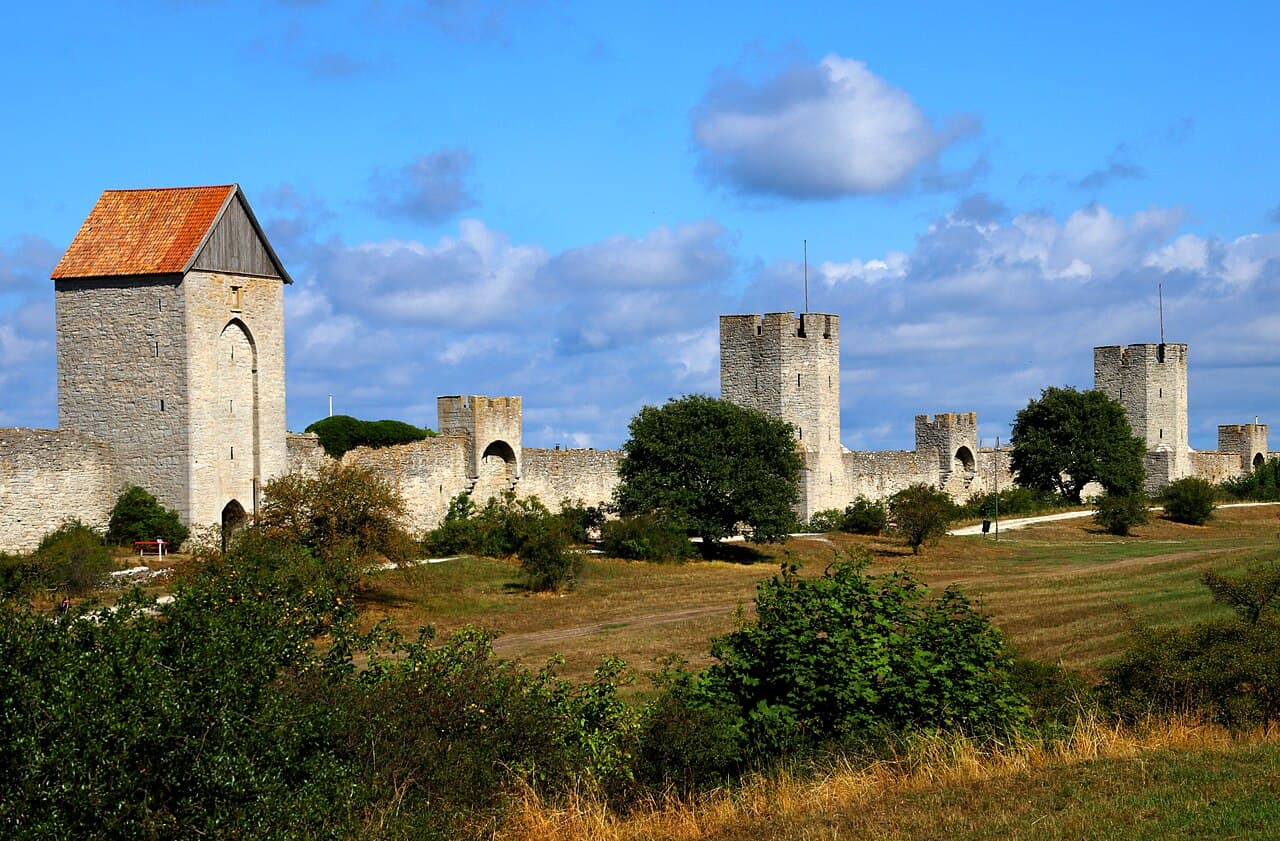
Visby city wall (Swedish: Visby ringmur, "Visby Ring Wall") is a prominent medieval defensive structure encircling the historic town of Visby on the island of Gotland, Sweden. Recognized as the strongest, most extensive, and best-preserved medieval city wall in Scandinavia, it is a vital component of the Visby World Heritage Site. This fortification exemplifies medieval urban defense and reflects the town's historical significance as a major Baltic trading hub during the High Medieval period.
Construction and architectural features
The Visby city wall was constructed in two main phases during the 13th and 14th centuries. Originally, the wall stretched approximately 3.6 kilometers (2.2 miles), of which about 3.44 kilometers (2.14 miles) still stand today, showcasing remarkable preservation. The wall incorporates a total of 29 large towers and 22 smaller towers, with 27 large and 9 smaller towers surviving. These towers were strategically placed to provide overlapping fields of fire and to strengthen the wall’s defensive capabilities.
One of the unique aspects of the wall’s construction is the integration of several pre-existing houses within its structure during one of the building phases. This incorporation illustrates a pragmatic adaptation to the urban landscape and the need to fortify the town efficiently.
The wall is built primarily of local limestone, typical of the region, and features battlements and crenellations that allowed defenders to observe and repel attackers. The fortification also includes several gates that controlled access to the town, each historically equipped with portcullises and drawbridges.
Historical significance and modifications
Visby was a vital trading center in the Baltic Sea during the High Medieval period, part of the Hanseatic League’s network. The city wall played a crucial role in protecting the town from rival powers and pirates, contributing to Visby’s prosperity and security.
During the 18th century, the fortifications underwent modifications to adapt to changes in military technology. Several towers were rebuilt or reinforced to accommodate cannons, reflecting the evolution from medieval to early modern warfare. Additional bastioned fortifications were added in some sections to improve the defensive perimeter against artillery attacks.
Key historical events
The wall witnessed several sieges and conflicts, notably during the 1361 Danish invasion led by King Valdemar IV, when the town was attacked and partially damaged. Despite this, the fortifications remained largely intact and were repaired and strengthened in subsequent years.
Preservation and cultural importance
Today, the Visby city wall is considered one of the best-preserved medieval city walls in Europe. Its extensive survival offers valuable insight into medieval urban defense architecture and the historical development of fortified towns in Scandinavia.
The wall is a central feature of the Visby World Heritage Site, attracting numerous visitors interested in medieval history, architecture, and Scandinavian cultural heritage. Conservation efforts have ensured the wall’s structural integrity and accessibility for educational and tourism purposes.
Visitor experience
Visitors to Visby can walk along sections of the city wall, explore the towers, and learn about the medieval fortification system through informative displays and guided tours. The wall’s impressive scale and preservation make it a striking visual reminder of Visby’s medieval past.
Frequently asked questions (FAQ)
- What is the best time to visit Visby city wall?
- The best time to visit Visby city wall is during the summer months from June to August when the weather is mild and most attractions are open. Spring and early autumn also offer pleasant conditions with fewer tourists.
- Can I walk along the entire length of the Visby city wall?
- Visitors can walk along significant portions of the Visby city wall, including access to several towers. Some sections are more accessible than others due to preservation efforts, but guided tours often include the best-preserved parts.
- What historical events is the Visby city wall known for?
- The Visby city wall is known for withstanding the 1361 Danish invasion led by King Valdemar IV. It also played a key role in protecting Visby during various medieval conflicts as a vital Baltic trading center.
- Is the Visby city wall wheelchair accessible?
- While some areas of the Visby city wall and towers may have limited accessibility due to their medieval construction, efforts have been made to accommodate visitors with mobility challenges in certain parts. It is advisable to check with local visitor centers for specific accessibility information.
- Are there guided tours available for the Visby city wall?
- Yes, guided tours are available that provide detailed historical and architectural insights into the Visby city wall. These tours often include visits to towers and explanations of the wall’s defensive features.
Photo gallery

Information
Loading map...
Visitor reviews
No reviews yet. Been here? Write the first review and help other travelers!
Write the first reviewVisited this castle? Share your experience
Your review helps other travelers and adds first-hand knowledge to our encyclopedia.