Citadel of Homs
The Citadel of Homs stands as a monumental testament to the rich and complex history of fortifications in the Syrian Arab Republic. Located on an artificial mound southwest of the Old City of Homs, this hill castle encapsulates millennia of architectural evolution and strategic military importance. Its origins trace back to the 3rd millennium BCE, making it one of the oldest continuously inhabited fortified sites in the region.
Throughout its extensive history, the citadel has witnessed the rise and fall of numerous civilizations, each leaving a distinct imprint on its structure and function. During the Roman period, the fortress transcended its initial defensive purpose to become a complex administrative and residential center. Under the patronage of Julia Domna, a prominent figure in Roman Syria and wife of Emperor Septimius Severus, the citadel expanded significantly. The construction of semi-circular walls enclosing living quarters, storerooms, and official buildings reflected the military and architectural innovations of the era.
Early islamic transformation and medieval fortifications
With the advent of the early Islamic period around 750 CE, the citadel underwent a major transformation under the Umayyad dynasty. It was formalized as a fortified stronghold, serving both military and administrative functions. By the 12th century, specifically in 1104 CE, the fortress was famously associated with Usama ibn Munqidh, a renowned warrior and poet of the Hamdanid era, earning the moniker "Citadel of Usama."
The citadel endured significant challenges, including a devastating earthquake in 1170 CE. The reconstruction efforts led by the Muslim leader Nūr ad-Dīn revitalized its defenses and infrastructure. The subsequent Ayyubid period brought further enhancements, notably the construction of two towers attributed to Asad ad-Din Shirkuh, a key military commander. These towers bear inscriptions that serve as enduring markers of the citadel's strategic importance during the 12th century.
Mamluk and ottoman eras
Throughout the Mamluk and Ottoman periods, the citadel was continuously fortified to adapt to evolving military technologies and threats. The fortress's walls and towers were strengthened, and its role as a military base was maintained. However, the 19th century brought considerable destruction when Ibrahim Pasha's Egyptian forces partially demolished the citadel during their campaigns in the 1830s.
Architectural features and archaeological remains
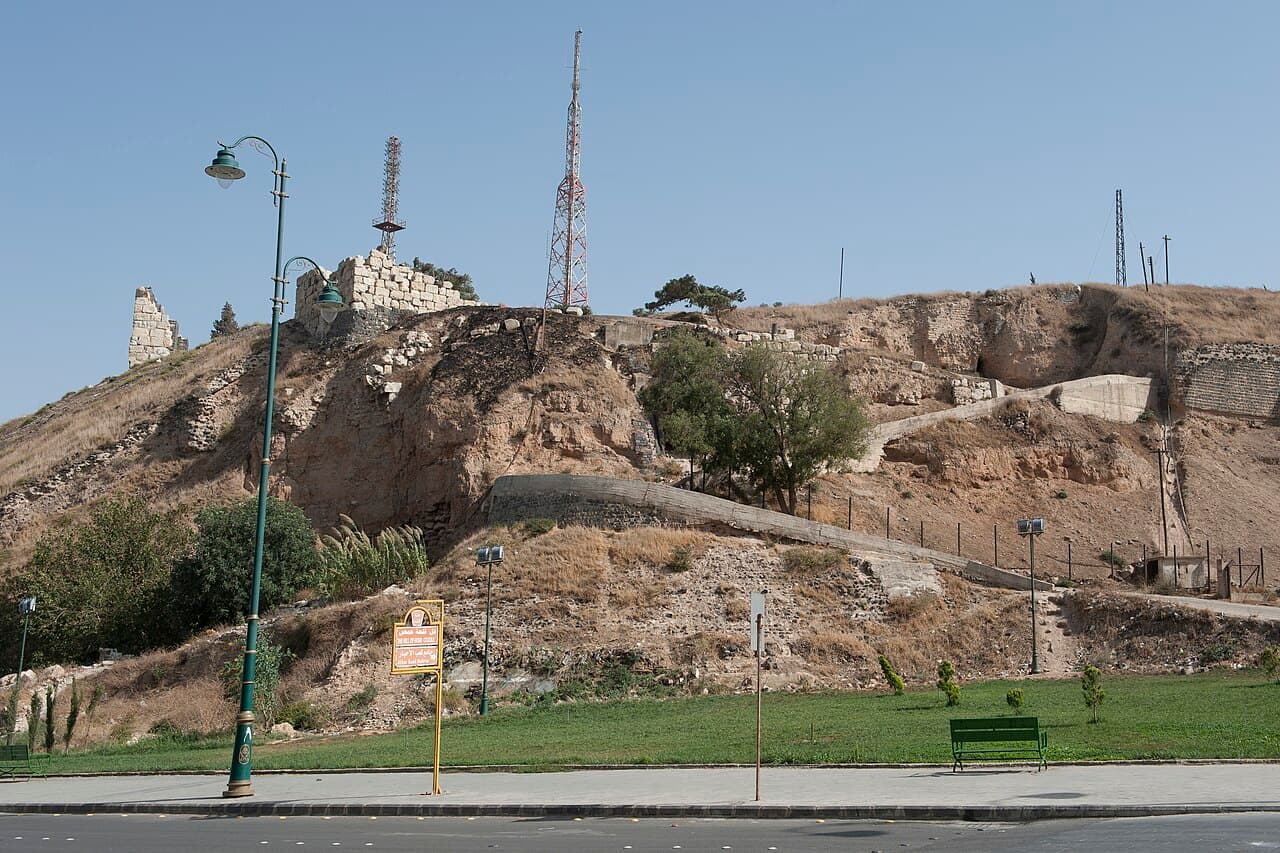
The citadel is situated on a large artificial mound approximately 275 meters in diameter and rising 32 meters high, with an elevation between 500 and 533 meters above sea level. This tell comprises numerous layers of mudbrick construction, revealing cycles of occupation, destruction, and rebuilding over thousands of years. Signs of burning in some layers indicate periods of conflict and upheaval.
Defensive structures dating back to the Roman era include the semi-circular enclosing walls that protected the citadel's core areas. The surviving Ayyubid towers on the northern side, inscribed with the name of Asad ad-Din Shirkuh, highlight the fortress's medieval military architecture. The summit hosts a small mosque used during later Islamic periods, emphasizing the citadel's religious as well as military significance.
Within the citadel, a complex network of cisterns and burial vaults underscores the advanced engineering and cultural practices of its inhabitants. A particularly notable feature is a hidden cave containing a natural spring, historically protected by iron bars to ensure a reliable water supply during sieges. This spring's management reflects sophisticated water engineering integral to the fortress's sustainability.
Modern history and preservation
Following the extensive damage inflicted in the 19th century, the citadel was partially leveled and repurposed by French colonial forces and later Syrian military units, which further altered its original form. It served as a military base until the late 1980s, after which stewardship was transferred to Syria's Directorate-General of Antiquities and Museums for preservation and archaeological study.
Today, the Citadel of Homs remains largely in a ruined condition, with only fragments of its once formidable defenses and buildings surviving. Despite this, it continues to offer invaluable insights into the region's layered history, from ancient times through the medieval Islamic era to modern conflicts. The citadel's enduring presence on the Syrian landscape makes it a significant cultural and historical landmark.
Cultural significance and historical narratives
Historical accounts from the 19th century describe the citadel as not only a military fortress but also a site of religious importance. The small mosque at the summit once housed a manuscript of the Quran believed to have been written by an early caliph, highlighting the site's spiritual heritage. The concealed spring and the fortress's strategic location further enhanced its role as a sanctuary in times of turmoil.
The citadel's association with prominent figures such as Julia Domna, Usama ibn Munqidh, Nūr ad-Dīn, and Asad ad-Din Shirkuh enriches its historical narrative, linking it to key moments in Syrian and Islamic history. Its architectural layers embody the transitions between empires and cultures, reflecting the dynamic history of the Levant region.
While much of the citadel lies in ruins, ongoing archaeological interest and conservation efforts aim to preserve its legacy. The site offers scholars and visitors alike a tangible connection to the ancient and medieval worlds, underscoring the enduring significance of the Citadel of Homs as a symbol of resilience and cultural continuity in Syria.
Frequently asked questions (FAQ)
- What is the historical significance of the Citadel of Homs?
- The Citadel of Homs is a remarkable example of medieval military architecture and has played a crucial role in the region's history. Built during the Crusades, it served as a strategic fortress and residence for various rulers, reflecting the rich tapestry of cultural influences in Syria.
- When was the Citadel of Homs constructed?
- The construction of the Citadel of Homs began in the 12th century, during the Crusader period. It was built on the foundations of earlier structures, showcasing the evolution of military architecture over the centuries.
- Can I visit the Citadel of Homs?
- Yes, the Citadel of Homs is open to visitors who wish to explore its ancient walls and learn about its history. However, it is advisable to check local conditions and any travel restrictions before planning your visit.
- What are the opening hours of the Citadel of Homs?
- The Citadel of Homs typically opens to visitors from 9:00 AM to 5:00 PM daily. It's recommended to verify the current hours before your visit, as they may change due to local events or conditions.
- Is it possible to access the Citadel of Homs with mobility challenges?
- The accessibility of the Citadel of Homs can be limited due to its historical architecture and terrain. Visitors with mobility challenges may find some areas difficult to navigate, so it's advisable to inquire about available facilities or assistance before visiting.
- What is the best time to visit the Citadel of Homs?
- The best time to visit the Citadel of Homs is during the spring and autumn months when the weather is milder. This allows for a more enjoyable exploration of the site and its surroundings.
- Are there any nearby attractions to visit after the Citadel of Homs?
- Yes, after visiting the Citadel of Homs, you can explore the ancient city of Homs, which features several historical sites and markets. Additionally, the nearby ruins of Apamea and the city of Palmyra are excellent options for further exploration.
- What are the ticket prices for visiting the Citadel of Homs?
- Ticket prices for the Citadel of Homs are generally affordable, allowing visitors to experience its historical significance without a hefty cost. It’s advisable to check for any updates on pricing or discounts available for students and groups before your visit.
Photo gallery

Information
Loading map...
Visitor reviews
No reviews yet. Been here? Write the first review and help other travelers!
Write the first reviewVisited this castle? Share your experience
Your review helps other travelers and adds first-hand knowledge to our encyclopedia.