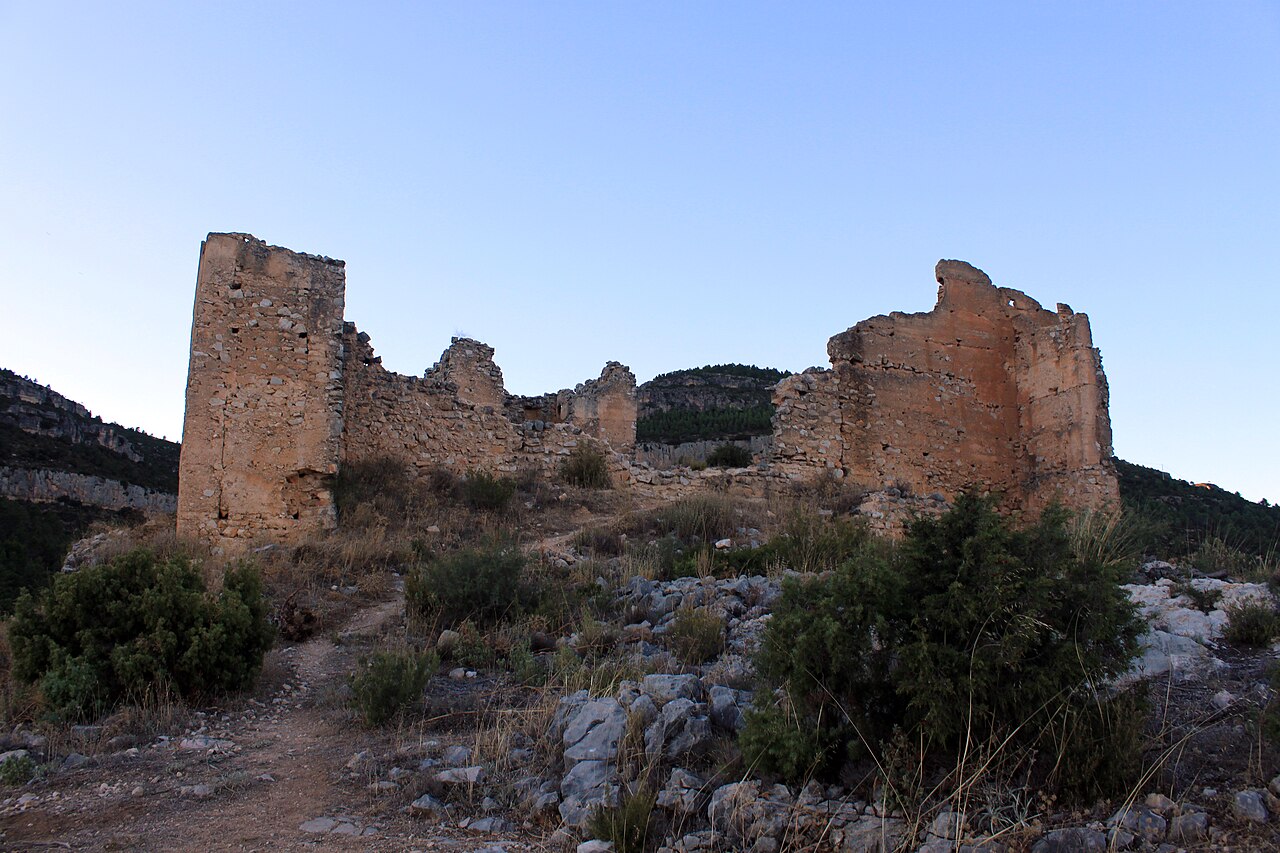
Chulilla Castle
Chulilla Castle stands prominently on a hill overlooking the town of Chulilla in Spain, serving as the historic core and a striking landmark of the area. Its ruins preserve a layered history that spans from the Roman Age through the medieval period and into the 19th century, reflecting the strategic and cultural importance of this site over centuries.
Roman origins and early fortifications
The earliest known feature of the castle hill is a Roman-era cistern, indicating the site's longstanding use for water storage and settlement. This ancient infrastructure laid the groundwork for subsequent fortifications. The hill's natural elevation made it an ideal defensive position, utilized and expanded by later occupants.
Muslim period and the hisn fortress
During the Muslim period, the site was developed into a hisn, a type of fortress common in Islamic military architecture. This included a tower with a base cistern, masonry walls, and constructions made of rammed earth. The fortress was strategically placed to control communication routes through the valley, serving as a refuge for nearby villagers in times of conflict. Alongside the castle of Alpuente, Chulilla Castle was one of the most important fortifications in the region during this era.
Christian conquest and medieval transformations
Following the Christian conquest, Chulilla became part of the Crown of Aragon. From the 14th to the 16th centuries, the castle underwent significant reforms and expansions. A notable addition was the construction of a watchtower designed to oversee and control the southwestern territory. The castle's function evolved to include serving as a noble residence and later as a prison for clergy, reflecting its shifting role in regional governance and social order.
Architectural features and layout
The castle's remains reveal a complex defensive system. It includes an outer wall that enclosed the site, a barbican tower providing an additional line of defense, and a circular bastion designed to cover vulnerable approaches. Inside, there is a vaulted room, multiple corner towers, and the main enclosure which housed a prominent tower along with the remains of residential and auxiliary buildings. The castle also contained a chapel dedicated to Saint Michael and four cisterns for water supply. Throughout the site, visitors can observe various engravings similar to those found in Denia Castle, indicating cultural connections or shared artistic influences.
Role in the Carlist Wars and decline
In the 19th century, during the Carlist Wars, Chulilla Castle was strategically used as a fortification by the Carlist forces on three separate occasions. Its position made it valuable for controlling the surrounding territory. The castle endured a siege by governmental troops, which ultimately led to its ruin. Since then, the castle has remained in a state of ruins, preserving its historical footprint but no longer serving a military or residential function.
Historical and cultural significance
Chulilla Castle embodies a rich historical narrative that spans multiple cultural periods, from Roman engineering to Muslim military architecture and Christian medieval fortification. Its layered history offers insights into the military, social, and religious transformations of the region. The castle's ruins continue to attract visitors interested in medieval history, architecture, and the complex heritage of the Valencian Community.
Visiting Chulilla Castle today
Today, visitors to Chulilla can explore the castle ruins, which offer panoramic views of the surrounding valley and town. The site provides a tangible connection to the past, with visible remains such as the barbican tower, bastions, and cisterns illustrating the castle's defensive and residential functions. Interpretive signage and local guides help contextualize the castle's role throughout history, making it a valuable destination for cultural tourism.
Information
Loading map...
Visitor reviews
No reviews yet. Been here? Write the first review and help other travelers!
Write the first reviewVisited this castle? Share your experience
Your review helps other travelers and adds first-hand knowledge to our encyclopedia.