Christchurch Castle
Christchurch Castle stands as a significant Norman motte and bailey fortress located in the historic town of Christchurch, Dorset, England. Its origins trace back to the early medieval period, with initial fortifications established during the Saxon era, making it a site of strategic military importance for over a millennium. The castle's enduring presence offers valuable insight into the evolution of English defensive architecture from wooden Saxon earthworks to robust Norman stone fortifications.
The earliest known fortification on the site dates to 924 AD, following the capture of the town's ramparts by King Æthelwold of Wessex in 901. Initially constructed in wood, this early defensive structure was part of a broader network of Saxon burhs designed to protect southern England from Viking raids. Subsequently, King Edward the Elder enhanced the defenses by creating a raised earthwork motte, a mound intended to support a fortified structure and improve the site's defensibility.
After the Norman Conquest of 1066, the castle underwent significant transformation. The Normans replaced the earlier wooden fortifications with a substantial stone keep built around 1160. This keep, positioned atop the motte, became the stronghold of the castle, symbolizing Norman authority and military strength. Surrounding the motte was a bailey—an enclosed courtyard fortified with stone walls and protected by a ditch—typical of Norman military architecture designed to secure the castle's perimeter and provide space for auxiliary buildings.
Historical significance and feudal role
Initially managed by the King's constable as a military outpost, Christchurch Castle's role evolved significantly during the reign of King Henry I. The castle was granted as the caput of a feudal barony to Richard de Redvers, Henry's cousin and feudal baron of Plympton in Devon. This transfer marked a shift from purely military defense to administrative and judicial functions, including enforcement of the New Forest Laws, which regulated forest use and hunting rights in the surrounding royal forests.
The castle's strategic importance was underscored during the mid-12th century civil war known as The Anarchy, fought between King Stephen and Empress Matilda. Around 1147, Baldwin de Redvers undertook extensive rebuilding to strengthen the castle's defenses, reflecting the turbulent political climate. Later, circa 1300, the addition of a great tower enhanced the castle's military capabilities and signaled its continued regional significance.
Architectural features and surviving structures
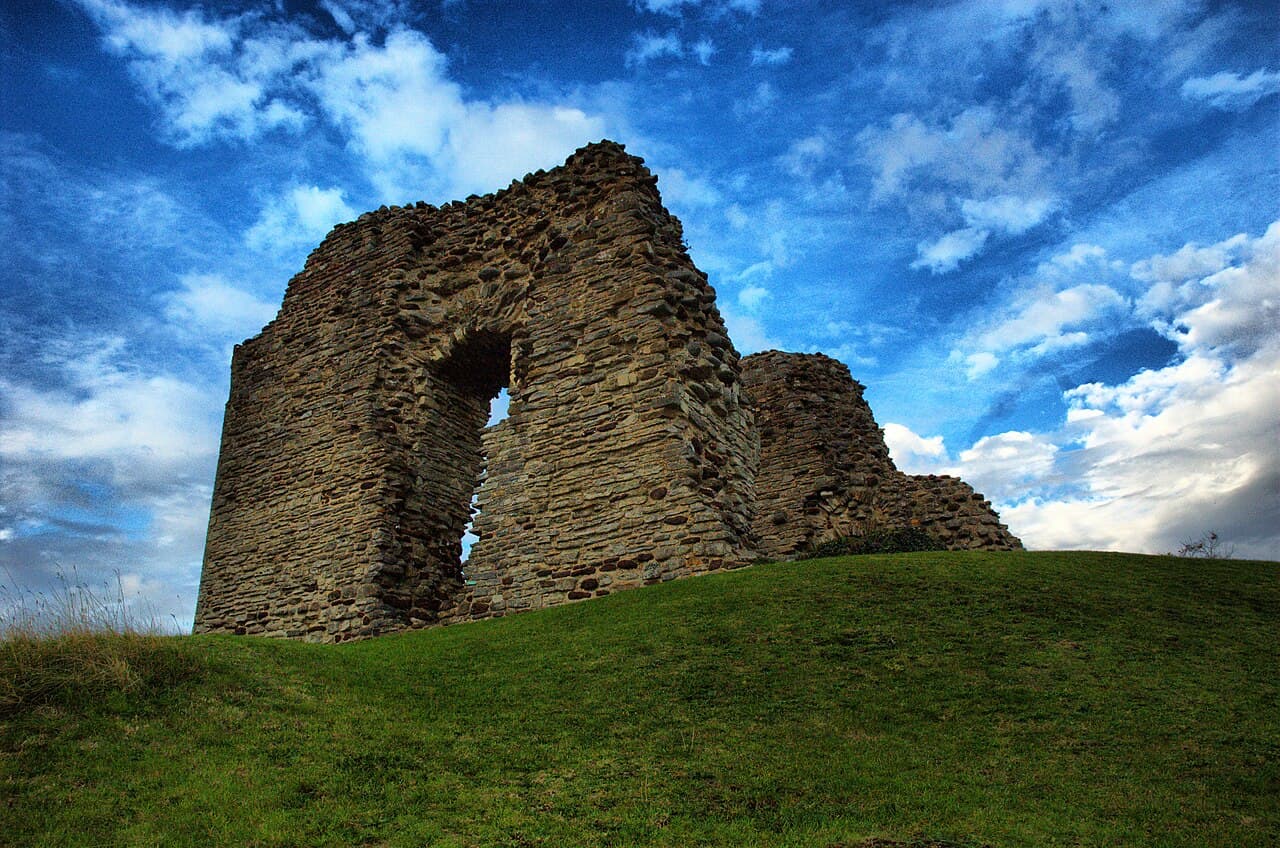
The surviving layout of Christchurch Castle exemplifies the classic Norman motte and bailey design. The motte, a raised earth mound, supports the remains of the stone keep, which replaced earlier timber structures. The keep's walls, though partially ruined, reveal the scale and robust construction typical of 12th-century Norman fortifications.
Within the bailey stands the Constable's House, an exceptional example of Norman domestic architecture dating to around 1160. Measuring approximately 67 by 23 feet (20 by 7 meters), the building is constructed from Purbeck marble stone, a distinctive local limestone prized for its durability and aesthetic appeal. Notably, the Constable's House contains one of only five known Norman chimneys in England, a rare architectural feature that highlights the building's residential function.
Interior layout and defensive elements
The Constable's House is arranged over two floors. The ground floor served primarily as storage, illuminated by narrow slit windows that provided both light and defensive capability. The upper floor functioned as the main hall, accessed via external steps and an internal staircase, where administrative and domestic activities took place. An early 13th-century addition to the structure is a garderobe tower, a medieval sanitary facility projecting over a mill stream to carry waste away efficiently, illustrating the integration of practical amenities in castle design.
Although the original defensive ditch around the bailey has largely been filled in, the footprint of a rectangular moat remains visible, delineating the castle's perimeter. The surviving stonework and earthworks offer valuable evidence of the castle's defensive layout and construction techniques.
Strategic location and landscape context
Christchurch Castle occupies a commanding position within the old Saxon burh, overseeing the lowest crossing point of the River Avon. Situated approximately six meters above sea level on the flat coastal plain of southern England, the castle controlled access to vital waterways, including the Rivers Avon and Stour. These rivers provided important inland routes to the sea, enhancing the castle's strategic importance for trade, defense, and administration.
The castle's proximity to Christchurch Priory creates a historically rich landscape where military and religious power coexisted. Both the castle and the priory are recognized as Grade I listed buildings and form part of a Scheduled Monument, ensuring their preservation as key heritage sites that illuminate medieval English history.
Later history and preservation
During the English Civil War in the 17th century, Christchurch Castle played an active role in military engagements. In 1644, Parliamentary forces captured the castle and successfully resisted a Royalist siege. To prevent its future military use, Oliver Cromwell ordered the castle to be slighted in 1652, deliberately damaging its fortifications to render it unusable. This act left the castle in a ruined state, which has persisted to the present day.
Today, the remains of Christchurch Castle, including parts of the stone keep and the Constable's House, stand as a testament to Norman military and domestic architecture. The site offers visitors a tangible connection to England's medieval past, showcasing the evolution of castle design and the shifting political landscape over centuries.
Efforts to preserve and interpret the castle and its associated buildings have ensured that Christchurch Castle remains an important cultural and archaeological site. It continues to attract historians, architects, and visitors interested in the rich tapestry of England's medieval heritage.
Frequently asked questions (FAQ)
- How do I visit Christchurch Castle?
- Christchurch Castle is open to the public, and visitors can explore the ruins and the Constable's House during designated opening hours. It is advisable to check the local council or heritage site website for current visiting times and any special events.
- What is the historical significance of Christchurch Castle?
- Christchurch Castle is a prime example of a Norman motte and bailey fortress that played a key role in medieval England's military and administrative history. It illustrates the transition from Saxon to Norman rule and the enforcement of feudal authority.
- Can I see the Constable's House when visiting?
- Yes, the Constable's House is one of the best-preserved Norman domestic buildings in England and is accessible to visitors. It features rare architectural elements such as a Norman chimney and a garderobe tower.
- Is Christchurch Castle wheelchair accessible?
- Due to the castle's ruined condition and historic earthworks, full wheelchair access may be limited. Visitors with mobility issues are advised to contact the site management for specific accessibility information and assistance.
- When was Christchurch Castle built?
- The stone keep and main fortifications of Christchurch Castle were constructed in the 12th century, replacing earlier Saxon wooden defenses.
- Are there any nearby attractions to visit with Christchurch Castle?
- Nearby attractions include Christchurch Priory, a magnificent medieval church, and the scenic River Avon, both offering additional historical and natural experiences.
Photo gallery

Information
Sources & official resources
Verify the information above using these authoritative references.
Loading map...
Visitor reviews
No reviews yet. Been here? Write the first review and help other travelers!
Write the first reviewVisited this castle? Share your experience
Your review helps other travelers and adds first-hand knowledge to our encyclopedia.