Choustník Castle
Choustník Castle stands as a remarkable example of medieval fortification in the Czech Republic, located in the municipality of Choustník. Founded in the 13th century between 1262 and 1282 by Beneš of Choustník, a noble descended from Groznata of Poděbrady, the castle originally began as a modest fortress perched on a rocky hill. Its strategic position controlled a key route connecting Vitorazsko to Prague, underscoring its military and administrative importance in the region.
Founding and early history
The castle's foundation by Beneš of Choustník marked the establishment of a stronghold that would evolve significantly over the centuries. After Beneš's death, the castle was inherited jointly by his sons, Beneš II and Jan. To accommodate both heirs, the fortress was expanded into a rare form known as a ganerbenburg or "double castle," featuring two separate cores each with its own tower and residential buildings. This architectural solution was uncommon in Bohemia and illustrates the social complexities of noble inheritance during the medieval period.
Ownership under the Rožmberk family
In 1322, the castle changed hands when the Choustník family exchanged it for lands in eastern Bohemia with Peter I of Rožmberk. Under the powerful Rožmberk family, Choustník Castle ceased to be a noble residence and instead became the seat of a burgrave, an official charged with managing the estate. Historical records mention burgraves such as Kras in 1375 and Janáček who served from 1383 to 1407, highlighting the castle's administrative role.
Role during the Hussite Wars
During the early 15th century, the castle played a significant role amid the religious and political upheaval of the Hussite Wars. It was used as a prison for Taborite preachers, reflecting its function in the suppression of religious dissent. The Rožmberks reinforced the castle's defenses in response to the turbulent times, especially after the estate was inherited by Oldřich I of Rožmberk in 1374, shaping the castle into its final medieval form.
Later history and decline
A major rebuilding phase occurred in 1563, modernizing parts of the castle. However, by 1596 or 1597, ownership transferred to Jiří Homut of Harasov, under whom the castle fell into neglect and was largely abandoned by 1614. Over the following centuries, the property passed through various noble families including the Černín, Špork, and Voračický lineages before coming into possession of the Czech branch of the French de Rohan family in the 19th century. Today, the castle remains a ruin open to the public, with ongoing conservation efforts initiated in the 21st century to preserve its historic fabric.
Architectural features and layout
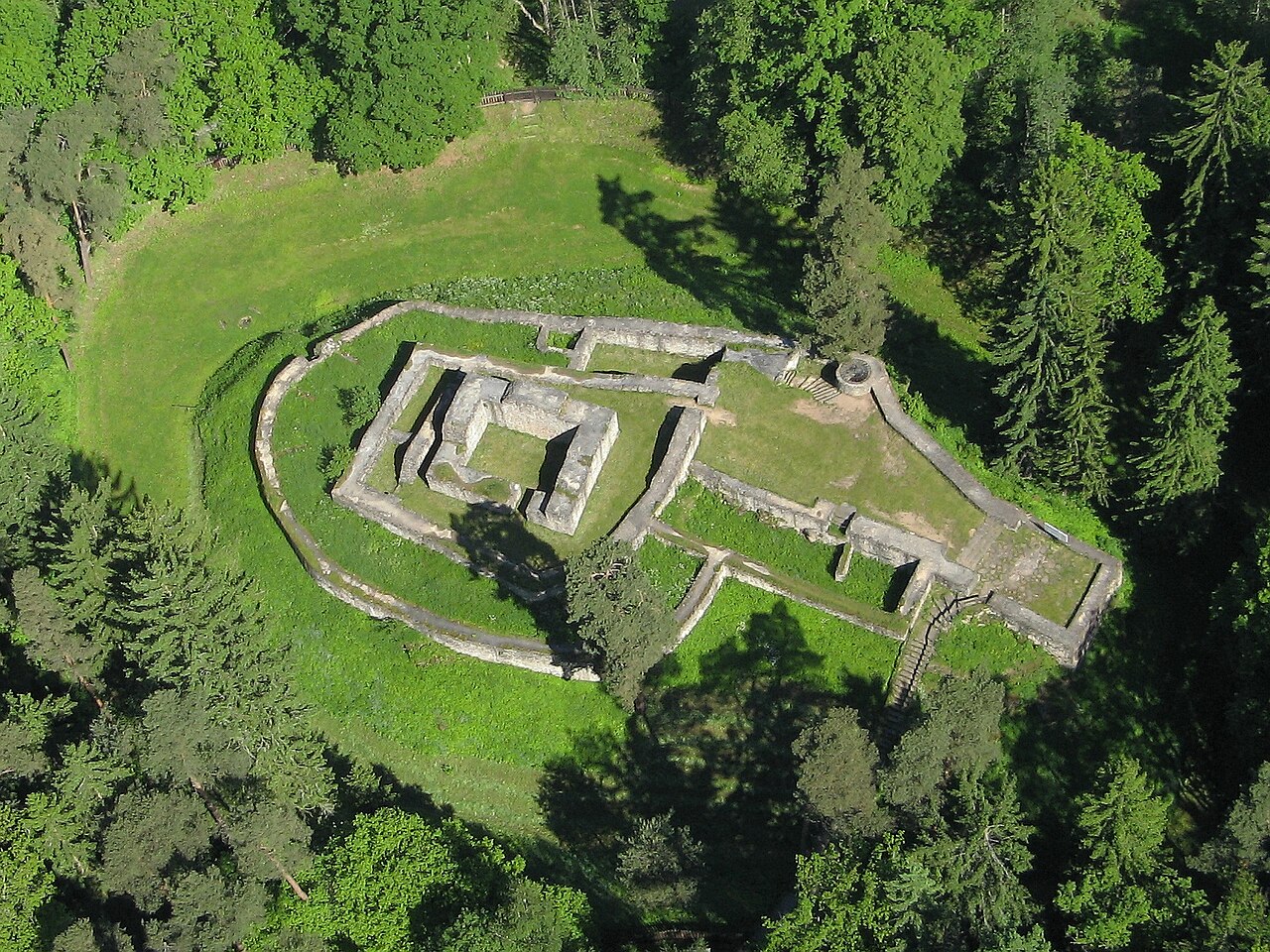
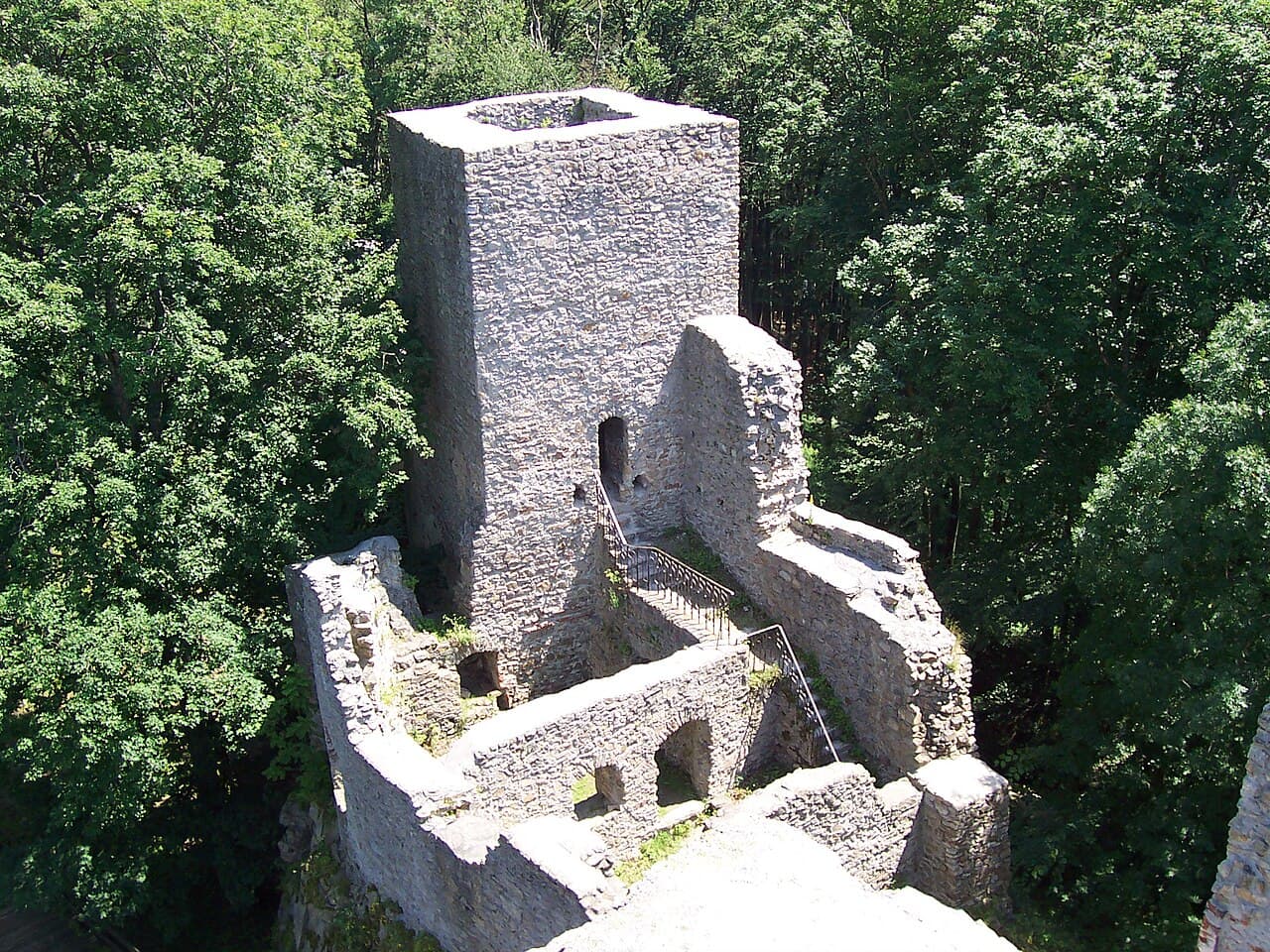
Situated on a rocky summit approximately 660 to 670 meters above sea level within a nature reserve, Choustník Castle follows the natural contours of the hill. The castle's irregular perimeter wall encloses the site, which was originally designed as a bergfried-type fortress. The prominent bergfried, a tall central tower primarily used for defense, stood on the northern side. This four-sided tower likely rose to four stories with walls up to 7.8 meters thick at the base and 2.5 meters thick on the first floor, demonstrating formidable defensive construction. The original entrance was located on the second floor of the tower's west side, accessible only via a wooden gallery along an outer wall. Later, a ground-level entrance was added, reflecting evolving defensive strategies.
Ganerbenburg design
The castle's most distinctive feature is its ganerbenburg layout, designed to accommodate multiple owners simultaneously. This is evident in the two separate living cores within the enclosure, each with its own prismatic tower and palace buildings. The eastern palace was expanded to include a southern wing with a room illuminated by traceried windows, an architectural element typical of medieval chapels, indicating the presence of a private chapel within the castle.
Outer bailey and defensive structures
Although the original configuration of the outer bailey is not fully known, it is currently bounded by a defensive wall lacking a parapet walkway. Access between the outer bailey and the inner castle was controlled by a stone bridge supported by three pillars, emphasizing the importance of secure passageways. Fortifications were significantly enhanced under the Rožmberks, particularly by Oldřich I, who fortified the southern curtain wall with a zwinger—a narrow enclosed killing ground between two defensive walls—protected by two inward-facing square towers equipped with narrow slit embrasures for firing weapons.
Additional fortifications
In front of the zwinger, a moat and earth rampart provided further defense, complemented by an advanced watchtower on the eastern side and another bastion in the forecourt. The main curtain wall surrounding the core was raised and fitted with a shooting gallery, a covered passage that allowed defenders to fire on attackers while remaining protected. These features illustrate the castle's adaptation to evolving military technologies and siege tactics.
Current condition and visitor experience
Today, Choustník Castle stands as a ruin that offers visitors a tangible connection to medieval history and architecture. One of the castle's towers has been adapted as a viewing platform, providing panoramic views of the surrounding landscape. The ruins are accessible within a protected nature reserve, combining cultural heritage with natural beauty. Conservation efforts in the 21st century aim to stabilize and preserve the remaining structures, ensuring that this unique example of a double core medieval fortress continues to educate and inspire future generations.
Frequently asked questions (FAQ)
- How do I get to Choustník Castle?
- Choustník Castle is located in the municipality of Choustník in South Bohemia, Czech Republic. It is accessible by local roads and hiking trails leading up to the castle hill. Visitors are advised to check local transport options and parking facilities in the village.
- What is the historical significance of Choustník Castle?
- Choustník Castle is historically significant as a rare example of a ganerbenburg, a double castle designed to accommodate multiple noble owners simultaneously. It also played important roles during the Hussite Wars and was a seat of administrative burgraves under the Rožmberk family.
- Can I visit the interior of the castle ruins?
- The castle ruins are open to the public, but as a ruin, much of the interior is exposed and not fully accessible. Visitors can explore the remains, including the bergfried tower adapted as a viewing platform, and enjoy the surrounding nature reserve.
- When is the best time to visit Choustník Castle?
- The best time to visit Choustník Castle is during the warmer months from late spring to early autumn when the weather is favorable for hiking and outdoor exploration. The nature reserve setting makes it an attractive destination for nature lovers and history enthusiasts alike.
- Are there any guided tours available at Choustník Castle?
- Guided tours may be available through the local municipality or regional tourist offices. Visitors interested in guided experiences should inquire locally for schedules and availability, especially during the tourist season.
Photo gallery

Photo by User:Bilboq (self)•Public domain
Information
Sources & official resources
Verify the information above using these authoritative references.
Loading map...
Visitor reviews
No reviews yet. Been here? Write the first review and help other travelers!
Write the first reviewVisited this castle? Share your experience
Your review helps other travelers and adds first-hand knowledge to our encyclopedia.