Cervená Lhota Castle
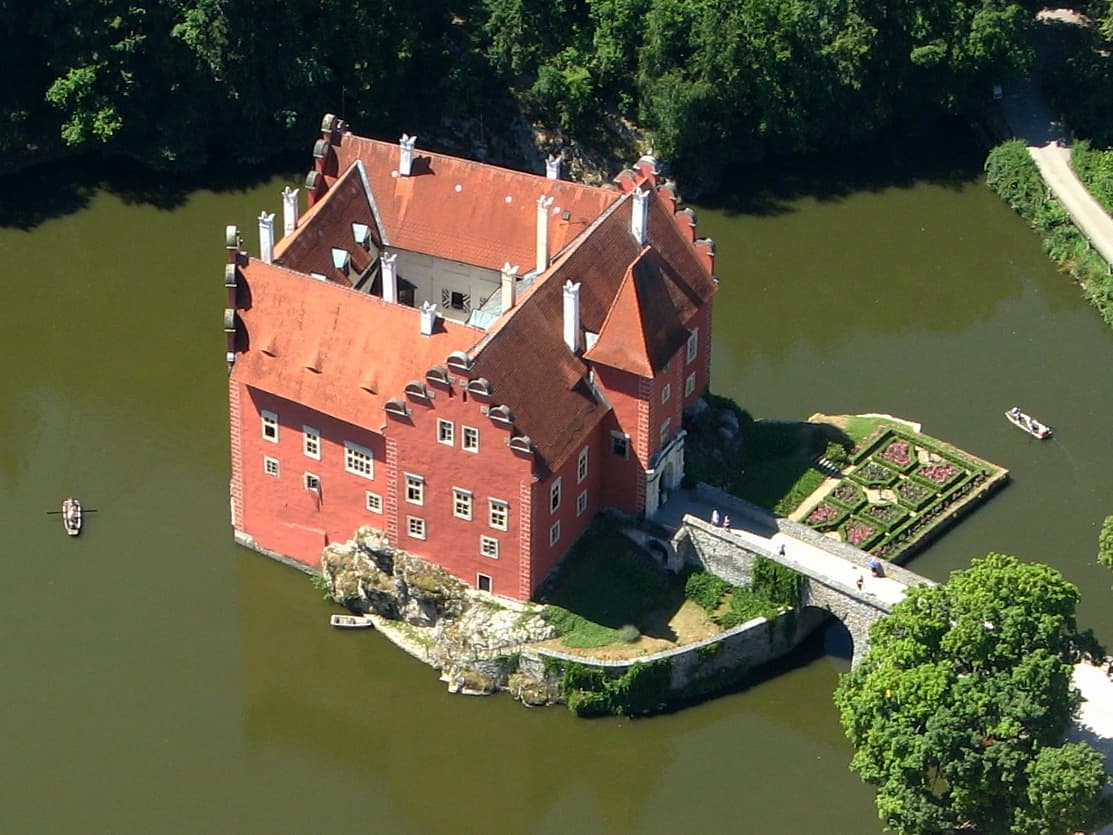
Červená Lhota castle is a striking example of Renaissance architecture located in the South Bohemian Region of the Czech Republic. This hill castle uniquely stands on a rocky island in the center of a fishpond, creating a picturesque scene that attracts thousands of visitors annually. The castle's name, which translates to "red lhota," is derived from the distinctive bright red plaster that covers its walls, a feature that was added in the late 16th century and remains one of its most recognizable traits.
The origins of Červená Lhota date back to the mid-14th century when an original fortress was established on the granite outcrop that forms the island today. This fortress was strategically built on a rocky promontory and later transformed into a castle surrounded by water, thanks to the damming of a stream and the creation of a fishpond. The first documented mention of the property appears in land records from 1465, which detail the inheritance division among the sons of Ctibor of Zásmuk.
Early history and architectural transformation
Ownership of the estate changed hands several times in the 15th and early 16th centuries. Around 1530, the knightly family of Káb of Rybžan acquired the property and undertook a significant transformation of the original Gothic fortress. Between 1542 and 1555, they rebuilt the castle in the Renaissance style, giving it the form that largely defines its appearance today. During this period, the castle was known as Nová Lhota.
In 1597, the castle was sold to Vilém Rút of Dílná, who applied the distinctive red plaster that gave Červená Lhota its current name. The castle's Renaissance features include its harmonious proportions, elegant facades, and the four-winged structure arranged around a small central courtyard. The castle's stone bridge, built in 1622, replaced an earlier drawbridge and connects the island to the mainland, allowing visitors to access the castle easily.
Subsequent ownership and historical significance
Following the Battle of White Mountain in 1620, the castle's ownership reflected the turbulent political and religious shifts in Bohemia. The last of the Rút family, Bohuslav, was forced to leave due to his Utraquist faith. In 1621, Antonio Bruccio became the owner, but with his death in 1639 and no heir, the castle ceased to be a permanent residence and was used more as a seasonal retreat by subsequent owners.
The castle passed to Vilém Slavat of Chlum and Košumberk in 1641 and later to the Windischgrätz family. Financial difficulties under Bedřich Arnošt Windischgrätz and his son Leopold led to the recommendation to sell the estate. In 1755, the castle was acquired by the free lords of Gudenus, who initiated construction projects that were interrupted by a devastating fire in 1774, which destroyed agricultural buildings but spared the main castle.
Baron Ignác Stillfried, a progressive aristocrat from Prussian Silesia, became the owner in 1776. His family held the property until the early 19th century when it was sold to Jakub Veith in 1820. Later, it passed into the hands of the princely Schönburg-Hartenstein family, who maintained the castle until the mid-20th century. Josef Alexandr Schönburg-Hartenstein, who died in 1937, was buried in a family tomb near the castle, thus avoiding the upheavals that followed World War II.
Architectural features and the castle grounds
The castle is a four-winged, two-story building that occupies the entire rocky island, surrounded by the fishpond waters. Its Renaissance style is characterized by symmetrical wings and a central courtyard that provides an intimate open space within the castle complex. The stone bridge constructed in the early 17th century remains a vital architectural element, replacing the original drawbridge and enhancing the castle's accessibility.
Inside, Červená Lhota houses an extensive collection of historic furnishings, including tiled stoves, period paintings, porcelain, and other artifacts that reflect its aristocratic past. The interiors showcase the refined tastes of its former inhabitants and provide insight into the lifestyle of the Bohemian nobility during the Renaissance and later periods.
The castle is complemented by a landscaped park on the northern side, featuring the Renaissance Chapel of the Holy Trinity. This chapel adds religious and cultural significance to the estate and is a notable example of Renaissance ecclesiastical architecture in the region. The southern edge of the fishpond is bordered by dense forest, creating a natural backdrop that enhances the castle's scenic setting.
Visitor experience and cultural importance
Today, Červená Lhota is a popular tourist destination, attracting visitors with its unique location and well-preserved Renaissance architecture. The castle is accessible via the stone bridge, and visitors can explore the richly decorated interiors and the surrounding park. A marked circular path around the fishpond offers pleasant walking opportunities, allowing visitors to appreciate the castle from various vantage points.
Boating on the fishpond is a favored activity, especially during warm summer months, with boats available for hire near the castle. This experience allows visitors to enjoy the castle's reflection on the water and the tranquil atmosphere of the setting.
Červená Lhota's history, architecture, and setting combine to make it a significant cultural landmark in South Bohemia. Its preservation and public accessibility contribute to the appreciation of Renaissance architectural heritage and the noble history of the region.
Frequently asked questions (FAQ)
- How do I get to Červená Lhota castle from Jindřichův Hradec?
- Červená Lhota castle is approximately 20 kilometers northwest of Jindřichův Hradec. Visitors can reach the castle by car or local bus services, followed by a short walk across the stone bridge to the island.
- What architectural style is Červená Lhota castle built in?
- Červená Lhota castle is built in the Renaissance style, featuring symmetrical four-winged structures, a central courtyard, and a distinctive red plaster exterior.
- When was Červená Lhota castle originally built?
- The current Renaissance castle was constructed between 1542 and 1555, replacing an earlier Gothic fortress from the 14th century.
- Can I hire boats to row on the fishpond surrounding Červená Lhota castle?
- Yes, visitors can hire boats near the castle to row on the fishpond, especially popular during the summer months for enjoying the castle's scenic reflections and peaceful waters.
- Is Červená Lhota castle open year-round?
- The castle is generally open daily from 9:00 to 17:00, but it is advisable to check seasonal variations or special closures before planning a visit.
Photo gallery

Information
Opening hours
9:00-17:00, daily
Ticket prices
€6 adult, €3 child
Current owner
State museum
Website
Visit websiteSources & official resources
Verify the information above using these authoritative references.
Loading map...
Visitor reviews
No reviews yet. Been here? Write the first review and help other travelers!
Write the first reviewVisited this castle? Share your experience
Your review helps other travelers and adds first-hand knowledge to our encyclopedia.