Chlemoutsi Castle
Chlemoutsi Castle, also known as Clermont, stands as a remarkable example of medieval military architecture in the Peloponnese region of southern Greece. Located in the northwest of the Elis regional unit within the municipality of Kastro-Kyllini, this hill castle was constructed in the early 1220s by the Frankish Crusader rulers of the Principality of Achaea. It served as the principality's main stronghold and remains one of the finest preserved fortifications from the early period of Frankish rule in Greece.
Perched on a small plateau approximately 226 meters above sea level, Chlemoutsi commands strategic views over the fertile plains of Elis and the nearby important medieval centers of Andravida and the port of Glarentza. The castle's design centers on a large hexagonal keep surrounding an inner courtyard, with two-storeyed halls lining the courtyard's perimeter. This central structure is complemented by an outer curtain wall enclosing an outer ward on the western side. The castle's architecture predominantly reflects the French Romanesque style of the 12th century, with some Byzantine influences visible in details such as chamfered impost blocks.
Historical context and construction
The construction of Chlemoutsi Castle took place between 1220 and 1223 under the direction of Geoffrey I of Villehardouin, the first Prince of Achaea. This period followed the establishment of the Principality of Achaea as a Crusader state in the Peloponnese after the Fourth Crusade. The castle was built not only as a military fortress but also as a symbol of Frankish authority in the region. Its founding was marked by tensions with local ecclesiastical authorities, as Geoffrey confiscated church property to fund the construction, underscoring the complex relationship between secular and religious powers during this era.
Strategically situated near the principality's capital of Andravida and the key port of Glarentza, Chlemoutsi was intended to control the surrounding fertile lands and serve as a military bastion. Despite its formidable defenses, the castle was never subjected to a siege throughout its history, a testament to its strategic deterrence and robust construction.
Political significance and ownership changes
Following the death of William II Villehardouin in 1278, ownership of the castle passed to his widow, Anna Komnene Doukaina. In the early 14th century, Chlemoutsi became a focal point in the complex political dynamics of the region, involving the Angevins of the Kingdom of Naples and local nobility. Notably, in 1314, a marriage alliance between Margaret Villehardouin’s daughter and Ferdinand of Majorca brought the castle into the center of rival claims over the principality.
In 1427, the castle was transferred to Byzantine control as part of a dowry to Constantine Palaiologos, who would later become the last Byzantine emperor. Constantine utilized Chlemoutsi as a military base during his campaigns to reclaim territories in the Peloponnese from Latin rule. This period represents one of the final Byzantine efforts to maintain influence in the region before the Ottoman conquest.
Ottoman and later history
The Ottoman Empire captured Chlemoutsi in 1460, incorporating it into their expanding territories in Greece. Although the Ottomans made minor modifications to adapt the fortress for artillery use, including the addition of buttresses and artillery bastions, the castle largely retained its medieval character. The fortress experienced brief Venetian occupation from 1463 to 1479, and in 1620 it was attacked by the Knights of Malta, highlighting its ongoing strategic importance.
During the Venetian rule from 1687 to 1715, Chlemoutsi served mainly as an administrative and fiscal center but was sparsely inhabited. Plans to dismantle the castle in 1701 were proposed but never implemented. By the early 19th century, the fortress had fallen into disuse, and during the Greek War of Independence in 1825, part of the outer wall was deliberately demolished by Egyptian forces under Ibrahim Pasha to prevent its use by Greek rebels.
Architectural features and layout
The hexagonal keep
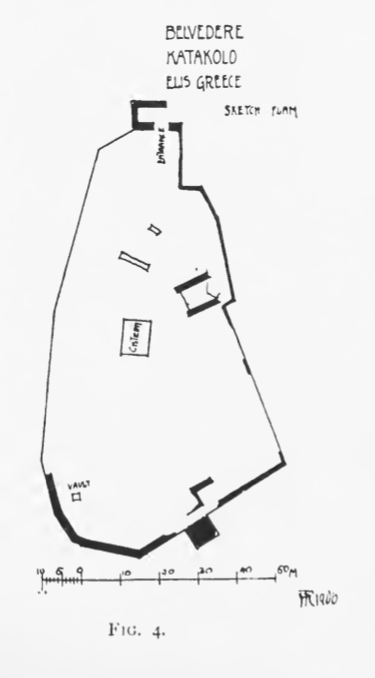
The heart of Chlemoutsi Castle is its imposing hexagonal keep, measuring approximately 90 meters east to west and 60 meters north to south, enclosing an inner courtyard of about 61 by 31 meters. The keep's walls feature two levels of halls that open onto the courtyard through arches. The upper floors contain vaulted galleries with ovoid barrel vaults constructed from finely dressed poros limestone, supported by transverse arches spaced at intervals of seven to ten meters.
The keep is flanked on its western side by round towers about five meters in diameter, set on square bases. While the northern tower remains largely intact, the southern tower suffered significant damage, particularly during the 19th century, likely from cannon fire during military conflicts. The eastern and southern sides of the castle rely on steep natural slopes for defense and therefore lack towers.
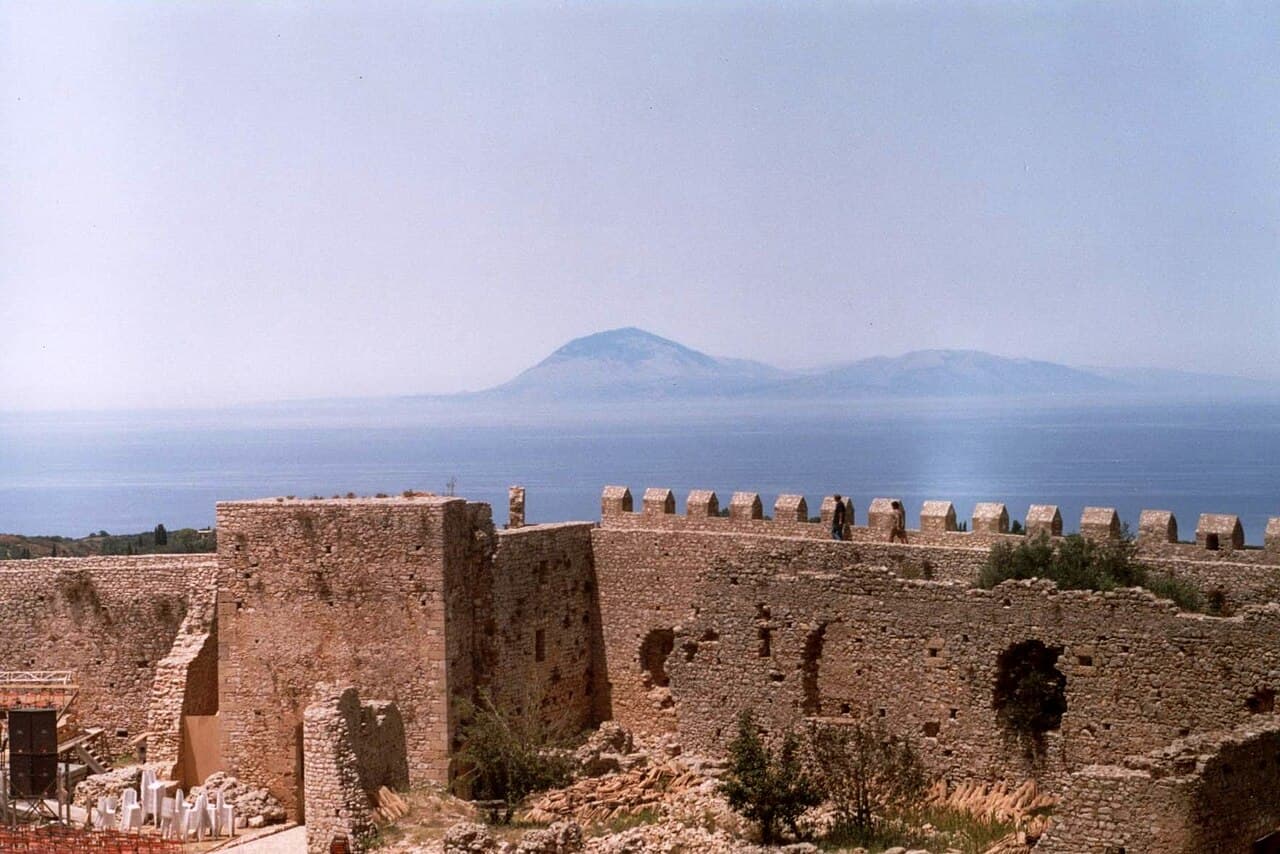
Originally, the keep featured a sloped or gabled roof with a parapet and a chemin de ronde (wall walk). This was later replaced by a flat terrace with an inner parapet and some battlements added during the Ottoman period. Notably, the roof does not contain artillery emplacements, distinguishing it from typical gunpowder-era fortifications.
Outer walls and defenses
The keep is accessed via its northern side through a vaulted passage between two gates leading from the outer courtyard. The castle's outer ward, or forburg, lies to the west and is enclosed by an irregular polygonal curtain wall constructed from limestone. Ottoman modifications include the addition of buttresses, merlons, and artillery bastions designed to accommodate early gunpowder weapons.
The main gate, located on the northwest side, was originally defended by a portcullis and a recessed wall section, which the Ottomans later filled in. Buildings were constructed against the curtain wall from the castle's initial construction period, with archaeological remains such as foundations, fireplaces, and lancet-shaped windows providing evidence of their domestic or administrative functions. One building near the main gate remains well preserved, offering valuable insights into the castle's usage.
The curtain wall also features small secondary gates called posterns and staircases leading to the wall walk, allowing defenders to move along the ramparts. An Ottoman artillery bastion and tower were added at the southwestern corner, reflecting adaptations to evolving military technology. Visible signs of cannon damage and repairs from Ibrahim Pasha's 1825 assault remain evident on the walls.
Cultural significance and preservation
Chlemoutsi Castle is a rare and exceptionally well-preserved example of Frankish military architecture in Greece, retaining much of its original 13th-century character with only minor later modifications. Its rapid construction within a few years resulted in a cohesive architectural ensemble that provides valuable insights into medieval fortress design in the Peloponnese.
Today, Chlemoutsi stands as a protected monument open to the public, offering visitors a tangible connection to the complex history of Crusader Greece, Byzantine resurgence, Ottoman conquest, and the Greek War of Independence. Its commanding location, architectural integrity, and historical significance make it a key cultural heritage site in the region.
Frequently asked questions (FAQ)
- How do I get to Chlemoutsi Castle?
- Chlemoutsi Castle is located near the village of Kastro-Kyllini in Elis, Greece. It is accessible by car via local roads from nearby towns such as Andravida and Kyllini. Visitors can also reach the castle by taxi or organized tours from larger cities in the Peloponnese.
- What is the historical significance of Chlemoutsi Castle?
- Chlemoutsi Castle was the principal fortress of the Frankish Principality of Achaea in the 13th century, serving as a military stronghold and symbol of Crusader power in the Peloponnese. It later came under Byzantine and Ottoman control, reflecting the region's complex medieval history.
- Is Chlemoutsi Castle open to the public?
- Yes, Chlemoutsi Castle is a preserved monument open to visitors. While specific opening hours may vary, it is generally accessible for tours and exploration, allowing guests to experience its well-preserved medieval architecture and scenic views.
- What architectural style is Chlemoutsi Castle built in?
- Chlemoutsi Castle predominantly features French Romanesque architectural style with some Byzantine influences. Its design includes a hexagonal keep, vaulted galleries, round towers, and a polygonal curtain wall typical of early 13th-century Crusader fortifications.
- Can I see evidence of Ottoman modifications at Chlemoutsi Castle?
- Yes, visitors can observe Ottoman-era additions such as artillery bastions, buttresses on the outer walls, and battlements on the keep's terrace. These modifications adapted the medieval fortress to early gunpowder warfare while preserving much of its original structure.
Photo gallery

Information
Website
Visit websiteSources & official resources
Verify the information above using these authoritative references.
Loading map...
Visitor reviews
No reviews yet. Been here? Write the first review and help other travelers!
Write the first reviewVisited this castle? Share your experience
Your review helps other travelers and adds first-hand knowledge to our encyclopedia.